Showing posts sorted by date for query denbigh Villas. Sort by relevance Show all posts

Wednesday, 20 May 2026

The Chorlton History Wall ........ looking for a new home

After two years the third Chorlton History Wall is on the move. 

It was the latest in our series where art meets history telling the story of a particular spot in Chorlton over the last three hundred years.

It  appeared on the builder’s boards at the site of the former Chorlton Swimming Baths and Leisure Centre and became a tourist attraction following the very popular 80-meter installation which told the story of Chorlton-cum-Hardy from 1500 to the 21st century.

It ran across 16 large panels along Albany Road and part of Brantingham Road, included Andrew’s stories, Peter’s original paintings.

You could walk from Chorlton Green just before Henry VIII walked up the aisle with Ann Boleyn and traverse the centuries discovering the changes to where we live, ending at the former Cosgrove Hall Productions, home of Danger Mouse, Chorlton and the Wheelies and Count Duckula.

No less bold was the wall telling the story of Denbigh Villas on High Lane, which mixed the story of the two houses with accounts of the surrounding area.

And now the Manchester Road wall is on the move having done the business of recording the history of the former swimming baths and the surrounding area.

The three panels Stretching across seven meteres looked back to when this part of Chorlton was open fields with names like Gilbury Marsh and Horsefield, accompanied by tales of “dark doings” and culminating with our own Carnegie library and its links to the Titanic.

Suggestions for a new home have included Chorlton's Community Garden, a spell in Chorlton Library or perhaps ome of our local schools.

And in the spirit of community history all suggestions are welcome

Location; Manchester Road

Pictures; bits of the History Walk

Tuesday, 1 October 2024

Remembering the swimming baths …. Gilbury Marsh and Horsefield

The Chorlton History Wall is back.

Very soon the third of our projects where art meets history will appear on the builder’s boards at the site of the former Chorlton Swimming Baths and Leisure Centre.

Many will remember the 80-meter installation which told the story of Chorlton-cum-Hardy from 1500 to the 21st century.

It ran across 16 large panels along Albany Road and part of Brantingham Road, included Andrew’s stories, Peter’s original paintings, and became a tourist attraction.

You could walk from Chorlton Green just before Henry VIII walked up the aisle with Ann Boleyn and traverse the centuries discovering the changes to where we live, ending at the former Cosgrove Hall Productions, home of Danger Mouse, Chorlton and the Wheelies and Count Duckula.

No less bold was the wall telling the story of Denbigh Villas on High Lane, which mixed the story of the two houses with accounts of the surrounding area.


And now on Manchester Road at the invitation of the developers* and in conjunction with Chorlton Arts Festival which is part of  Chorlton Civic Society we have created three panels stretching 7.2 meters long. 

Together they describe the story of the former swimming baths with a look back to when this part of Chorlton was open fields with names like Gilbury Marsh and Horsefield, accompanied by tales of “dark doings” and culminating with our own Carnegie library and its links to the Titanic.

The panels will soon go up allowing the curious and the tourist another opportunity to walk Chorlton’s past.

Location; Manchester Road

Pictures; bits of the History Walk

*MSV HOUSING GROUP

Saturday, 22 July 2023

Welcome back Wellfield ….. that impressive and historic house in Whalley Range

History hasn’t been kind to that grand old house at the end of Upper Chorlton Road close to the former Whalley Hotel.

Wellfield, 2023

Once it was home to a succession of wealthy families but for most of the last century it was the site of a series of commercial ventures, which included a laundry, a wallpaper warehouse and more recently a carpet showroom.

And to add to the indignity the property was divided into a number of self-contained flats, which were themselves subdivided over the decades.

But all that decline has been reversed by Peter Armistead and his team of architects, builders, and interior designers, and today as the development enters its final stages, 59 Upper Chorlton Road is once again an attractive place to live.

It first appears in the records in 1861 as the home of Mr. and Mrs. Hinchelwood, their four children and four servants.

Wellfield, 1894

The property commanded a rateable value of £160 which marked it out as one of the more expensive properties along the road with views across fields towards the gardens of Hullard Hall.  

Original floor, 2020
It was set in an extensive garden with two greenhouses and fronted the still private Upper Chorlton Road which had been cut by Samuel Brooks in the 1830s for his new Whalley Range development.

From the beginning it carried the name of Wellfield, and throughout the rest of the 19th century was home to merchants and manufacturers.  

Of these the McQuade family, bought the house in 1871 and stayed there until 1899 were the longest residents.

But by then the surrounding area was being developed, and the fine views towards Hullard Hall were obscured by row of semidetached properties, which included The Whalley Range Orphanage, while some of the grand houses close to Wellfield had vanished to be replaced by more modest homes. 

And by the turn of the century the Hichelwood’s former home had also undergone a transformation, and was being used as a laundry, with only part of the house occupied by a family who worked in the business.

Just when the laundry ceased is as yet unclear but the OS maps for 1933 and 1951 record the property as Wellfield Linen Works, which doesn’t preclude it still being be a laundry.

After the demolition of the industrial workshops, 2020
But in 1954 it is listed as the Paramount Wallpapers Ltd warehouse and in 1962 59 Upper Chorlton Road operated as “Linda Gay Dresses Ltd. Gown manufacturers” and 59a as "Needham F. (Shopfitters) Ltd". 

The last directory entry is for 1969 when the property was listed as “W.P.M ltd. Wallpaper mfs”.

That said in the 2000s it was a carpet warehouse, and I can attest to buying two cheapy carpets from them.

As for the house, by 1939 it was divided into three flats, and continued as such into 1962, and later still seems to have been further subdivided into 10.

It is a common enough story, which saw a once grand house converted to fit the changing needs of the 20th century when its size and decline in the use of domestic servants made it less attractive as a home for one family.

What perhaps adds a twist is its partial conversion in to industrial and retail use.

And that may have just saved it from being demolished in favour of a block of pedestrian flats which maximise the footprint to squeeze as many flats as possible onto the exiting plot of land.

That could still have been the fate of Wellfield, but instead it was acquired Armistead Property who specialise in transforming old residential properties into modern apartments while retaining as much of the original character as possible.*

Work in progress, 2020
Their work has featured on the blog over the years, including the award-winning Denbigh Villas development on High Lane and the equally impressive Carlton Terrace, at 199 and 201 Upper Chorlton Road.**

In the case of Wellfield the plan was to create 17 apartments using the existing house and an extension and creating roof top gardens.

Features like the large south facing window, and the floor tiles in the hall have been retained and any internal features which survived the brutal years of “laundry and multi occupancy”.

But modern planning regulations have precluded the retention of the barrel roof in the cellar.

That said the architect Simon Jones and the contractors have been alert to the possibilities of saving more of the original house as possible.

Added to these the original brickwork has been restored to what it would have looked like when Mr. and Mrs. Hinchelwood first took possession sometime in 1861. 

It will always remain an area of debate as to how far an old property should be saved and what the price of saving it will be.  

There are countless examples of where the conversion has been done badly and fails to honour the original building but done properly and it seems to me, we are on a winner.

Armistead conversions fall into that second category.  Witness Denbigh Villas on High Lane which was home to a famous industrialist and historian as well as a school

Finished rooms, 2023
Its survival and renovation by Armistead has done much to save a bit of our history, while the alternative would have been to see such a historic building left and sliding slowly into an increasingly parlous state till safety demanded its demolition.

That could have been the fate of Wellfield, and I am pleased it has also been saved.

And just after the story went live, Nick Turner got in touch and added, "My dad owned 59 Upper Chorlton Road in the 70s, 80s and 90s. 

It was an upholstery and soft furnishings business known as LE Swain and Turner.
 
The business was in the long warehouse. The block was offices and then converted into 10 studio apartments, I used to collect the rent from the tenants. They've done a great job on it, looks amazing!"


Location; Whalley Range

Pictures; Wellfield, 2022, from the collections of Andrew Simpson the site 1894, from the 1894 OS map of Lancashire and the 1894 OS map of South Lancashire, courtesy of Digital Archives Association, http://digitalarchives.co.uk/ and other  pictures by Jak Spedding, https://jakspedding.co.uk, courtesy of Armistead Property Armistead Property


Finished, 2023
* Armistead Property, http://www.armisteadproperty.co.uk/


**Denbigh Villas, https://chorltonhistory.blogspot.com/search?q=denbigh+Villas&max-results=20&by-date=true & Carlton Terrace, 

Friday, 17 June 2022

Wellfield .... in Whalley Range ...... rises again …………

 No. 59 Upper Chorlton Road has had one of those “interesting stories” which is only to be expected for a house which is 161 years old.

Work in progress, 2022
It first appears in the records in 1861 as the home of Mr. and Mrs. Hinchelwood, their four children and four servants.

The property commanded a rateable value of £160 which marked it out as one of the more expensive properties along the road with views across fields towards the gardens of Hullard Hall.  

It was set in an extensive garden with two greenhouses and fronted the still private Upper Chorlton Road which had been cut by Samuel Brooks in the 1830s for his new Whalley Range development.

The site of Wellfield marked in red, 1854
From the beginning it carried the name of Wellfield, and throughout the rest of the 19th century was home to merchants and manufacturers.  

Of these the McQuade family, bought the house in 1871 and stayed there until 1899 were the longest residents.

But by then the surrounding area was being developed, and the fine views towards Hullard Hall were obscured by row of semidetached properties, which included The Whalley Range Orphanage, while some of the grand houses close to Wellfield had vanished to be replaced by more modest homes. 

And by the turn of the century the Hichelwood’s former home had also undergone a transformation, and was being used as a laundry, with only part of the house occupied by a family who worked in the business.

Wellfield surrounded, 1894
Just when the laundry ceased is as yet unclear but the OS maps for 1933 and 1951 record the property as Wellfield Linen Works, which doesn’t preclude it still being be a laundry.

But in 1954 it is listed as the Paramount Wallpapers Ltd warehouse and in 1962 59 Upper Chorlton Road operated as “Linda Gay Dresses Ltd. Gown manufacturers” and 59a as "Needham F. (Shopfitters) Ltd". 

The last directory entry is for 1969 when the property was listed as “W.P.M ltd. Wallpaper mfs”.

That said in the 2000s it was a carpet warehouse, and I can attest to buying two cheapy carpets from them.

As for the house, by 1939 it was divided into three flats, and continued as such into 1962, and later still seems to have been further subdivided into 10.

It is a common enough story, which saw a once grand house converted to fit the changing needs of the 20th century when its size and decline in the use of domestic servants made it less attractive as a home for one family.

Work begins, 2022
What perhaps adds a twist is its partial conversion in to industrial and retail use.

And that may have just saved it from being demolished in favour of a block of pedestrian flats which maximise the footprint to squeeze as many flats as possible onto the exiting plot of land.

That could still have been the fate of Wellfield, but instead it was acquired Armistead Property who specialise in transforming old residential properties into modern apartments while retaining as much of the original character as possible.*

The original floor tiles, 2022

Their work has featured on the blog over the years, including the award-winning Denbigh Villas development on High Lane and the equally impressive Carlton Terrace, at 199 and 201 Upper Chorlton Road.**

Transforming the upstairs, 2022
In the case of Wellfield the plan is to create 17 apartments using the existing house and an extension and creating roof top gardens.

Features like the large south facing window, and the floor tiles in the hall will be retained and any internal features which survived the brutal years of “laundry and multi occupancy”.

But modern planning regulations may preclude the retention of the barrel roof in the cellar.

That said the architect Simon Jones and the contractors have been alert to the possibilities of saving more of the original house as possible.

Added to these the original brickwork is in the process of being cleaned to brig it back to what it would have looked like when Mr. and Mrs. Hinchelwood walked in on for the very first time.

It will always remain an area of debate as to how far an old property should be saved and what the price of saving it will be.  

There are countless examples of where the conversion has been done badly and fails to honour the original building but done properly and it seems to me, we are on a winner.

After the laundry and warehouse were demolished, 2022
So, the survival of Denbigh Villas which was home to a famous industrialist and historian as well as a school does much to save a bit of our history, while the alternative is to see such historic buildings left neglected in an increasingly parlous state till safety demands their demolition.

Location; Whalley Range

Pictures; Wellfield, 2022, from the collections of Andrew Simpson and Armistead Property and the site in 1854 and 1894, from the 1854 OS map of Lancashire and the 1894 OS map of South Lancashire, courtesy of Digital Archives Association, http://digitalarchives.co.uk/

* Armistead Property, http://www.armisteadproperty.co.uk/

**Denbigh Villas, https://chorltonhistory.blogspot.com/search?q=denbigh+Villas&max-results=20&by-date=true & Carlton Terrace, https://chorltonhistory.blogspot.com/search/label/At%20200%2F198%20Upper%20Chorlton%20Road


Saturday, 26 October 2019

Chorlton’s most recent History Wall ....... has a final home ……

Now, I maintain, and I maintain most strongly that that the story of a place can be presented in many different ways.

And it was that simple idea which led Peter Topping, me and Armistead Property to produce the story of Denbigh Villas as a giant display during the renovation and development of this property on High Lane.

Denbigh Villas was built in the 1870s, and for a while was home to a number of private schools, before reverting to residential use.  More recently it had suffered from some poor structural additions and less than sympathetic conversions into flats. *

During the last year Armistead Property Ltd have restored the exterior, demolished the mid-20th century additions and transformed the interior into modern, comfortable apartments. **

It followed that while all this work was being undertaken it would be fun to make the story of the property better known, and that led to the installation.

The six boards ran along High Lane and on to Stockton Road, for three months, and that time were seen by lots of people, some of whom were passerby but plenty more who came especially to see the history of this bit of Chorlton-cum-Hardy and in particular the story of Denbigh Villas.

The project was a unique one, which brought to together a developer, a historian and an artist.

Usually the giant boards fronting a development are devoid of anything, other than safety notices and adverts for the finished properties.

But together we produced something different, which offered up the background to the building, something of how the surrounding area changed over time, and a description of the work of Armistead Property.

It was designed as a “History Walk”, starting in the 1870s and concluding in the 21st century with the completion of the renovated Denbigh Villas.

And I am pleased that some of the panels are now back on permanent display.

Location; Chorlton

Pictures; three of the six panels, 2019

*Denbigh Villas, https://chorltonhistory.blogspot.com/search/label/Denbigh%20Villas

**Armistead Property Ltd, http://www.armisteadproperty.co.uk/  

Sunday, 30 June 2019

A unique partnership between a local artist, a historian and a developer ……. Denbigh Villas

Now I don’t think you can get enough of our new History Wall on High Lane which tells the story of two historic Chorlton houses and the surrounding area.

And nor does the Manchester Evening News which featured an article by Helen Johnson describing the wall and the work by Armistead Property Ltd who commissioned the new installation and have restored the two houses, converting the tired old flats into smart new apartments.*

I could say more ……. But I rather think over the last year I have written a lot** about the two old houses, along with some of the residents and of course the work by Armistead Property Ltd, *** who are also sponsor of Chorlton Arts.

So, that just leaves me to suggest you go to the link and read Helen’s story.

Location; Chorlon

Picture; panel one of the new Chorlton History Wall, produced by Andrew Simpson, and Peter Topping and commissioned by Armistead Property Ltd.

*The houses that tell the story of Chorlton through time, By Helen Johnson, Manchester Evening News, June 30th, 2019 https://www.manchestereveningnews.co.uk/news/greater-manchester-news/houses-tell-story-chorlton-through-16499195

**Denbigh Villashttps://chorltonhistory.blogspot.com/search/label/Denbigh%20Villas

***Armistead Property Ltd, http://www.armisteadproperty.co.uk/ 

Thursday, 27 June 2019

Everywhere deserves a History Wall ……………… Didsbury and Withington

Now I think, Didsbury and its neighbour, Withington do deserve some public installations which record the people, buildings and events of their past.

Across the border in Chorlton, Peter Topping and I continue to produce history panels which celebrate the townships history.

They can be found in shops, pubs and bars, and on the temporary walls behind new building developments.

In 2012, we produced an 80-meter installation which told the history of Chorlton from the sixteenth century to the 21st ad was designed as a history walk allowing the interested to walk from one end to the other and take in centuries of Chorlton change.

Each large panel, included an original painting by Peter, period photographs and maps, along with stories by me.

Last week we installed a new one on High lane which told the story of Denbigh Villas and the surrounding area.

The Wall was unveiled by the Lord Mayor of Manchester, was paid for by Armistead Property Ltd who are restoring and developing the two historic old houses and is one of the first ventures of Chorlton Arts.

It represents a unique partnership between a developer, local artist and historian and is an exciting way to bring the history of a place to a wider audience.

So I rather think it is time that Didsbury and Withington are celebrated in the same way.

After all there are plenty of development sites, not to mention, pubs, bars shops and restaurants.

Location; Chorlton

Pictures; one of the History Walk Panels, the Walk in institu, from the collection of Peter Topping, and the Lord Mayor of Manchester unveiling the Wall with Cllr Eve Holt, courtesy of APL.

Denbigh Villas, https://chorltonhistory.blogspot.com/search/label/Denbigh%20Villas

Armistead Property, http://www.armisteadproperty.co.uk/

Chorlton Arts Festival, http://chorltonartsfestival.org/about-chorlton-arts-festival/

Monday, 24 June 2019

Walking Chorlton’s history along High Lane ……………. The History Wall

Every place should have a History Wall.

One of the panels of the History Wall
And I am pleased to say Chorlton has its wall of historical stories, which runs along High Lane and round on to Stockton Road, and consists of six panels which include original paintings by Peter Topping, period photographs and maps with stories by me.

Together they tell the story of Denbigh Villas which was built in 1871, briefly became a private school and is now being converted into apartment by Armistead Property Ltd, who have painstakingly restored the exterior.*

The History Wall
And in the process have brought the two houses out of the shadows, along with some of the occupants.

These include Josiah Slugg who lived at no. 59 was well known in Chorlton.  He had arrived in 1830, to start an apprenticeship and became a leading manufacturer of microscopes.

But he is also remembered for his book on the history of Manchester, which was written in 1881, and describes the city of his youth, a full half century earlier.

It is a fascinating account of Manchester, which neatly juxtaposes stories of the horse drawn stagecoaches, which were still the main form of long distance travel, with a detailed account of the opening of the Liverpool and Manchester Railway which terminated in its fine new railway station on Liverpool Road.

Mr. Slugg’s residency was but a short one, and while many of those that lived in Denbigh Villas have been lost to us, we do know something about the two who ran schools from the property at the turn of the last century.

The Lord Mayor of Manchester and Cllr Holt unveil the Wall
The panels also feature the surrounding area, offering up views of neighbouring fields at ploughing time, the old village school on the green and examples of 18th century wattle and daub cottages.
Armistead Property Ltd** paid for the Wall and it is part of the new Chorlton Arts project*** and will remain until the restoration of Denbigh Villas is complete.

That said the Wall is not the first.  Back in 2012, Peter and I produced an 80-meter installation along Albany Road, which told the story of Chorlton from the sixteenth century to the present, while in shops and bars across the township there are smaller boards focused on the area in which they are located.

All of them are predicated on those simple idea, that history is not just to be found in a book, and the most interesting accounts of the past are the “stories behind the doors”.

The Denbigh Villa/ High Lane Wall is an exciting and unique partnership between a developer, local artist and historian.

Deborah and Peter Armistead with the Lord Mayor
In the week that it has been up it has already attracted a lot of attention and may yet become a tourist attraction.

And as befits a tourist attraction, the Wall was unveiled by the Lord Mayor of Manchester who was accompanied by our own Chorlton elected representatives, Cllr Eve Holt and Cllr Matt Strong, along with  invited guests, the staff of Armistead Property Ltd, and Peter and Deborah Armistead.

Location Chorlton

Pictures; one of the six wall panels, The Lord Mayor and Cllr Holt, courtesy of APL, The History Wall, 2019, from the collection of Andrew Simpson and and Peter and Deborah Armistead, 2019, from the collection of Peter Topping

*Denbigh Villas, https://chorltonhistory.blogspot.com/search/label/Denbigh%20Villas

**Armistead Property, http://www.armisteadproperty.co.uk/

***Chorlton Arts Festival, http://chorltonartsfestival.org/about-chorlton-arts-festival/


Wednesday, 19 June 2019

The new Chorlton tourist attraction .............. from Thursday

Installing the panels, 2019
During the summer there will be a new tourist attraction along High Lane, which tells the story of two Victorian houses and the project to renovate them.

Now if you wanted two houses which between them offer up a lot of the story of Chorlton, Denbigh Villas must rank in the top league.*

They were built just before the big housing boom transformed the Township, were home to several eminent Chorlton residents and for a time were one of the foremost private schools in the area.

They were built in 1871 by Thomas Alker, who lived in number 57, and rented 59 out to Josiah Thomas Slugg who is best remembered for his book, Reminiscences of Manchester, published in 1881 which is a wonderful description of the city in the 1830s.

Restoration work in progress, 2018
But time had not been kind to Denbigh Villas, and by the beginning of this century they needed care and attention.

This has been lavished on them by Armistead Property, who have restored the frontage, converted the interior into modern apartments and added a communal roof garden.

And in the course of the restoration, Armistead Property commissioned a “history wall” which told the story of Denbigh Villas and the surrounding area.  The wall stretches to six large panels, which include original paintings by local artist Peter Topping, along with period photographs and maps, and stories by me.

One of the panels
It has been designed as a walk-through time, running along High Lane, and round on to Stockton Road, and will remain insitu until the renovation is complete.

The installation is one of the first projects of the new Chorlton Arts Festival*** and was funded by Armistead Property and represents an exciting new partnership between a developer, historian and artist.

And we are confident that it will draw people down to 57 & 59 High Lane to follow the history of the two houses and celebrate their contribution to Chorlton’s history.

Pictures; the history panels being installed, 2019, and the restoration work in progress, 2018, courtesy of Peter Topping


*Denbigh Villas, https://chorltonhistory.blogspot.com/search/label/Denbigh%20Villas

**Armistead Property, http://www.armisteadproperty.co.uk/

***Chorlton Arts Festival, http://chorltonartsfestival.org/about-chorlton-arts-festival/


Tuesday, 26 February 2019

Denbigh Villas ...... saving that historic building

Now it is one of those sad observations, that we do not really care that much about buildings with a past, which have fallen on hard times.

The back of Denbigh Villas
So, while it is true there are charities, government agencies, and individuals committed to saving everything from a crofter’s hut, to castles, stately homes, and the odd shippon, there will never be enough money or groups to save everything.

All of which means that many places despite being unique and full of history will be bulldozed away and replaced by an unremarkable block of flats.

But during the last three decades there has been a move to retain buildings and convert them in to modern residential properties.

Inside
Not all these warehouse conversions or transformed old homes have been done well, but when they are, they achieve something special, providing homes, while at the same time saving a piece of our history.

And so, it is with the two on the corner of High Lane and Stockton Road which were built in 1877 and were called Denbigh Villas, and pretty much reflect the story of where we live.

They were once grand homes for the comfortably well off, one of whom wrote a fascinating account of Manchester in the 1830s.*

The communal garden under construction
Later the two properties became a school for the children of the “middling people”, who worked in the professions or owned businesses, and could afford to pay for their children to attend private schools.

By the mid-20th century they had been turned in to a series of flats, which were not particularly well designed, and by the end of that century the two properties were tired and in need of much tender care and attention.

They could so easily have been demolished, but instead have been brought back, by Armistead Propertry, who have spent the last year gutting the two buildings, and making them structurally safe before starting work on creating twelve, two bedroomed apartments.**

Looking across Chorlton
And because of their history I have not only become attached to Denbigh Villas, but regularly visit them, to record the progress and written about them on the blog.***

Yesterday was one of those visits, and I spent an hour and half wandering through the two buildings, and the highlight was roof garden which will be a communal area for all the residents offering superb views across Chorlton.


Location; Chorlton

Looking towards the city
Pictures; inside Denbigh Villas ...... a work in progress, 2019, from the collection of Peter Topping


* Reminiscences of Manchester, J T Slugg, 1881

**Armistead Property, http://www.armisteadproperty.co.uk/


***Denbigh Villas, https://chorltonhistory.blogspot.com/search/label/Denbigh%20Villas


Saturday, 4 August 2018

Denbigh Villas ...... a work in progress

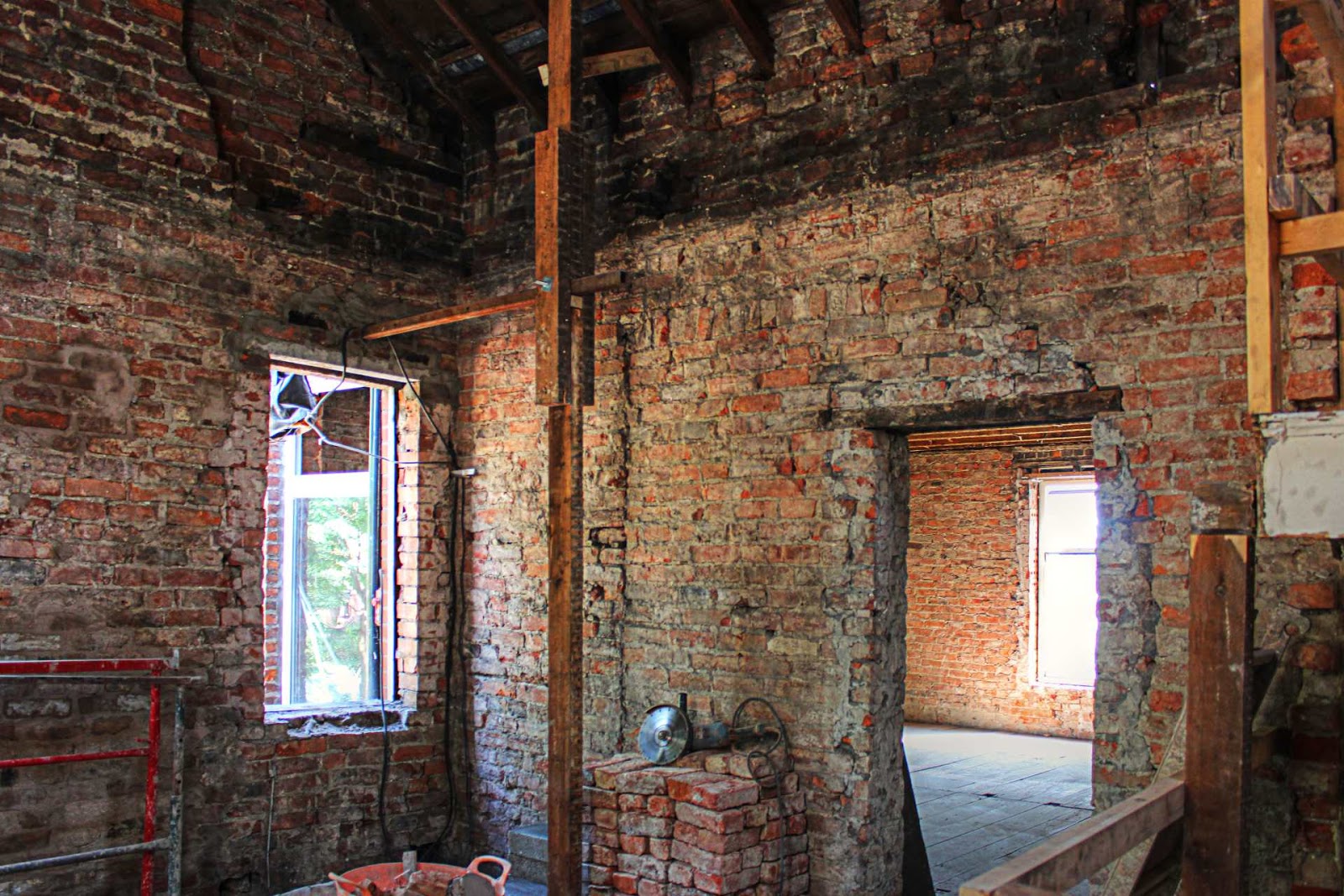
If you travel down High Lane you will have spotted the builder’s boards up around 57 & 59.

The two are on the corner with Stockton Road and were built in 1877, were called Denbigh Villas and pretty much reflect the story of where we live.

They were once grand homes of the comfortably well off, one of whom wrote a fascinating account of Manchester in the 1830s.

Later the two properties became a school for the children of the “middling people” who worked in the professions or owned businesses and could afford to pay for their children to attend private schools.

More recently in line with the trend across south Manchester they were converted into bedsits.

And now the properties are being redeveloped with work being done to strengthen the buildings, stripping away extensions which were long past their sell by date and creating 12 self contained apartments, making the best use of the space available.

But more than this,  Armistead Properties are saving two Chorlton building, with lots of local history.

So with that in mind I have decided to periodically revisit the site and record the progress.

And as you do, I told Peter who came along and took some pictures which will accompany the story, and he will also be on subsequent trips which will mean that there will be a detailed record of the transformation of an old and tired set of houses into something new and exciting.

In keeping with previous developments, the company will retain the facade, while making the interior fit for the new century.

As in all old conversions, the devil is in the detail, with nasty surprises sometimes hidden behind decades of poor re-plastering and layers of woodchip wall paper.

So, some internal walls were wobbly and the outriggers which for you and me are the jutty out bits at the back had seen better days.

These were not part of the original properties and added nothing to the grand plan.

In the same way, few of features that once graced the houses back in 1877 still exist, which is a great shame.

On previous developments, what features had survived a half century and more of poor bed sit conversions were kept, but sadly not here in Denbigh Villas.

But at least the foot print and the exterior of the buildings will survive and someone will have the opportunity to sit in what was once Josiah Thomas Slugg’s front room and speculate, that it was here that he put the finishing touches to his book, Reminiscences of Manchester,** and where maybe a bored school boy twenty years later, might well have gazed out of the window at the passing traffic on High Lane having been defeated by the exercise in his Algebra text book.

So there you have it the first instalment with more over the next 14 months to come.***

Location; Chorlton


Pictures; inside Denbigh Villas ...... a work in progress, 2018, from the collection of Peter Topping

*Armistead Properties, http://www.armisteadproperty.co.uk/

** Reminiscences of Manchester, J T Slugg, 1881

***Denbigh Villas, https://chorltonhistory.blogspot.com/search/label/Denbigh%20Villas 

Thursday, 2 August 2018

Denbigh Villas ...... the name that was lost and is found

It is odd how a house can lose its name, but that is what almost happened to Denbigh Villas on High Lane. 

Denbigh Villas, 2018
The two properties were built in 1877 and were recognised as Denbigh Villas in the rate books, were listed as such in the street directories and are recorded on the stone gate posts.

But possibly because by the end of the last century the two houses had been converted into eight flats, the name had fallen out of common usage.

And that presented a problem, because the name had also been lost from the official records which the Council relies on when a property is registered, which seemed to preclude the present owner, Armistead Property from using the historic name.*

All of which would have meant that a little piece of our history could have been erased, taking with it the link to Josiah Thomas Slugg, Miss Booth and Mr C Dadley, all of whom made their own contributions to Chorlton.

Denbigh Villas, circa 1910
J.T. Slugg had arrived in Manchester in 1830, still in his teens, went on to have a successful career as a chemist and manufacturer of microscopes and played a part in the cultural and political life of Chorlton.

Miss Booth and Mr Dadley ran successful private schools from Denbigh Villas during the opening decades of the 20th century.

So the two houses on High Lane have history, and have Chorlton history and today the Council confirmed that they have been registered\as Denbigh Villas, which means that there is now that seamless continuity which reaches back to 1877 and stretches on into the future.

Of course the Council can’t be blamed for losing the record as the name appeared in the rate books of the Withington Local Health Board which was responsible for public health in Chorlton from 1875 until 1894 when its powers and responsibilities were taken over by the Withington Urban District Council which was subsumed by Manchester City Council when the ratepayers of Chorlton, along with Withington, Burnage and Didsbury voted to join the City in 1904.**

Denbigh Villas, 2009
All of which meant that the name was there in the historic record, albeit in a convoluted way.

That said, both the 1903 and 1909 street directories also listed the properties as Denbigh Villas.

These street directories were not official listings but commercial ones but were widely regarded as the first port of call to look for an individual householder, or business.***

So I bet Mr Thomas Alker, Josiah Thomas Slugg and our two teachers would be pleased at the outcome.

Location; Chorlton

Pictures; 57-59 High Lane, 2016 from the collection of Tony Goulding, in 1910 from the Lloyd Collection and in 2018 from the collection of Andrew Simpson

*Armistead Property, http://www.armisteadproperty.co.uk/

**Manchester Rate Books, 1706-1900 including surrounding townships, Manchester Archives, Central Ref

***Slater’s Manchester, Salford and Suburban Directory, 1903 and 1909


Saturday, 28 July 2018

Denbigh Villas ....... and the mystery of the missing coach house

Now, I like the way that not all of our history comes from a book or even from the memories of individuals.

The coach house, 2018
Sometimes you have go ferreting around, pulling up old council documents and equally old maps and matching them against street directories and adverts, and only then do those little bits of the past come together.

So it is with 1a Stockton Road which for as long as I can remember has been a lock up garage only shutting up shop around 2013.

But look closely at Peter’s picture and its origins as a coach house are clear.  To the left there are the large doors which would have given access for the carriage while above was the hayloft, with space to the right for the horse or horses.

It is a basic and familiar design, which was once replicated across Chorlton, and beyond.  They turn up in the grounds of even the most modest family homes and survive as flat conversions or workshops.

Ours stood in the garden of Denbigh Villas which were two semi detached properties, fronting High Lane.

If we want to be more precise, the coach house was in the garden of 59 so I guess it is reasonable to suppose the occupier of that house used or had the opportunity to use the building.

That said it might have been shared with 57, whose garden was dominated by two large green houses.

The mystery is just when the coach house ceased to be part of Denbigh Villas, because at present it is owned by a family who live opposite.

I could go and ask and I may do that but where is the fun in that?

The gardens of Denbigh Villas, 1894
Instead I shall ponder, using the OS map for 1933, which offers up the following clue, which is that by then the green houses have gone and what was left of the garden east of the coach house is marked as part of the Convent which had once been a school and is now the Islamic School for Girls.

So it would be reasonable to suppose that when the land was sold and the green houses demolished, our coach house also left Denbigh Villas.

By then its days as two grand homes may have also come to an end, but here the official documents are of no use, because both the record of who lived in both has been redacted because they might still be alive.*

And that means at present we have no idea whether the residents were posh enough to have owned or a horse and carriage or even if they had succumbed to the age of the motor car.

All I can tell is that neither property had started their long association with multi occupancy.  The record shows that both houses were occupied by one family each.
There is a suggestion that in the 1950s our coach house became the offices of a local builder, before it became that garage.  We shall see.

So that pretty much is that, except to say my grandparents had bought a big rambling old house on the edge of Derby, which had a coach house, and on a hot summer’s day there was still that distinctive smell of hay mixed with the lathe and plaster of the walls, along with the faint buzzing of trapped insects.

Location; Chorlton

Picture; the old coach house; 2018 from the collection of Peter Topping and the gardens of Denbigh Villas, 1894 from the OS map of South Lancashire, 1894 courtesy of Digital Archives Association, http://digitalarchives.co.uk/

*1939 Register

Friday, 27 July 2018

Denbigh Villas ..... the house that lost its name

This is the story of two houses in Chorlton and how they seem to have lost their name.

Denbigh Villas, 2018, on the cusp of an exciting future
They were built in 1877 and were called Denbigh Villas and they began as fine residential homes, became a school in the early 20th century and finally ended their days as flats.

Now they are in the process of being developed into a series of apartments by Armistead Properties.*

And here comes the surprise because having started off as Denbigh Villas, the Council does not recognise the name and will not grant permission for it to be recognised as the official address.

It would appear that they have no record of such a name, falling back on the Post Office who does not list it as Denbigh Villas.

Added to which the Council does not accept the word Villa as an appropriate name, suggesting instead the word “House”.

Denbigh Villas, circa 1910, Mr Dadley's school
All of which is a little odd, given that in 1877 the Council’s own rate books record it as Denbigh Villas when it assessed the new houses on High Lane as having a rateable value of £46.

True by 1900 they had dropped the title on the Rate Books, but the name appears on the stone post outside the houses, and no doubt the postman would have delivered his letters to “Denbigh Villas”.

But perhaps that has something to do with its change of use into a school, run by Miss Booth who occupied just one of the two properties and a little later Mr Dadley who expanded the school into the other house.

And it may also be Miss Booth who confuses things by  listing the house as Springfield in 1904 in a local directory.

While Mr Dadley dropped all pretence at a name, preferring to advertise the place as Mr Dadley’s Grammar School specialising in training for “Law, Medical Accounts, Prelims, University, and Civil Services Exams” and listing it in the census record for 1911 as Chorlton, High Lane, School.

Denbigh Villas, 2016, waiting for change
I have to say, Mr Dadlely may be accurate with the address, but it suggests a slightly unromantic side to his nature.

I prefer Denbigh Villas, because that was its name, and it was where Josiah Thomas Slugg lived in the 1880s.

He is fascinating chap, who is best remembered for his book, Reminiscences of Manchester, published in 1881 which is a wonderful description of the city in the 1830s which includes vivid accounts of the stage coach inns, the shops and personalities that occupied the main streets, along with a detailed description of a journey Mr Slugg took on the Liverpool to Manchester Railway soon after it opened in 1830.

So Denbigh Villas has history, and has Chorlton history, so for that I think it should be allowed to continue to retain its historic name.

Next; Denbigh Villas ....... and the mystery of the missing coach house

Location Chorlton

Pictures; 57-59 High Lane, 2016 from the collection of Tony Goulding, in 1910 from the Lloyd Collection and in 2018 from the collection of Andrew Simpson

*Armistead Properties, http://www.armisteadproperty.co.uk/