Saturday, 5 October 2019

Celebrating 65 years of retail history …….. here in Chorlton …… one to do..... today

Now every so often the question reappears as to which is the oldest business in Chorlton.

And the title falls to Ken Foster’s cycle shop on Barlow Moor Road, to which Ken and his staff invite everyone to share in that history today from 10. am onwards.


The business has a proud record, not only in the sale and after sale of its bikes and accessories but in its support for the community.

Leaving me just to say as the poster indicates, there will be lots going on, including a preview of The Story of Ken Foster's Cycles.

Location; 374-376 Barlow Moor Road, Chorlton-cum-Hardy, Manchester, M21 8AZ

Pictures; poster courtesy of Ken Foster, and cover of The Story of Ken Foster's Cycles.

Ken Foster’s Cycles,  https://www.kenfosterscyclelogic.co.uk/
374-376 Barlow Moor Road, Chorlton-cum-Hardy, Manchester, M21 8AZ
info@kenfosterscyclelogic.co.uk  0161 881 7160

Friday, 4 October 2019

The letter from Harpurhey ……………

The letter sent by Mr. Jack Scott from the military hospital on Alfred Street in the January of 1916, is a mix of optimism, pleasure at some good news and a reflection on the future.

Posted by a Wounded Soldier, 1916
In that sense it will not be different from the millions of similar letters that were sent during the Great War.

Mr. Scott, commented on “the good news”, adding “it’s a pity it was not a decrease of £90 a year, but we must not grumble, if we manage to get a decent man, we shall be a happy little party”.

Just what the money was for, and what the “decent man” was engaged to do is lost forever.

But we know “he was getting on very well”, despite some upsets leading him to confide that “I have a had a very rough time and never expected to get better.  I’m one of the lucky ones.  I don’t want to go to the East again, don’t mind France”.

B7 Ward, Alfred Street Hospital, 1916
Just where in the East he served is not made clear, and so far, a search of the military records have thrown up a number of men who might be Mr. Scott.

Nor have I been able to locate the recipient of the letter who was a J. J. Clayton of the Post Office, Clacton-on-Sea, but I am confident that in time both will come out of the shadows.

For now, I shall finish with the hospital, which until 1915 had been Alfred Street School, which catered for 360 boys, 420 girls and 320 infants.

Alfred Street School, 1911
It was one of seven schools which the Government had taken over in the March of that year and prepared to accommodate 1,015 wounded soldiers.

According the chair, reporting back to the Manchester Education Committee, these were the “municipal Central School at Ducie Avenue; Grange Street School Bradford; Alfred Street School, Harpurhey; Lily Lane School, Moston; Mosley Road School, Fallowfield; Atherton Street School, Deansgate; and Heald Place School”. *

In response to a question about the provision of education for the displaced students, he replied “If you can tell me, I shall be glad. 

We shall have to go into the whole thing, so that it may come before the Committee, later.”

That something, became part time education for the displaced students and a series of ad hoc provision by Manchester University, all of which is covered in great detail in Manchester Remembering 1914-18. **

By the end of 1915, a total of 14 schools had been taken over, across the city, and into Salford, Stockport and Trafford, and another four during 1917-18.***

Leaving me just to point the interested to the follow up stories, at A new book on Manchester and the Great War


And with that outrageous bit of self promotion out of the way, I am pleased that the school does still exist.


Harpur Mount Primary School, 2019
The foundation stone was laid by Mrs. Emmeline Pankhurst on October 15th 1904, cost £18,850, and is now known as Harpur Mount Primary School.

Location Harpurhey, Clacton-on-Sea

Pictures, the letter, 1916 from the collection of David Harrop, record of Alfred Street School, Slater’s Directory of Manchester and Salford, 1911, and Harpur Mount Primary School, 2019, courtesy of the school.

*Schools for Hospitals, Eight Thousand Scholars to be displaced, Manchester Guardian, March 16th, 1915.


**2nd Western General Hospital, Manchester, 1914-1919, 1919

*** Manchester Remembering 1914-18, Andrew Simpson, 2017, and

****A new book on Manchester and the Great War, https://chorltonhistory.blogspot.com/search/label/A%20new%20book%20on%20Manchester%20and%20the%20Great%20War

Ghost trams ....... on seeing tram 1001 again

Now those who travel regularly on the East Didsbury and Airport lines will be familiar with the big tram depot between Firswood and Trafford Bar.

Here can be found a little bit of our Metrolink history,

Parked up,  sitting quietly, minding their own business, can be seen those blue trams, which ran the rails in the early days.

I have to say I prefer the new ones but then I have always liked the colour yellow.

But yesterday Andy Robertson that photographer of all things to do with changing Manchester and Salford sent me these two pictures with the caption “1001, the very first tram, pictured here at Old Trafford awaiting its fate”,adding  that “when I worked in The Abraham Moss in Crumpsall in 1992 the window by my desk on the third floor looked directly out on the tram line, and I saw the first trams being tested on the Bury route. 


I did a rewind back to my youth and jotted down the numbers. I spotted all 1001 to 1026 apart from 1013 which I later learned was permanently in the depot and therefore not spot-able. 

These sittings were well before The Abraham Moss tram stop was built”.

Location, a depot near you

Pictures; tram 101 and friends, 2017 from the collection of Andy Robertson

In Piccadilly before the last tram ran


Now this is another of those how to date a picture stories where either dear reader you sit back in awed wonder at my detective skills or just mutter tedious big head and move to the bottom of the page for the answer. 

So I shall begin with the working out.

It could be anytime in the year but no later than spring  judging by the number of people in overcoats.

And the flowers are out in the gardens to our left and the whole place seems bathed in that sharp sunlight which opens everything up but does little to warm the city.

I guess it might be sometime in the 1930's into the 40's.

In the absence of any wartime hints I think we are in the years of peace before 1939 or in those last four years before the last of our trams ran in 1949.

And it must be after 1932 when that great slab of a white building with its radio mast was opened.

This was the Rylands Building which back in the 1930s was the largest wholesale textile warehouse in the city.

At this point I have to confess that I had to rewrite the post in the light of a very helpful set of comments from Jane Campbell who is the research cataloguer and database administrator for the Photographic Collections held at the University of St Andrews, which I trust dear reader will make you ponder on the lengths I will go for a good story.

St Andrews has an extensive collection of postcards produced by Valentine and Sons of Dundee and our picture was one of theirs, so as you do I contacted them and Jane kindly replied with a possible date. But before I reveal that I should point out that there are a few obstacles in the way.  As Jane says,

"with Valentine care needs to be taken when using the registration date for dating their images – these registration dates refer to when the title was written into the register and was not necessarily when the photograph/view was taken.  

They sometimes would replace the original image with a newer photograph (updating the scene but using the same title) and in the earliest numbers the photograph could have been taken sometime (even years) earlier than the registration date.  As for the actual date of the postcard that you hold that would depend on when it was printed.

It is an interesting photograph not least because most in the collection date to a time before the 1920's but as ever the place is busy.

I especially like the glass and iron shelters which run down in front of the statutes.

And that reminds me that sometime in 1970 someone had painted a set of foot prints leading from Queen Victoria’s statute to the public lavatories.

I suspect she would not have been amused.

I guess there will not be that many who remember this view of Piccadilly and the northern section of the gardens.

Picture; from the collection of Alan Brown


And for those who want to follow up on Valentine & Son, the link to the University is Valentine Collections available via our new website at
http://www.st-andrews.ac.uk/imu/imu.php?request=home


Remembering unique people ....... Alan Turing

Now monuments can come in many shapes and sizes, and we have long moved away from the traditional statue, which in the past were confined to men, who were usually remembered as generals, politician, or scientists.

So this wall painting of Alan Turing is most welcome.

"Alan Mathison Turing OBE FRS, 23 June 1912 – 7 June 1954 was an English mathematician, computer scientist, logician, cryptanalyst, philosopher and theoretical biologist. 

Turing was highly influential in the development of theoretical computer science, providing a formalisation of the concepts of algorithm and computation with the Turing machine, which can be considered a model of a general-purpose computer.


Turing is widely considered to be the father of theoretical computer science and artificial intelligence.

Despite these accomplishments, he was not fully recognised in his home country during his lifetime, due to his homosexuality, and because much of his work was covered by the Official Secrets Act".*

It stands almost at  the junction of Barlow Moor Road and Princes Road.

I have seen it countless times, but never thought to record it.

But Andy Robertson did, and for good measure here is what it used to look like.

Location, Alan Turing Memorial

Picture; Alan Turing Memorial, 2019, &2014, from the collection of Andy Robertson

*Alan Turing, https://en.wikipedia.org/wiki/Alan_Turing

Thursday, 3 October 2019

The General Garibaldi ......The Admiral Haddock, .......... and a heap of lost other Manchester pubs

The names of our pubs are as much about history, and location as they are about fashion and commercial considerations.

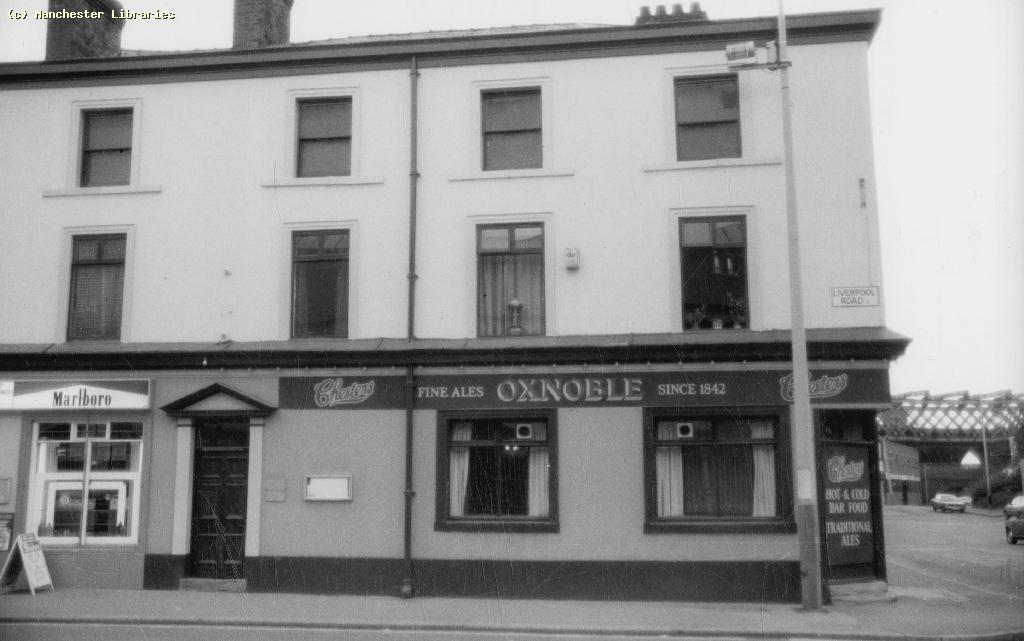
The Oxnoble in 1984
So, the old and venerable Oxnobel pub on Liverpool Road which opened in 1785 and took its name from a potato landed at nearby Potato Wharf, became the Ox for a short while. 

This was no doubt on the whim of a smart young thing in marketing, who decided the place needed rebranding. 

It was a decision which came with a series of large paintings of the said animal, which I suppose was to reflect the new shortened name.

To what extent this proved a sound commercial decision is best left to the observation that the pub is now again the Oxnoble, reinforcing its history and connection to the area.  That said the painting are still there.

Pubs of course do change their names, which are often to do with national events, as much as they are to a new marketing campaign.

The Fox Inn 1910, Byrom Street, 1854-1933
The Ball and Nimrod in Didsbury was renamed the Nelson Inn after the naval hero, while others picked up new names on the personal choice of the landlord.

The Gladstone Arms on Deansgate had been The Two Cocks, The Grosvenor also on Deangate had traded as The Commercial, and the Moulder’s Arms on Chorlton Street became Ingham’s Hotel.

In some cases, these just originated from the name of the new owner or landlord.  In Hulme “four nineteenth century licensees named their houses after themselves.  They were George Kennet of Kennet’s Hotel on Bristol Street; James Platford of Platford’s Hotel on Stretford Road; Joseph Bedale of the Bedale Arms on Chester Street and George Bentley of Bentley’s Hotel, Upper Moss Lane”. *

The original handwritten records, 1908-84
While other landlords fell back on their place of birth, local occupations, and some went for regiments.

Now the extent of the variety of such names has been brought back to me as I digitize a list of pubs drawn from the old Licensing Records for the City and surrounding areas.

And here I have to say that the original research was not mine, but that of Bob Potts who undertook the task during the early 1980s. 

The project took him four years, and during the that time he swapped the County Records Office in Preston for the Licensing Department at the City Magistrate Court in Crown Square, and trawled hundreds of pubs.

Unfortunately, there is an unexplained gap in the Licensing Records for the period 1830 through to 1872, which Bob assumes were destroyed “during the transfer of Licensing Records from Minishul Street to Crown Square sometime in the 1960s or 70s”.

But despite this, Bob has produced a unique data base of the pubs in the city centre.

And as you do during the course of transcribing them, I was drawn to the General Garibaldi and The Admiral Haddock.

Garibaldi's soldiers, Varese, 2014
Giuseppe Garibaldi was an Italian general and nationalist, who contributed to the unification of Italy and the creation of the Kingdom of Italy. 

As such he appealed to many politically progressive people across Europe and beyond during the middle decades of the nineteenth century, and particularly here in Britain.

In 1865, Nottingham Forest chose their home colours from the uniform worn by Garibaldi and his men in that year.  A school in Mansfield, was also named after him, along with the Garibaldi biscuit and a style of beard. **

So, given the City’s progressive politics which it is not surprising that his name also was bestowed on a pub, which the records show opened in 1864 at 7 Gartside Street, and only closed in 1968. 

That said it doesn’t show up on maps or the directories of the period and remains a disappointing mystery.

But it is there and reminds us of the interest in Garibaldi in 1864 which saw the City Council discuss how they were to honour the man on his visit to the city in that year

Less disappointing is the story of the Admiral Haddock, not to be confused with the fish or the character in Tintin.

Admiral Haddock actually existed.  He was born in 1629, died 84 years later and served in the navies of the Commonwealth and the restored Stuart Kings, and pops up in two letters by Samuel Pepys.

Parsonage Lane, 2016 from Deansgate
The pub was situated at 3 Parsonage Lane, which is that narrow Lane that runs from Deansgate back to Parsonage, and today the site is a car park. 

But from 1780 until 1904 this was the Admiral Haddock, variously also called the admiral Haddock and Parsonage House.

Which offers just a tad of a mystery, because Parsonage House was the former home of Thomas La Warre and was demolished in 1897, and given that this was on Parsonage Lane, it follows that this was our pub, but that didn’t close till 1904.

The name Parsonage House is linked to the pub on a variety of directories and maps throughout the 19th century and is listed in the Rate Books for the 1890s as belonging to various people and by 1897 to Cronshaw’s Alexandra Brewery who were based in Erskine Street, Hulme.

So, I suspect that there is much more digging to do. 

One route of which will be those Rate Books which should take the story back to the beginning of the 19th century.

Parsonage Lane 1851
And in the meantime, I shall continue transcribing Bob’s handwritten records to excel that powerful spreadsheet and data package.

Not just because the records need updating to a new platform but also because the list offers up a fascinating insight into the development of pubs and beer shops across Manchester as the city grew.

Location; Manchester

Pictures; The Oxnoble, 1984, m50193, courtesy of Manchester Libraries, Information and Archives, Manchester City Council, http://images.manchester.gov.uk/index.php?session=pass, The Fox Inn, circa 1914, courtesy of Debs Brack, Parsonage Lane, 2016 from the collection of Andrew Simpson, Parsonage Lane, 1851,  from Adshead’s map of Manchester, courtesy of Digital Archives Association, http://digitalarchives.co.uk/

*Potts, Bob, The Old Pubs of Hulme and Chorlton-on-Medlock, 1997, page 5

** Giuseppe Garibaldi, https://en.wikipedia.org/wiki/Giuseppe_Garibaldi

Of tennis courts, a Soya Mill and a new project …….. down by Old Trafford ..... part two

About a week ago I featured Andy Robertson's new project which is to record the demise of part of the Soya Mill on Skirton Road in the Old Trafford.

Over the years Andy ghas done quite a few of these and they stand as a wonderful record of our changing industrial landscape.

So this is one of the dozen he took and it is my favourite.

Location; Skirton Road

Picture; demolition in progress, 2019 from the collection of Andy Robertson

*Of tennis courts, a Soya Mill and a new project …….. down by Old Trafford, https://chorltonhistory.blogspot.com/2019/09/of-tennis-courts-soya-mill-and-new.html