Thursday, 4 April 2024

Three pictures ..... one place ..... and another pub vanishes

I am not sure I believe that story that when another pub closes Eric Postlethwaite calls last orders and rings his bell somewhere in the vast licensing hall in the sky.

2020
But who am I to challenge the myth?

Instead I present three days in the life of the Farmer's Arms on Stockport Road  in Edgeley accompanied by Andy Robertson's observation on his pictures, "The Farmers Arms flattened on a flaming Friday in February.   Friday and February may or may not have been involved but I do like the liberal use of F words!"

On a May day in 2020 all seemed well, by November of the following year the place had gone dark and a week ago there was just a hole in the ground. 

2021

'nuff said.

2024

Location Stockport

Pictures; three days in the life of the Farmer's Arms, 2020, 2021, and 2024, from the collection of Andy Robertson


Wednesday, 3 April 2024

The lost grocery shop on London Road ........ 1960


Now, for me, these images perfectly capture  that time when I was growing up.

And I suspect it will be the same for many others who were also born n the late 1940s, and for whom these pictures  will chime in with their memories of a changing Britain.

There were the empty bombsites, the drab tired looking buildings, and plenty of horse drawn vehicles.

But many of those bombsites were car parks catering for the growth in car ownership, new and exciting consumer products were becoming available at affordable prices, and above all there was a sense of optimism about the future.

So, here we are, on the corner of London Road and Buxton Street with the grocery store of P. Prole, where the promise of the future was edging out the past.

At first glance, the shop front could quite easily pass for one from the turn of the century.  

The tiles, the signage and the metal fitments look dated, but the poster in the window extolling the power of Stergene “To wash away the shadow of nylon” is accompanied with that elegant looking woman wearing the height of fashion.

While just a few doors down, the empty site has become a secondhand car business, where a 1956 Vauxhall Cresta is on offer for £475, making the Black Bentley look decidedly ancient.  

And for those who like period detail, the Cresta is advertised with a “heater” and the Bentley has been given new tyres, leaving just the odd shaped Morris van lurking in the background.

But despite the signs of modernity, the buildings and the area have seen their best.  

The upstairs floors of the shop have long been abandoned, the glass in some of the windows needs replacing, while the roof and gutters look in a sorry state.

Just when it and its neighbours were demolished I have yet to discover, but demolished they were.
The space it inhabited was replaced by what was one a telecom building and is now a hotel.

You can still walk along Buxton Street, but alas access to it is now via a car ramp which passes under the hotel, and the site of P. Prole’s grocery store is marked by a locked  hotel door.

Location; London Road, Manchester

Picture; The shop with a story, J Prole’s grocery store, corner of London Road and Buxton Street, 1960,Courtesy of Manchester Archives+ Town Hall Photographers' Collection,  


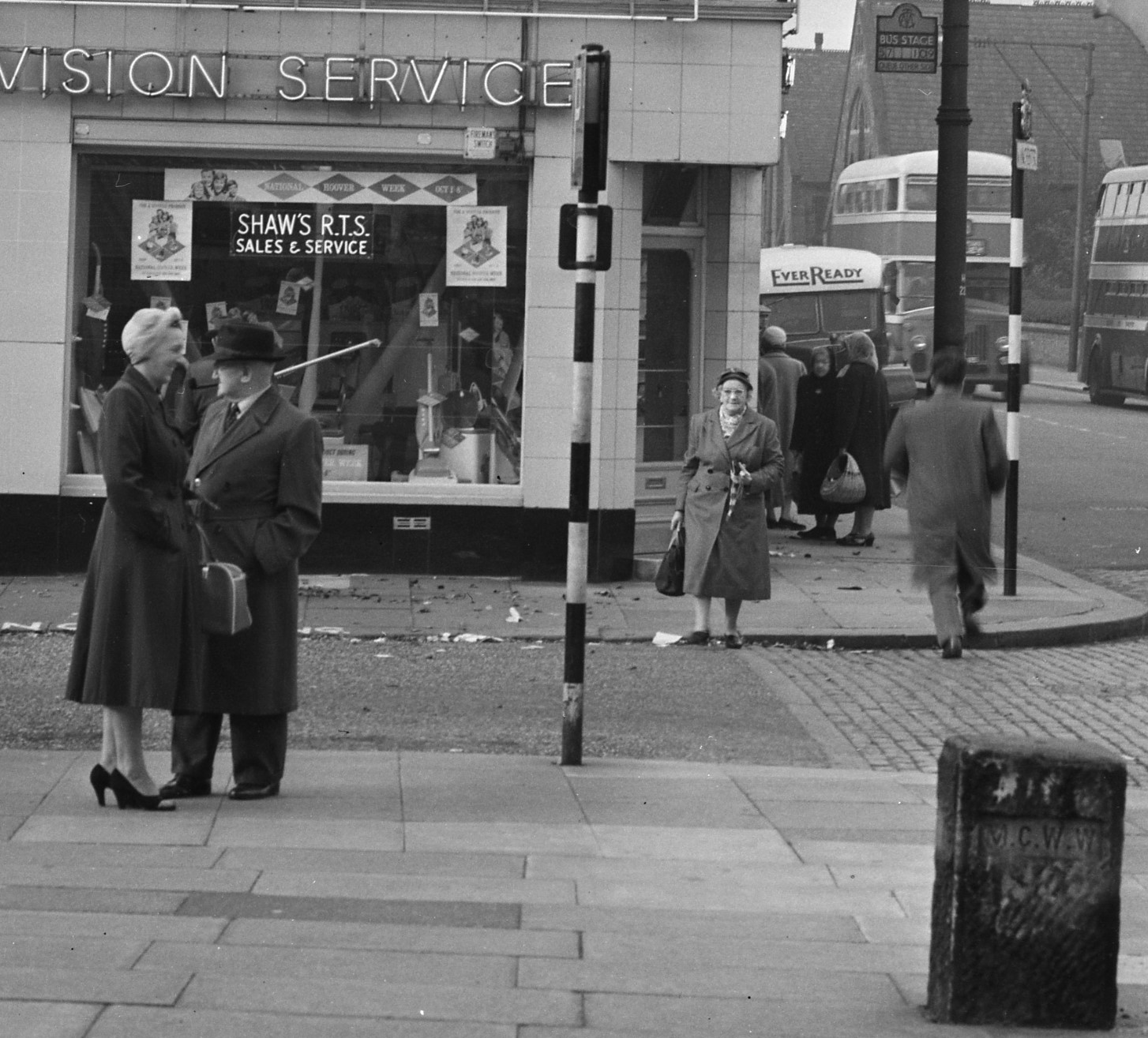
The mystery of Cranbrook Road ........ with televisions, fridges, and much more ....... how we lived in 1960

Now sometimes you come across an image which captures perfectly a moment in time.

And so, it is with this one from 1960, where the clues to how we lived tumble from the photograph.

This was still a time when adverts were painted on walls, and this one for Shaw’s Radio and Television Service is a wonderful example.

There will be plenty of people who recognise the brands of electrical products, along with particular machines, like the Ultra Bermuda 17” television.

And many will also remember as each of these new appliances came in to the house, some less glamorous than others, but all of them marking that slow move from the post war years of rationing and austerity to the consumer society, reflected in that phrase you have never had it so good.*

Of course, this explosion in new goods which made life easier and more fun, was set against pockets of dire housing and abject poverty.

A later generation might criticise the rush to acquire shinny new white goods or state of the art radios and TVs, but that is to ignore the fact that these were being bought by people who had grown up and lived through two world wars and a trade depression, and were in part looking to the consumer age to deliver as much for their children and grandchildren as for themselves.

Added to which this was a period of full employment where factories were turning out the things people wanted, thus sustaining the growing prosperity.

All of which brings me back to the picture, and the other clues to a lost time, which include the purchase price expressed in guineas, the head scarf, the profusion of hats, and sturdy old-fashioned prams.

But there is one mystery associated with the picture, and that is its location.

The street sign says Cranbrook Road and the telephone number is I think Openshaw, but as yet I have been unable to find it where I thought it might be on Ashton Old Road.

Nor are the bus routes any help.  The bus stop carries the numbers 57 and 109.

The 57 ran from Piccadilly to Salford and on to Pendleton, Swinton, and Pendlebury, which seems to be confirmed by the destination sign on one of the buses, but the 109 was a Wythenshawe bus.**

So, I am left confused.

That said, I know someone will come up with the answer.

And they did.

My old friend Andy Robertson tracked down Cranbrook Road to Reddish Lane.

And as way of evidence offered up a road map from 1934, following it up with a picture from Manchester's Local History collection, which features our shop from 1964.

None of which helps with those bus routes ...... but that's another story.

Location; Cranbrook Road

Picture; Cranbrook Road, 1960, "Courtesy of Manchester Archives+ Town Hall Photographers' Collection", https://www.flickr.com/photos/manchesterarchiveplus/albums/72157684413651581?fbclid=IwAR0t6qAJ0-XOmfUDDqk9DJlgkcNbMlxN38CZUlHeYY4Uc45EsSMmy9C1YCk 

*More accurately, “most of our people have never had it so good”, which was part of a speech made by the Conservative Prime Minister Harold Macmillan, in 1957,  in which he asserted, “You will see a state of prosperity such as we have never had in my lifetime - nor indeed in the history of this country.  Indeed, let us be frank about it - most of our people have never had it so good. Go around the country, go to the industrial towns, go to the farms and you will see a state of prosperity such as we have never had in my lifetime - nor indeed in the history of this country."  At a rally to mark 25 years' service by Mr Lennox-Boyd, the Colonial Secretary, as MP for Mid-Bedfordshire.  July 20th 1957, ONTHIS DAY,BBC, http://news.bbc.co.uk/onthisday/hi/dates/stories/july/20/newsid_3728000/3728225.stm

**Service list, 1969, The Manchester Bus Michael Eyre and Chris Heaps, 1989


Tuesday, 2 April 2024

The story waiting for the memories …….. Chorlton’s secret and forgotten places

There remain little pockets of land across Chorlton, devoid of houses and pretty much apparently forgotten.

Lost and forgotten Chorlton, Manchester Road, 2023

Some still show signs of past cultivation, along with the remnants of a hut or shed but most are hidden away, and long ago have been reclaimed by nature.

One such strip runs beside the Metro line from Manchester Road as far as the old Chorlton Junction east of St Werburghs Road where the Fallowfield Loop departed from the main railway line.

According to the historian John Lloyd, “It was intended that the section through Chorlton [of the railway line] should be four tracked and land on the east side was reserved for this purpose.  

Even when the St Werburgh’s Road Bridge was rebuilt in the 1920’s an arch for the additional tracks was provided but in the last few years much of this strip has been sold for housing”.*

And as late as 1952 the OS map shows this as open land, a section of which the Bailey family used to graze their bulls and horses, and which in the 1930s and 40s was reserved for the travelling circus who used it for their animals, including their two prize elephants, Salt and Sauce.*

A railway line and an aqueduct, 1955
All of which I was reminded of today when Peter showed me a series of pictures, he and Linda had taken during Chorlton’s Open Garden Project.***

Some were of the forgotten railway land, while others followed the line of the Thirlmere Aqueduct which runs through Chorlton, and having crossed Manchester Road follows a route which takes it along Cheltenham Road across Oswald and Grange Roads before leaving the township and proceeding into Stretford.****

I had often wondered why there was such a long thin strip of valuable building land snaking through the heart of the area, and now I know leaving me just to ponder on what memories these bits of land might hold for people.

I suspect that the elephants have long since faded from living memory, but there will be plenty who remember the bulls, as well as the grazing horses and so I look forward to accounts of daring dos along the overgrown land, and perhaps illicit cricket games on the strip between Grange Road and Oswald Road, and if we are very lucky perhaps a few pictures.

And just maybe there will be the odd person who has pictures of the old railings, along the former railway land.  

Looking along the Aqueduct, 2023
Much of the bits are rusty forlorn and in danger of being covered in ivy but they are a little bit of that old Chorlton.

So, someone might have caught them on camera.

They may even have stories of when the German air force came looking for the Aqueduct, and dropped a string of bombs across Chorlton in the December of 1940.  They failed to hit it but did serious damage to a heap of properties and killed several people. 

We shall see.

The invite to the Urban Forest, 2023
That said one section of the land  beside the old railway is being transformed into Chorlton's own Urban Forest.******

It can be accessed from Buckfast Close which is off Buckinham Road and in time will have all the promise of a mysterious spot.

Location; Chorlton

Pictures; secret and overgrown bits of lost Chorlton, Manchester Road, 2022, from the collection of Andrew Simpson, the land and Thirlmere Aqueduct, 1955, from the OS map of Manchester & Salford, 1952, Peter Topping's pictures, 2023 from Open Garden Week and Marsh Meadow, 1950 from the Lloyd Collection

Rewilding our city, 2023

To which my botanist friend David Bishop has responded with a series of comments which have given me pause for thought on our secret places and forests in Chorlton.  

At the entrance to the Urban Forest, 2023
He writes, "Trouble is, Andrew, they tend not to remain secret - and if they don't get built on, people now want to 'rewild' them - which often seems to mean planting things - especially bloody trees! 

I wish that people would learn what the word 'rewild' actually means. It means establishing high functioning ecosystems on a landscape scale by restoring as many trophic levels as possible. 

You can't do that in a city (wolves in Southern Cemetery anyone?). You can increase the biodiversity of such spaces by careful and ecologically sound management but planting stuff - especially bloody trees - usually reduces biodiversity".

It is an alternative view which challenged the mass planting of trees on the meadows three decades ago, and while I enjoy the landscape on Chorlton Ees, a bit of me wishes it could be returned to its 19th century state of meadow land.

The Marsh Meadow, 1950
And for those who wonder what the "Meadows" once looked like, the picture The Marsh Meadow shows a very different landscape and one that would have been familiar to anyone who lived in Chorlton a full 70 years ago.

And it may even inspire more memories.
 
Marsh Meadow was at the point on the modern meadows where Ivy Green Road suddenly twists north to join Cartwright Road and Hawthorn Lane.
 
*Lloyd John, The Township of Chorlton cum Hardy, 1972, page 91

**Chorlton and a circus, https://chorltonhistory.blogspot.com/search/label/Chorlton%20and%20a%20circus

***Chorlton Open Gardens, https://www.chorltonopengardens.org.uk/

**** Thirlmere Aqueduct, https://en.wikipedia.org/wiki/Thirlmere_Aqueduct

*****Bricks, gas pipes and much more ...... memories of the Chorlton Blitz .... Christmas 1940, https://chorltonhistory.blogspot.com/2018/08/bricks-gas-pipes-and-much-more-memories.html

******Urban Forest, https://www.urbanforest.uk/

Bits of my history ……….

It started out as a folded wall chart progressed into a block mounted display and survived one house move, rested on several walls in several rooms and for a while was banished to the cellar.

But in that 46 years it was always a favourite bit of my history and has now been restored to a prominent place in the room where I scribble away on historical matters and delve deep into other people's past.

It came in a Sunday Times booklet on Roman Britain, which I bought for £1.95 in 1978, and that too was for a while also sent down to the cellar and to my shame spent longer in that dark place.

Some of the scholarship will have been overtaken by new archaeological finds and by revisions and reinterpretations about the Romans in Britain but it is still a fascinating glimpse into how they lived.


And as ever here are some of my favourites from the “leather bikini trunks of a dancing girl or acrobat” found in the Thames mud to  fine pictures of four Roman Emperors, an equally fine map of the Province and heaps more.

But the block mounted wall chart has not fared so well.  Forty years of being exposed to the sunlight has caused it fade in places, while one edge was damaged and part of it has come away from the its backing.

All of which means bits of it no longer deliver the story of the Roman Army as they did, but enough survives to make it a talking point.

I did once consider getting rid of it but our Ben said that would be an awful thing to do and so I didn’t, and glad I am that it is still here.

Most days I don’t give it a second glance, but occasionally I will stand in front of it, get lost in the detail, and reflect on how the Romans captured my imagination sometime around 1958 and still hold a power over me.

For others it will be the Vikings, the Tudors of the Industrial Revolution, and I do wonder what individually draws so many of us to a particular period or group of people ……. So answers on a postcard, preferably one with a historical image on the front.


Location; our house

Pictures from The Sunday Times Roman Britain  “Full-colour wall chart, map and guide to Roman life”, 1978

Monday, 1 April 2024

Catch it before it goes ….. Manchester’s past in pictures

Now here is an exciting project which has been launched to record all those heaps of street art which pop up and vanish almost as suddenly as they appear.

New Wakefield Street, 2002

They range from the thoughtful and artistic to the scrawl of someone who has just discovered a spray can or a paint by numbers box set.

Spear Street, 2016
You can find them on the sides of buildings, bridges and even pavements.

Most have short lives, either because they are painted over, or removed.  Worse still some linger on neglected and as the paint peels and the image fades, they become a ghostly and forlorn reminder of their former self.

Over the years some of those I count as favourites have gone, like the one on New Wakefield Street I photographed back in 2002.

Or the one of the reclining lady on Spear Street.  She appeared in all her glory in 2016 and was obliterated two years later by a series of sprayed tags which can claim no artistic skill and say little about the artist other than a narcistic need to paint their name.

Salmon Street, 2023

And they deserve to be remembered, partly because many make a statement of what was going on in the city at the time, and because some are humorous and well executed.

Radium Street, 2023
All of which is a lead into the project which is seeking funding and will rely on volunteers to record the pictures with a date, location and description of the condition of the image.

The eventual aim will be to display the collection at a suitable venue, possibly in the Northern Quarter or in the restored Town Hall.

The original idea came from a group of art students and Manchester historians who saw the importance of the project and the potential for a series of “historic walks”.

The scheme has now been endorsed by "Manchester 69" which has a long track record of sponsoring similar projects 

It was established as a centre for the contemporary arts in the late 1960s and mounted campaigns to save some of our 19th century buildings from demolition. 

More recently it has engaged with the London born photographer Richard Bux on a history of tripe shops in the city.

Roman fort, 2002
The launch of this new street art project will be at 10 am today in its studio on Sugar Lane off Withy Grove.

The centre piece will be a collection of recovered graffiti found on the wall of the Roman fort at Castlefield and include a series of comments on the Roman Governor and Emperor along with the enigmatic Latin tag "Aprilis stultus es fuerat".

So it should be a good morning.

Location; Manchester

Pictures, New Wakefield Street, 2002, Spear Street, 2016, Salmon Street, 2023, Radium Street, 2023, and the Roman fort at Castlefield, 2002, from the collection of Andrew Simpson


Sharing a fine meal with a bit of history ..... in Didsbury at 4 Of Us .... part 1

Now if like me you have knocked around in Didsbury for over 40 years you will know that restaurant beside the Old Cock.

In its time it has had different names and was variously a “streak house” and more recently a companion to Dimitris’s the Greek Taverna on Deansgate.

Today it is called 4 Of Us, was opened nine months ago by four friends and is also a wine shop with an impressive range of wines on offer.*

Some of these we were treated to as samples by our host Magda, who chose two English wines and ones from Austria and Slovakia.

Of the five we sampled it was the two English wines we preferred, and one of these accompanied the meal.  

I could of course at this point list the food on the menu, but where would the fun be in that when by following the link, you can discover it for yourself along with the all the wines on offer.

That said I do have to mention my dish which the menus describes as “roasted cauliflower fricassee, curried aubergine, baby spinach and chick peas”.

As a vegetarian who tends to go for the “same stuff”, this was a wonderful blend of some simple ingredients with a fine light sauce.

All of which just leaves the history of the building which over the next few days I will endeavour to research.

Back in the 1970s I can’t remember even clocking the building on the odd visit to the Old Cock when we would miss the odd lecture, preferring a pint of Badger’s Surprise to an hour on the Philosophy of Education.

Years later and in front of a classroom in Poundswick High School in Wythenshawe I  sometimes reflected how the pub had been the better choice.

But we were post grads doing the year course for a Cert Ed, and had the arrogance of graduates who had made a career of missing lectures during the previous three years.


Suffice to say I know that in 1901 the building which is home to 4 of Us was a “pastry and confectioner’s” run by a Mary Sharp.

And that leaves Martha Dimond also a confectioner and Arthur Garret  Gibons  who described himself as "Baker and confectioner", all of whom occupied the place in the decades either side of 1911.

So more to uncover.

Location; Didsbury

Pictures, at the 4 Of Us, from the collection of Andrew Simpson, 2024

*4 Of Us, https://fourofus.co.uk/