Sunday, 5 May 2024

The lost Eltham & Woolwich pictures ...... no. 38 ..... down a narrow Greenwich street

Not Eltham or Woolwich but part of the same series ..... have camera will travel, which I will leave up to older readers to recognise as an adaption from an American TV show.


For four decades it was one of the pictures I took of Eltham and Woolwich in the mid ‘70’s which sat undisturbed in our cellar.

But all good things eventually come to light.

They were colour slides which have been transferred electronically.

The quality of the original lighting and the sharpness is sometimes iffy, but they are a record of a lost Eltham and Woolwich and in this case Greenwich.

And I have Gary Luttman to thank for identifying the street.  Back then I never noted where I was photographing, wrongly assuming that a] I would be back and b] I would always remember, but over 40 years later both assumptions have not played out.

Location; Greenwich

Picture; Crane Street, Greenwich circa 1979, from the collection of Andrew Simpson

Saturday, 4 May 2024

It's the one on the corner of Piccadilly and Chatham Street .............

 I collect old buildings.

Union Bank of Manchester, 2024

So, l was pleased when my friend Juliette sent over this picture of the former Union Bank of Manchester.

More so because it is one l have passed heaps of times over the last half century.

It is on the corner of Chatham Street and Piccadilly and does seem to have an uncertain future.It was built on the site of pa previous bank in 1911 and is on for those fine Manchester commercial buildings, which shout out solid reliable and trustworthy.

All of the things the Directors of a bank would want to project, and I think the Union Bank of Manchester got it right.

The site in 1886
According to one source the bank traded between 1836 to 1940 and was later part of Barclays Bank. *

Just when it closed I have yet to discover, but it seems to have still been part of the Barclays empire in 1969.

It’s last occupant appears to have been Pound Empire who were trading there in 2008, after which it seems to have been empty.  

In 2012 a To Let sign adorned a spot above the door to 12a but that subsequently vanished and the place has been a boarded up and forlorn looking site.

There have been various applications for the development of the property, dating back to 1982, all of which were granted.

The latest is for "Listed Building Consent for the external and internal alteration and refurbishment of no12. Piccadilly to form aparthotel in association with the erection of a 32 storey building (land at no. 14-16 Piccadilly), including ground floor cafe (Use Class E (b), first floor exhibition hall (Use Class F1) and a rooftop bar and restaurant (Use Class E (b)), and associated works.”**

Planning applications can be a fascinating key to the story of the building because with many of them comes a Heritage Report, and the one for 12 Piccadilly does not disappoint.

Chatham Street with the bank to the left, 1963
A long with a detailed description of the area, the building and its story come some wonderful photographs of the interior.

The report fills a much-wanted gap because there is not much else that I can find about the place.  Even my Pevsner fails to mention it.***

Although to be fair it does reference its next door neighbour on Chatham Street, which was the Refuge for the Manchester & Salford Boys; and Girls’ Refuges which played a major part on the welfare of young people in the late 19th and 20th centuries and still fulfils that task today as the Together Trust.****

So that pretty much is that , leaving me just to thank Juliette and recommend the link to the planning application and the Heritage Report.

Well almost the end, because my friend Juliette is also a writer, and is currently writing three novels on John and Enriqueta Rylands.  The first is due out in September and will be on sale in amongst other places, Chorlton Bookshop.*****

Longford Hall, Stretford, 1914

It is entitled Longford, follows their early lives before they met, their romance, marriage and the start of their life together in Longford Hall.*****

I could say more but that would just spoil the read.

12 Piccadilly, 2024
So that really is that.  I am looking forward to the publication of Longford and intrigued for the future of 12 Piccadilly which of course is where we came in and like all good stories offers an ending

Location; Piccadilly

Pictures; the former Union Bank of Manchester, 2024, from the collection of Juliette Tomlinson, and the site of the bank prior to its construction from Goad’s Fire Insurance maps, 1886, courtesy of Digital Archives Association, http://www.digitalarchives.co.uk/ and Chatham Street, from London Road, 1963, Higham, W., m00942, courtesy of Manchester Libraries, Information and Archives, Manchester City Council, http://images.manchester.gov.uk/index.php?session=pass Longford Hall, 1914 from the series Longford Park, issued by Tuck and Sons, courtesy of Tuck DB, http://tuckdb.org/

*Manchester History, https://manchesterhistory.net/manchester/tours/tour13/area13page60.html

**Planning request for 12 Piccadilly, 137795/LO/2023, Manchester Planning Portal, https://pa.manchester.gov.uk/online-applications/applicationDetails.do?activeTab=documents&keyVal=RZ0YZJBCLTX00

*** Manchester, Clare Hartwell Pevsner Architectural Guides, Penguin, 2001

****The Ever Open Door, 150 years of the Together Trust, Andrew Simpson, 2020, Together Trust

*****Longford, Juliette Thomlinson, ISBN 978190606930, due out in September 2024


Back at Chorlton's own Aerodrome


The aerodrome, circa 1924
You can never get enough of stories about aerodromes, especially when the aerodrome in question was here in Chorlton.

So I am back with Hough End Aerodrome,* and in the interests of accuracy it was actually called Alexandra Park Aerodrome, taking its name from the nearby railway station.

The site had been chosen by the War Department in 1917 partly because this was still open farmland and also because of the railway line which meant the aircraft could be transported direct from factories in Newton Heath and Stockport to the airfield and assembled on site.

Its operational life had two short periods.  It lasted as a military aerodrome for just a year from May 1918 till May 1919, and operated as civil airfield until 1924.

During the later phase it operated flights to London, Southport, Blackpool and Amsterdam.  But for great chunks of this time there was uncertainty about its future.  Almost as soon as civilian aircraft began using aerodrome there was a debate about whether it should be taken over by Manchester Corporation. Much was made of its closeness to the city centre and the boost it could give to the economy.  Birmingham Council had already bought the West Bromwich Aerodrome and this was a 40 minute car ride from the centre compared to just the ten minutes it would take to get to Albert Square.  There was also a strong belief that the Air Ministry would sell for a very low price.

But reading the newspaper reports of the period there is a sense that it was still not as successful as it could be.

One journalist commented that “the aerodrome has known many vicissitudes.  The travellers on the railway between Manchester and Withington have seen it alternate between a place of stirring activity during and just after the war and a place of flat desolation untroubled by the whirr of a single propeller, the great sliding doors of the hangars firmly closed, the weather gauges streaming out in indication of breezes that interested no one.  Now and then awakened by the measure activity of a civilian service or its pulse has been quickened to a very swift beat by it being a station for the round Britain air Race.”*

Part of the problem I suspect was just the cost of flying.  A flight from Manchester to Paris would shave six to seven hours off the journey by rail and channel crossing but the fare would be 9 guineas making it a third more expensive than the conventional trip.  Moreover this assumed that the service had been subsidised “by £10,000 to cover the installation and inauguration of a service.” Which even then might as one newspaper reported only be used by businessmen “whose time is worth money, earns say £2000 a year, which is £2 an hour, [who would] save six hours and so make between £8 and £9 on the deal.”**

The demolition of the hangars, 1924
The case became even more important with the development of the surrounding area for housing.  Soon the argument ran there would not be enough land for an airport.
The Egerton estate appeared to view with favour a Corporation buy up and promised to hold off selling the land till a decision could be made.  

But in the event there was no Corporation buy out and by the terms of the original lease agreement all flying use stopped five years after the war’s end and on September 24th 1924 all the buildings and power plant were put up for auction including nine hangars and other buildings, two generators, cables electric fittings, boilers, heating piping, water piping, baths, wash basins, lavatory fittings and other items.”****

Already some of the wooden huts had been used by the City Police to house its unmarried officers.
And that pretty much is that for the aerodrome, leaving me only to record that the name of the Alexandra Park Railway Station was changed to Wilbraham Road in July 1923, almost a year before the airfield closed and that the station itself closed in 1958.  It’s one last buzz of activity coming when Granada used it for the venue of its Blues train show in 1964.  But that is another story.

Pictures; courtesy of Nora Templar and now in the Lloyd collection

*Alexandra Park Aerodrome, Ministry’s Lease Expiring, The Manchester Guardian August 22nd 1924
** The Alexandra Park aerodrome. Pros and Cons of Purchase, The Manchester Guardian September 27th 1922
*** Sales by Auction, The Manchester Guardian September 6th 1924


A book for all places …….. and all seasons

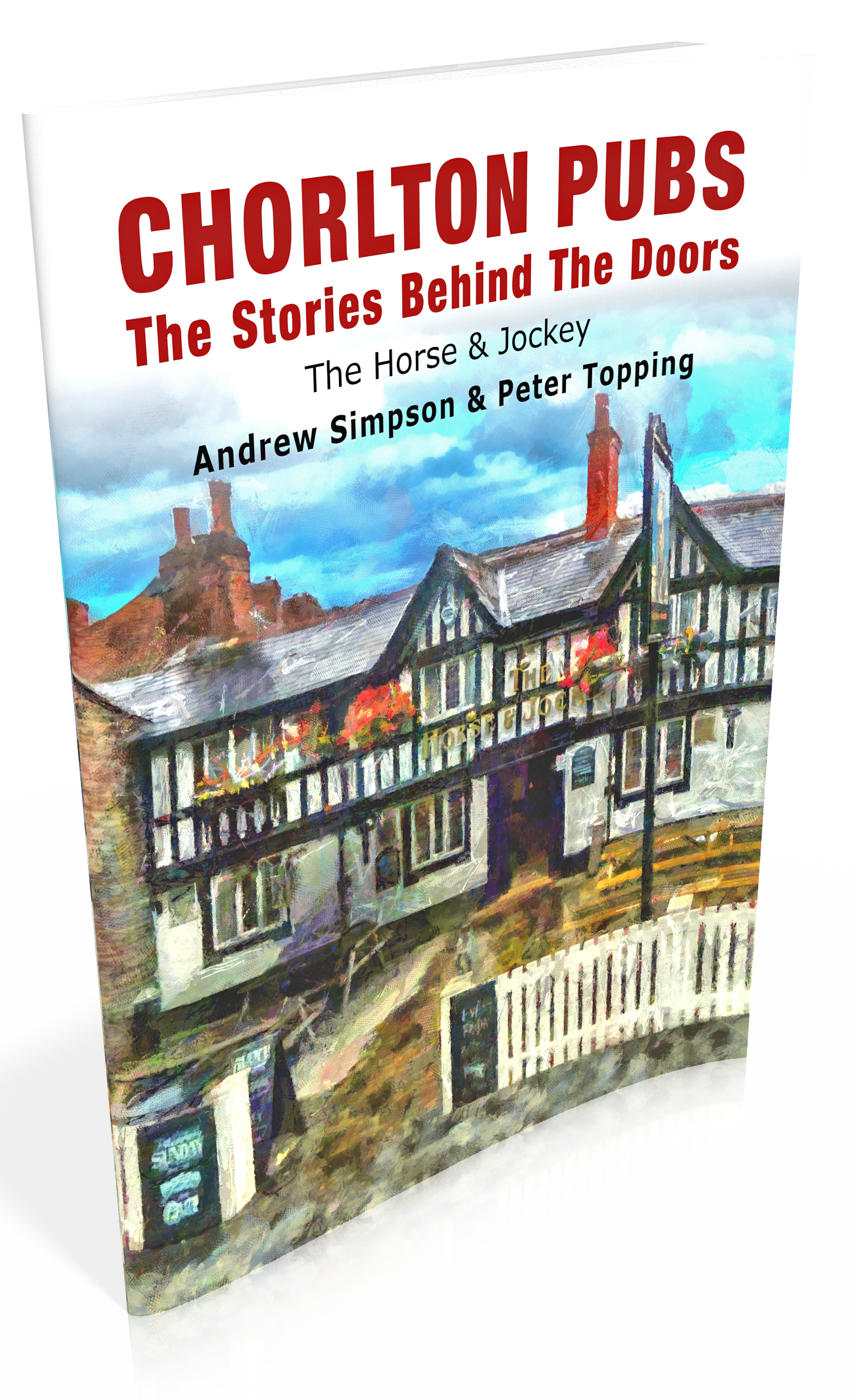
If you want a book about pubs, parks, places of worship along with historic buildings and quirky local stories the Simpson Topping partnership will have something for you.

The collection, 2012-2024

And yes, this is a piece of outrageous self-promotion but contained in today’s piece there is a story of how a jobbing historian and much a regarded Manchester artist came together in 2012 to do something different.

The History Wall visited by Manchester Evening News, 2012
Since then, they have staged a series of installations and written 18 books, along with presentations and heaps of history walks.  

Peter is an accomplished artist and Andrew a storyteller and their collaboration is where art and history come together to tell the story of where we live.

These are the stories of the people, buildings, and events which history has not just forgotten but in many cases never ever bothered to record.


The Horse & Jockey, 2023

The installations have included one for the Big Green Festival, a second which recorded the history of two iconic houses on High Lane and the 80-meter project which described Chorlton’s history from the beginning of the 16th century on Chorlton Green and terminated at Albany Road in the 21st century and was popularly known as the “History Wall”.

Their books have ranged from an account of Hough End Hall to a series on Manchester pubs, a trip through historic Didsbury and a quirky look at Chorlton’s past.

They mix the serious with the trivial, are grounded in scholarship and look to offer up the big picture as well as the tiny detail some history books ignore and always aim to offer the “stories behind the doors”.

Peter has also written his own book, “Smile Dammit Smile!!! Chorlton” which is an irreverent look at Chorlton. He is also an accomplished artist who has held exhibitions and was the Director of Chorlton Arts Festival.

Andrew has written three books of his own, and writes extensively on a range of historical subjects, contributing to various publications as well as his popular history blog at chorlton.blogspot.co.uk.

The Story of Hough End Hall, 2015

Their last three series of books have been designed as small pocket publications which can be read at home or as a guide to walks around Greater Manchester.

The History of Greater Manchester by Tram, 2024

The first series focused on places in Chorlton, the second local pubs, and the latest is The History of Greater Manchester By Tram.

Each book in the series costs just £4.99, is lavishly illustrated with Peter’s original paintings, a selection of old “period” photographs and stories from Andrew about our collective past.

And in the planning stage ...... a new book on our canals, the Lost Streets of Chorlton, along with Stories from an attic, and what ever takes our interest.

All the books are available from Chorlton Bookshop, or from us at www.pubbooks.co.uk

Friday, 3 May 2024

Five elections … five results …… Chorlton, Didsbury & Whalley Range

 So, a day after we went to the polls here are the results.


The sun shone for most of the day, and in the run up to the day the political parties offered up their own take on what would happen, while the pundits on endless news programmes examined the possible outcomes, projecting as yet imaginary results as suggestions for the forthcoming General Election.

Today as the results tumbled in those spokespersons and "expert" analysts set to with the partial results to make of what they would.


Nor should we forget there was an election for the Mayor of Greater Manchester, result of will be  available after the count on Saturday. 

And after all that you can read about past Chorlton elections by following the link.

Compiled from The Elections Office, Manchester Town Hall, https://www.manchester.gov.uk/electionresults


Pictures; The Election at Eatanswill, Phiz (Hablot K. Browne), August 1836, the Pickwick Papers, Municipal Election results for Chorlton, Chorlton Park, Didsbury, East & Didsbury West & Whalley Range,  from Manchester City Council

*Election results for Manchester City Council, 2024, https://www.manchester.gov.uk/electionresults


**Elections; https://chorltonhistory.blogspot.com/search/label/

BREAKING NEWS ... East Didsbury .... Labour takes both Council seats.

Doing elections the old fashioned way ……………

It is a sobering thought that many things I took for granted and did regularly have become a bit of history as anachronistic as paying someone to wake me up by tapping on the window or turning on a gas lamp.

All the electoral extravaganza, 1986
And at 74 there are heaps of these, but on this day after yesterday’s elections I am drawn to how we managed and ran local election campaigns in the middle decades of the last century.

From 1966 into the early 2000s I was one of those "party workers” who tramped the streets knocking on doors, canvassing electoral preferences and on the day tirelessly working to ensure our candidate won.

And from 1981 to ’87 and again in the mid 1990s I ran the campaign as the Agent, which involved developing the local election strategy, preparing leaflets, overseeing things during the campaign and on the day, and making a financial return.

I suspect some elements are still the same today and cross party lines but back then it was the predigital age.

Calling card, Kirkdale Ward, 1946

All records compiled from canvassing were written up by hand by an army of members onto self-carbonised pads, known as Reading or Mikado pads and arranged by street.

The Election team, 1986
These were then laid out on long tables in the Committee Rooms and on the day were used to indicate who of your promises had voted and who had to be gently and politely reminded to vote.

This involved teams of “number snatchers” who sat for hours on polling stations on the day collecting the polling numbers of voters as they left.

This in itself was a logistic exercise given that we covered all the polling stations Chorlton from when the polls opened till they closed.

This left much of the day as a quiet one of receiving the information and crossing off names on the pads, which was interspersed with a bit of early knocking up of our promises, taking those who had requested assistance to get to the polling stations and a bit of leafleting with Vote Today leaflets.

Old fashioned leaflet, 1986
And depending on the availability of the team there might also be an early round of Vote Today leafletting before breakfast, matched with regular outings with the speaker cars, throughout the day.

All of which led up to the “big push” in the evening where a team linked to a car would take a specific area working it by visiting those who had yet to vote and taking some to the polling station.

At which point the team took charge of the Reading Pads in their area, deciding which to visit and revisit.

In the 1987 General Election this worked so well that by the evening all the promises had been visited on several occasions and there were few names that had not been crossed out, leaving the teams just to crisscross the ward in their cars emblazoned in party posters.

Polling Station, 2024
And during the campaign mindful of that old tradition of meeting the candidates, we still endeavoured to hold public meetings where the candidates introduced themselves, outlined the Party Programme and their own special interests along with answering questions.

Of all the elements of the campaign this one was sadly on the decline.  The growing emphasis on the national message over the local, combined with greater television election coverage and the development of “sound bites”  pushed the public meeting to the fringe.

Afterall on a wet April evening with a chill in the air, the attraction of sitting in a school hall on uncomfortable chairs lost out to the slick performance of a polished politician delivered via the Six o’clock News.

Today Manchester doesn’t count its votes till the following morning in a venue far from the Town Hall, and that has taken some of the drama out of waiting for the result, but must be welcomed by those who do the counting.

Chorlton has its firs Labour MP, Keith Bradley, 1987
Leaving me just to reflect that I always found the day after the election a huge anti-climax.  Win or lose the Agent only had to look forward to clearing the committee rooms, reengaging with family and friends and trying to fill the void.

And if the candidate were successful then the Agent also had to come to terms with being out of the spot light. 

Quite rightly everyone now looked to the newly elected candidate and within a few days the name of the Agent was forgotten.

So, while Dave Black will always be remembered as the first Labour Councillor elected for Chorlton Ward in 1986 his agent, Andrew Simpson has faded into obscurity, recorded only on the odd piece of election material to have survived as an imprint at the bottom of a leaflet.

Dave Black canvassing, 1986

But ever was it so.

Pictures; Chorlton has its first Labour MP, Keith Bradley, 1987, courtesy of Manchester Evening News, remaining images, 1946-2024, from the collection of Andrew Simpson

When we had an aerodrome


There are always more stories to tell, and I think it’s time for one on our own aerodrome.

I first came across Hough End Aerodrome while reading articles by Nora Templar* who lived at Dog House Farm for 47 years.

She remembered “the landing of the first small aeroplane in the fields, the forerunner of many between 1916 and 1918. Manchester’s first aerodrome was built by the Government at Hough End.  

The first planes were delivered by train.  Pilots came in low over the Dog House chimneys and waved from their Avro’s and Handley Pages.” **

It may well be that the plane that took our first picture of the aerodrome had already flown over Nora's home.  It is a wonderful picture showing not only the hangers and admin buildings but a military aircraft on the ground.

The aerodrome was on what is now Hough End Playing Fields and was opened in May 1918 by the War Department for the assembly and delivery of aircraft to the RAF.

The planes were built by A.V. Roe & Company at Newton Heath and the National Aircraft Factory No 2 at Heaton Chapel and were brought in sections by railway to the Alexander Park station which was just 300 yards away.

After the war it became a civilian airfield and from 1922 flew a service down to Croydon Airport near London, and as Nora remembered was used by aircraft competing in the King's Cup Race air races in 1922 and 1923. “There were also a number of flying displays at the aerodrome and the Lancashire Aero Club, the oldest flying club in Britain, was formed at and operated from Alexandra Park until 1924, when it moved to Woodford Aerodrome.”***

But the aerodrome closed in 1924.  Like our brick works it had been given a set life by the Egerton estate who leased the land on condition that it ceased being used five years after the end of the war. So on August 24th 1924 the place closed and the hangers and workshops were demolished.

Today nothing remains save two plaques recording the presence of the aerodrome.  One in the sports pavilion at Hough End Playing Fields and the other in the grounds of No. 184 (South Manchester) Squadron, Air Cadets in Hough End Crescent.

There are of course a few photographs and there is also one special picture.  It is a pencil sketch of the aerodrome as it was being demolished and what makes it special and I think unique is that it was drawn by Nora Templar’s father which I suppose takes us full circle.

Pictures; courtesy of Nora Templar and now in the Lloyd collection

*http://chorltonhistory.blogspot.co.uk/search/label/Nora%20Templar
**Chorlton Journal 1977
***http://en.wikipedia.org/wiki/Alexandra_Park_Aerodrome_(Manchester)