Showing posts sorted by relevance for query public lavatories. Sort by date Show all posts

Wednesday, 29 October 2014

Recording the passing of our great public lavatories .......... nu 1 down by Southern Cemetery

Now I doubt I am alone in mourning the loss of so many of our Victorian and Edwardian public lavatories.

They ranged from the sumptuous ones all glazed tile, shiny brass and rich dark wood, to the simpler public urinals and in their way they were as much a statement of municipal provision as the parks, the schools, the supply of gas and clean water and of course the tram and bus.

And most have gone, some rationalized out of the equation by bigger more modern conveniences and others just because they cost too much.

I still remember those in Albert Square and that one at the top of Great Bridgewater Street which became a pub.

All of which is a way of starting a new series from the camera of Andy Robertson who suggested that it was time for a “bog for the blog.”

He chose that one on Barlow Moor Road by Southern Cemetery to accompany the idea, and I rather think he has now walked his way into recording as many as he can because they are like the public water fountains and stone horse troughs vanishing from our streets and parks.

The horse troughs were the first to begin disappearing and while I can remember plenty when I was young I have to think hard about when I last passed one.

And if I were to ask my sons who are all now grown up I expect none of them will even know what I am talking about.

As for the public lavatories by the cemetery I doubt that they have even clocked they were there.

I know their closure passed me by.  But as you do I went looking for their history and the best I could come up with was that they were built sometime between 1894 and 1934.

Not much I grant you but there it is.

All of which just leaves Andy to go off and find some more with perhaps help from others.

Pictures; of the former public lavatories at Southern Cemetery, 2014, from the collection of Andy Robertson


Monday, 3 March 2025

In Albert Square with the unusual ..........

Now for anyone born before 1970 there will be nothing odd about a bus stop in Albert Square, or the parked up black cabs.

Equally the presence of two underground public lavatories either side of Albert will be no surprise.

That was just what the square was like, pretty much from its construction to sometime in the 1980s or '90s, when the public lavatories, the taxi rank and the bus stops disappeared.

And like so much modern history I can’t remember exactly when it all happened.

Of course the serious side of me knows that I should go off and find out but I bet someone will know and come back with chapter and verse which is always more fun.

Added to which they, or some else, will also be able to explain what happened to the two public lavatories.

Were the fittings carefully and lovingly taken out, and perhaps placed elsewhere or was the void just back filled?

And if it is the latter that raises fascinating thoughts about the discoveries and theories put forward in future archaeological papers on the “Role and significance of underground public services”.

Still for now, I can’t say I miss the bus stops and take pleasure in just sitting in the square, admiring the Town Hall, and pondering on the plight of those underground public lavatories.

Leaving me only to admit that there is still a taxi rank in the Square and the buses still stop but not not directly outside the Town Hall.

Location; Manchester

Pictures; Albert Square, 1978, from the collection of Andrew Simpson

Sunday, 9 February 2020

The lost lavatories …………… Manchester and beyond

Today I was reminded of a short but sad series on the blog reflecting on the demise of our Corporation public lavatories.*

Albert Square, 1985
And yes, there is always a place for such a subject, especially if like me you suffer from “weak bladder blues”

This story was occasioned by a picture of Albert Square from 1967, which prompted Margaret to comment on the following lost lavatories,

1. Albert Square, 4 of them, external removed, steel plate laid, and all subterranean parts remain, was done in 1986
2. Great Bridgewater Street, all external remain and subterranean turned into a bar
3. Cathedral Approach/Victoria Street, all external removed and steel plate placed over entrance, all subterranean remain known as Cathedral Vaults.
4. Stevenson Square, most of external remain and bricked up (now turned into art project) presume subterranean still remains.
5. St Anne's Square, external still remains, subterranean now an electricity substation.

Birmingham, 1983

So, thank you Margret, and I expect this will not be we shall hear of those lost lavatories.

Location; Manchester and Birmingham

Pictures; Albert Square, detail from a picture by M. Luft, 1985, m00128, courtesy of Manchester Libraries, Information and Archives, Manchester City Council, http://images.manchester.gov.uk/index.php?session=pass   and Birmingham, 1983, from the collection of Andrew Simpson

*Public lavatories, https://chorltonhistory.blogspot.com/search?q=public+lavatories

**Margret Copeland Gain

Tuesday, 4 November 2014

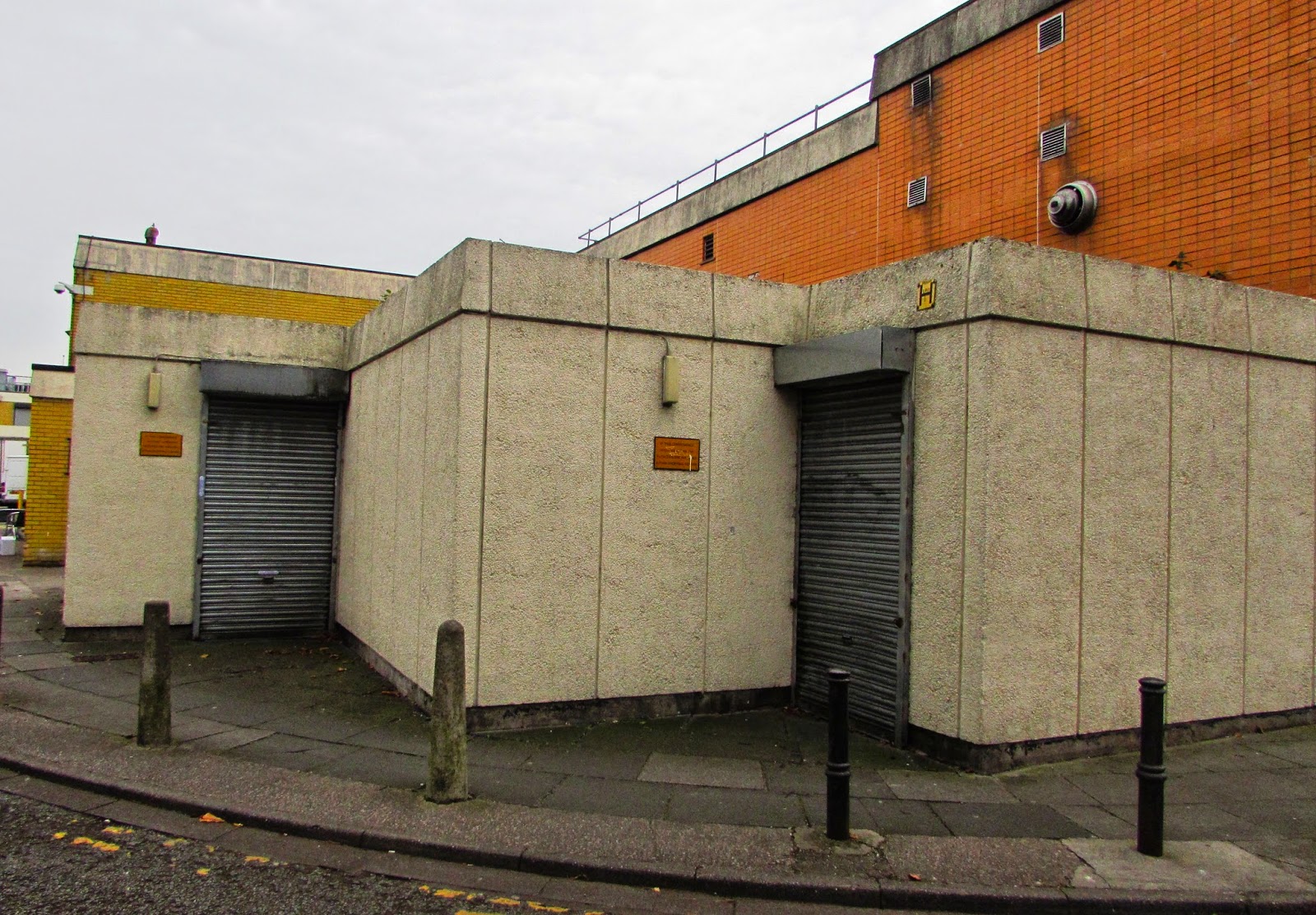
Another two buildings closed and empty in south Manchester

Now compared to those impressive Victorian and Edwardian public lavatories these two are ugly buildings which even function cannot bestow any beauty on.

Withington Road and Moss Lane East, 2014
But like so many of those early public lavatories these have long been closed and I doubt will ever be reopened.

Indeed I remember a for sale sign gracing the side of the one on Withington Road and Moss Lane East.

I thought at the time and still do that this was an act of staggering optimism rather than a practical assessment of the property market.

Barlow Moor Road, 2014
Likewise the second at the top of Barlow Moor Road must be almost unique in that as Andy Robertson asks out it is “is there a facility like this anywhere that is  closer to two pubs, probably a combined distance of 40 yards?”

All of which is part of a new series which Andy has called a “bog for a blog” and which promises over the next few months to record many more of our closed and increasingly threatened public lavatories.

Pictures; Withington Road and Moss Lane East and the  top of Barlow Moor Road, 2014

Friday, 13 March 2020

Another one of the lost public lavatories

Now it was Andy Robertsons who suggested the idea of a bog for the blog and contributed two fine late 20th century public lavatories.

Since then quite a few other people have chipped in with ones that I had entirely forgotten.

The upshot I reckon will keep him busy for a while.

In the meantime here is one suggested by Steven Robertson.  Steven offered up a few but this one I recall vividly.

Like so many it was situated near a pub, in this case the Lloyds in Chorlton and stood in the car park.

Now not so long ago I went looking into the history of the place and I think this bit of open land was where one enterprising landlady opened up a set of tennis courts in the 1880s.

Long gone now, along with the public lavatory and the car park.


Picture; The Lloyd Hotel with that public lavatory, 1970, A Dawson, courtesy of Manchester Libraries, Information and Archives, Manchester City Council, http://images.manchester.gov.uk/index.php?session=pass

Friday, 19 November 2021

When you can no longer spend a penny …….

Now I understand why over the last two decades, public lavatories have vanished from our streets and squares.

2014

Faced with enormous pressures to save money in the face of revenue cuts from central government, many local authorities have closed their public conveniences and redirected the money to front line services.

This I know, but as someone who longer ago parted company with a strong bladder it makes for uncomfortable problems. 

Seven years ago, Andy Robertson chronicled the closure of some of these vital bits of street furniture, and last week he was back with the one on Withington Road, opposite the former Whalley Hotel.

It was not the most attractive of buildings, but it did the biz.  

2021

For a while it was an office/show room, and now is Divine Wellness, serving vegetarian and vegan food, with heaps of good reviews.  You can dine in or drive by to pick up and has its own Facebook page.

So to mangle that biblical quotation from Judges that “out of the strong came something sweet” you could say out of a basic necessary has come something exciting. *

And there will be some who remember when the site, stretching from the corner of Moss Lane West along Withington Road was a strip of shops and houses.

1960
I don’t, but I do remember drinking in the Whalley Hotel and visiting a fine example of a Victorian urinal, which is but maybe now was in Birmingham.

Leaving me just to finish with that old and well-known piece of lavatorial graffiti, “Here I sit broken hearted, spent a penny and only farted”, for no other reason than for sixty years it has brought a smile to my face.

Only surpassed by "you have to kiss a lot of toads till you meet your Prince Charming" and often written on the bottom of the inside door, "beware limbo dancers"

1983

Pictures;  the change of use, 2014, & 2021, from the collection of Andy Robertson, and The Whalley Hotel, Whalley Range, Upper Chorlton Road, 1960, A.H.Downes, m40816,courtesy of Manchester Libraries, Information and Archives, Manchester City Council, http://images.manchester.gov.uk/index.php?session=pass and a Birmingham urinal, 1983 from the collection of Andrew Simpson

*Public lavatories of Manchester and Salford, https://chorltonhistory.blogspot.com/search/label/Public%20lavatories%20of%20Manchester%20and%20Salford


**Judges 14:14

Sunday, 29 November 2020

Beware a challenge ...... the story behind the Fatal Wedding

I am on a quest to find the most boring picture post card ever seen, bought, or sent.

I can’t claim this was an original idea.  It came from my friend Jean who laid down the challenge.

“In the 70's when I was working in the National Postal Museum we did an exhibition of postcards.

As part of this, we did a small display which we called "Boring Postcards."

One I recall was the public lavatories at Huddersfield which to add to the gloom was not even in colour.

But it proved to be the most-looked at part of the Exhibition! “

So off I began with the collection of Tuck and Sons and the site, Tuck DB which offers 133,745 postcards, 29,023 sets and 309,326 uploaded pictures.*

Now this is a site I have plundered over the last year because of the sheer number and variety of images covering the late 19th and a big chunk of the 20th century and it has given up plenty of fascinating stories.**

And sure enough with just a little effort I came across this card from the series The Fatal Wedding from the Princess’s Theatre, London.

I thought I had struck gold and while it does not rival the public lavatories at Huddersfield it seemed a close contender.

But then as you do I went in search of Mr Bert Coote’s big production of the Fatal Wedding and discovered a story.

The Fatal Wedding was written by Theodore Kremer who was born around 1871 and died in 1923.  He wrote a number of melodramas including The Slaves of the Orient, The Great Automobile Mystery and Bertha the Sewing Machine Girl which focused on a sweatshop worker who is victimised by her father’s murderer.***

The Fatal Wedding falls into the same category mixing drama, danger and forbidden love.  In this case Cora Williams destroys the happy marriage of Howard and Mabel Wilson and drives them to divorce. Howard gets custody of their children Jessie and Frankie but Mabel winds up abducting them.

Five years later Cora discovers Mabel living in poverty with the children. She tries to poison Mabel and frame Jessie on a charge of theft but is unsuccessful. Howard and Mabel eventually reconcile and live with their children.****

It was first staged in New York in 1902, before going to London and went on to tour Australia where in 1911 it became a film under the same name.  Like its stage predecessor it proved very popular but sadly is one of those lost films.

Nor is that quite all. For the Princess’s Theatre, London also has a history.

It was on Oxford Street and opened in 1828 as the Queen’s Bazaar before adopting the name the Princess’s Theatre in 1836.

Over the next seventy years it specialized in operas, light entertainment and pantomimes and for a while staged Shakespeare productions by Charles Kean before concentrating on melodramas.

And it was our play, the Fatal Wedding which was the last ever to be acted out on its stage.
In 1902 it closed and became a warehouse before being demolished and replaced by a Woolworth store and has since been home to a number of big retail chains.

All of which leaves me to concede defeat with the most boring postcard, so I leave it open to suggestions and retire from the competition leaving Jean at present the winner.


Picture; from the series, “The Fatal Weeding from the Princess’s Theatre, London, Tuck & Sons Ltd, 1902, courtesy of Tuck DB, http://tuckdb.org/


*Tuck DB, http://tuckdb.org/

**Raphael Tuck and Sons Ltd, http://chorltonhistory.blogspot.co.uk/search/label/Raphael%20Tuck%20and%20Sons%20Ltd

*** Daniel S. Burt, The Chronology of American Literature: America's Literary Achievements from the Colonial Era to Modern Times, Houghton Mifflin Harcourt, 2004 p314 quoted in Theodore Kremer, Wikipedia, http://en.wikipedia.org/wiki/Theodore_Kremer

**** The Fatal Wedding, http://en.wikipedia.org/wiki/The_Fatal_Wedding


Monday, 22 December 2014

On the trail of more closed public lavatories

Burton Road
I am not sure what has surprised me most about the clutch of stories on our closed public lavatories.

Firstly it is the sheer number of them that are still around but more sadly the fact that so many are closed.

Today along with another from Andy Robertson who was out on the top of Burton Road are two more from the camera of Slideshow John.

The first is from the Princess Road and Barlow Moor Road junction  and the second is on Hollyhedge Road in Benchill.

Princess Road
Leaving aside all the old ladies and penny jokes it remains an awful situation that cash strapped local authorities have had to close so many.


Pictures; Burton Road, 2014, from the collection of Andy Robertson, and Princess Road and  Hollyhedge Road 2014, courtesy of Slideshow John


Hollyhedge Road

Monday, 17 August 2020

Down in Didsbury and away in Birmingham with the humble public lavatory

Now it has been some time since I pondered on the lost public lavatories of Britain.

Birmingham, 1983
And I can see that for some the subject lacks the romanticism of a ruined castle or the significance of listed great country house.

But they are in the way as equally important.

Some like the Victorian and Edwardian ones are unique pieces of work, with the outside care to detail matched by the interior tiles, and porcelain fittings.

Even those built in the last decade, while they can’t match the style of the earlier ones, say something about public architecture in post war Britain.

Added to which there is that simple observation that they reflect that commitment to municipal public health, and certainly for the Victorians came with a belief that even the humblest of structures should be imbued with good taste and be built to last.

Didsbury, 2019
So here are two of my favourites.

I have no idea if the iron one I photographed in 1983 still stands but the Didsbury one on Barlow Moor Road is still there, although it closed a long time ago.

Location; Birmingham and Didsbury

Pictures; 19th century public library, Birmingham, from the collection of Andrew Simpson, and 20th century, version Didsbury, 2019, courtesy of Andy Robertson


Friday, 7 November 2014

At Stretford with Andy Robertson and a little bit more of our lost public history

So even the ugliest looking of public lavatories will fall victim to economies.

I have to confess I never even knew these ones existed but as part of his continued plan to capture our closed conveniences Andy Robertson snapped them earlier this week adding  “these were the public loos for Stretford Arndale or the ex public loos for Stretford Mall.

They have been closed for at least 10 years possibly even 20 and replaced by ones inside the building. The old ones were the best because they were free, now costs 48 old pennies!”

And with that nostalgic comment Andy moved off looking for more which will appear in the fullness of time.

Now there is of course a series point to the exercise, for not only are they a little bit of our history but also they are a public piece of history, opened in more optimistic times and in the case of the Victorian and Edwardian predecessors provided as part of that civic provision.

Picture; courtesy of Andy Robertson, 2014

Saturday, 24 August 2024

Closed Chorlton ……………

Now by any judgement Chorlton is “open for business”.

Closed, former Police Station, 2022
So, when a shop does close it pretty much doesn’t stay empty for long.

The most favoured change of use remains a bar or restaurant with takeaways a strong second, and in the last few years followed by speciality confectionery shops.

Although the tile and floor store on the corner of Wilbraham and Barlow Moor Roads is a welcome exception, as was the launderette which slid into the former Greggs pastry and sandwich place but appears to have closed.

And that is the subject for today which explores those “closed bits” of Chorlton.

Closed, Public Lavatories, 2022
The first two are those sad empty looking buildings by the bus terminus.  Both are no longer in use.

The first is the old Police Station, which is not that old.  

It replaced the one on Beech Road and dates from the 1950s and closed sometime early this century.

I can’t remember ever going in but do remember the air raid siren on its low flat roof which was occasionally tested in the 1980s.

The other closed building is the public lavatory, and here I draw a blank.  I can’t remember when it opened or when it closed.

Both properties seem to be waiting for something to happen.

Open, Chorlton Police Station, 1959
Occasionally a property board will go up for the police station inviting interested people to bid for or rent it but apart from a short period as furniture emporium like its near neighbour it sits closed and abandoned.

Which just leaves me to add that both do deserve a place on a history blog, and more so because with the passage of a few more years less people will remember visiting either, or in the case of the police station I guess it won’t be long before its place in the story of fighting crime is completely forgotten.

Well, we shall see.

Location, Chorlton

Pictures; Closed for Business, 2022, from the collection of Andrew Simpson, and Chorlton Police Station, 1959, m17522, 99 Beech Road, 1958, m17665, R E Stanley, courtesy of Manchester Libraries, Information and Archives, Manchester City Council, http://images.manchester.gov.uk/index.php?session=pas

Monday, 30 June 2025

Lost in memories in Albert Square …..

How easy it is to find and post images of Manchester before now.


But how much better to post an image you took and share it along with the memories of the place at the time.

We are in Albert Square when public lavatories were still a feature of the main island sandwiched between the statues of the great and the good and parking meters ringed this public space.

I think it is 1979 but could be any year up to 1984.  

A clue might well be the construction work on the western side of the square which now houses offices and a restaurant.

Over the years I have sat in the colonnaded space looking out at Prince Albert and the Town Hall beyond and pondered on just when the Victorian urinals vanished under a previous makeover of the Square.

They were not remarkable but were still fine examples of Municipal provision and a century or so after they were laid out as part of the memorial to Prince Albert I remember using them, marvelling at the mix of tiles and polished metal.

Location; Albert Square

Picture; Albert Square, 1979, from the collection of Andrew Simpson


Monday, 8 September 2025

Of town plans and visions of a future that never quite happened, Eltham in the 1970s and Manchester in 1945.


Cover of A Future for Eltham Town Centre, 1975
Nothing dates as much as those planning booklets issued by the Council as part of a brave new consultation process.

Of course at the time they look bold innovative and exciting, but go back to them 30 or 40 years later and many of them frankly just look embarrassing.

In most cases the plans never came to anything, or they didn’t work or worse still they did but time has over taken them and a new plan is called for.

But in their way they are as much a history book and a comment on past times as any learned piece of original research.

All of which was prompted by A Future for Eltham Town Centre, which fell through dad’s door sometime in 1975.  It was produced by Greenwich Borough Council and invited residents to “make your views known to the Council.”

Back of A Future for Eltham Town Centre
Like all such documents it rehearsed the problems, speculated on how these might develop and offered possible solutions.

As ever “increased trade has brought pedestrian/ traffic conflict and parking pressures and a growing interest by multiple chain stores accompanied by a reduction in the smaller family business.”*

Added to this were issues of parking, demand for more office space, a need to accommodate more community services, while recognising that it was desirable "to promote the provision of residential development, some small service industry and some open space within Eltham town centre.”

It is a litany of concerns which could apply to many urban areas and no doubt our own planners in the town hall wrestled with similar issues here in Chorlton.

And like everywhere many of the opportunities for change were constrained by the amount of space, lack of money and other priorities.

But the planners did their best offering ideas to retain and plant more trees and improve the green spaces on the north side of Eltham High Street and suggesting a multi story car park down Orangery Lane as well as developing the reservoir.

Plan for the top of wel Hall Road
My own favourite was the idea of a small Town Park “on the disused part of Eltham Cemetery and a community centre beside the parish church, which would involve moving the public lavatories “when an opportunity occurs.”

Like so many planning ideas it would seem that the opportunity never did occur.

But I think I may be a little unfair on the planners given the constraints they faced.

So how much more of a problem was it for the town planners here in Manchester in the closing stages of the last world war?  They too were well aware of what they could do, but at the same time were galvanised by the issues of a tired looking city where many of the inner city  residential areas were no longer fit for purpose and some of the commercial areas showed the effect of haphazard development during the past century.

Trinty a new station for Manchester,  1945, from the Manchester Plan
Of course what they had in their favour was the wide open spaces which had been made by enemy action and a will shared by both politicians and planners to do something decent for the city.

Theirs was a bold plan which envisaged broad new avenues, People’s Places and rationalization of work, traffic and leisure along with new social housing.

The 1945 Plan for Manchester fitted an optimistic age fired by that post war belief that this time things had to be made to better.

Each time I go back to it I still get excited but do have to admit that I am pleased that not all of it came to pass, for while the slums would have been banished, new pleasant public places would have replaced the twisting dark courts and alleys, we would also have lost many fine Victorian buildings.

The People's Place, All Saints, 1945, from the Manchester Plan
Some still went under the commercial projects of the late 1950s and 60s but many more have survived.

The 1945 plan no less than the consultation document for Eltham in 1975 may not have gone the wayt he planners wanted but they do take me back to another time.


*A Future for Eltham Town Centre
** The 1945 Plan for Manchester, http://chorltonhistory.blogspot.co.uk/search/label/The%201945%20Plan%20for%20Manchester

Pictures; from A Future for Eltham Town Centre, Greenwich Borough Council, Planning Department, 1975, The 1945 plan for Manchester, Manchester Corporation, 1945


Wednesday, 9 July 2025

The history of Eltham in just 20 objects ........Nu 1 the Tram sheds

The challenge is to write a history of Eltham in just 20 objects which are in no particular order, and have been selected purely at random.

Anyone who wants to nominate their own is free to do so, just add a description in no more than 200 words and send it to me.

Today I have chosen those three buildings on Well Hall Road beside the parish church.  For over a century they consisted of a waiting room flanked by public lavatories.  They were originally built to serve tram passengers when the service began in 1910 and carried on in to the age of the motor bus.  In the 1970s the planners wondered if they should be demolished for a public place.  In their way they are a little bit of our history.

Picture; courtesy of Jean Gammons

Wednesday, 18 October 2023

When Albert Square looked just a little different


I don’t have a date for the photograph but I rather think we are sometime in the 1950s, although I am quite prepared to be proved wrong.

Either way it is a wonderful picture of Albert Square before the space in front of the Town Hall was made traffic free and the public lavatories just at the bottom of the picture closed and built over.

Now I am not one of those secret tunnel enthusiasts but I would love to know if the gents and ladies were stripped of all of their fittings and filled in or just caped, ready to be reused at some later stage.

It is one of those pictures which is almost the Albert Square we know today but not quite. The memorial and surrounding buildings have yet to have a century and a bit of soot and grime cleaned from their walls, and the road behind the statutes still has its island bus stops and shelter.  They will go in the 1970s along with the buildings to the left of the picture

But there is that is still familiar. Cross Street to the north of the square is pretty much unchanged as are the buildings directly facing us.

I do have to admit I am little curious about the white building in the right hand corner which today is monumental slab with a Starbucks outlet on the ground floor.

Having said all that it does look old fashioned, which I guess it partly because of the quality and colour of the photograph and the odd looking cars and buses.

And here I have to admit the unpalatable.  I am old enough to recognise the scene from the darkened buildings to the layout of the square and above all the red buses.  These belonged to the corporation of Manchester but equally there were green and blue buses operated by neighbouring local authorities who crossed in and out of the city.

Picture; Albert Square from the collection of Rita Bishop, courtesy of David Bishop

Saturday, 23 May 2026

Albert welcomes you back to his Square …… Friday in May*

For those in the know and heaps more who just wandered into Albert Square, the place has been progressively reoccupied by office workers, tourists and me.

Our Albert, 2026

The sun was shining and having completed a trip to the Crescent in Salford, the bus deposited me back by the Town Hall.

On Albert's steps, 2026


Sitting below Mr. Heywood, 2026


And as you do, I took a stroll across this much-loved open space which along with the Town Hall went dark while the builders, and restorers got to work.

Sharing the moment, 2026

I can remember the square back in the 1960s when buses and taxis vied with parked cars to dominate what should have been a grand civic statement framed by the Town Hall and shared with two public lavatories, Prince Albert, and four 19th century worthies.

It was busy and not always a place you wanted to linger.

Confused and cluttered, 1979


Passing through, 2026


But judging by the numbers sitting in the sun yesterday that has changed, and it is now becoming popular again and will rival  St Peter’s Square just round the corner.

Mr. Gladstone approves, 2026

Of course, the square by the trams does have one of the only statues to a woman, while Albert shares his spot with Mr. Gladstone, Mr. Heywood, John Bright, and Bishop Fraser.

What we have lost, 1979
Still the fountain will soon be working again leaving me just to reflect that Albert and hs four chums should be pleased with the place they inhabit.


Location; Albert Square

Pictures; Friday in May sharing the square with office workers and tourists, 1979 & 2026, from the collection of Andrew Simpson

*Ofcourse Eric would dispute that the square is Albert's ... pointing outt that it is and always was a place for everyone.


Saturday, 14 March 2026

When we still had a furniture shop and a free car park .... down by the Lloyds in 1990

Now I am on a roll again with pictures from our most recent past.

And so here is another of Andy Robertson’s taken I think in the early 1990s.

I will leave you to identify the shops which have gone, along with that little piece of history which was Chorlton’s lost car par, which I think was free, contained also a set of public lavatories, and once a very very long time ago had been a set of tennis courts beside the Lloyds.

Picture;  looking out towards Wilbraham Road, circa 1990, from the collection of Andy Robertson

Saturday, 16 August 2025

When history is just a series of adventures

Now I do take history seriously, both in the research and in the writing but as someone once said “always have a bit of fun everyday”

Sir Robert Peel and friends, 2016

And today in the company of Peter Topping I am off on some historical adventures, collecting the pictures to support  our new tram book.

This will be the fourth in the series, The History of Greater Manchester By Tram.  It is a unique, perhaps quirky way to tell the history of Greater Manchester by using all 99 stops on the eight routes of the tram network.*

The Milk Maid, 1906
I write about the history of each of the stops and the surrounding area, and Peter produces a collection of original paintings of significant places and buildings.

And together they make up a history or the region.

So today we are off to Piccadilly Gardens, the Railway Station and New Islington, pausing to make the pictures which fit the stories.

They include the memorials, the old BBC building, with a look at the new Mayfield Gardens and that nightmare for motorists which is Stoney Brew.

We will even take the train from the Railway Station to the first stop on any of the lines, just to come back and check just how much the skyline behind Piccadilly has changed since I regularly made the journey half a century ago. 

And for those in the know I want to find the exact location of the Milk Maid on Parker Street while Peter wants to stand where students once painted a trail of footsteps from Queen Victoria’s statute to the site of the public lavatories..

So silly adventures in a good cause.

The books are available at £4.99 from Chorlton Bookshop, the shop at Central Ref, St Peter's Square, or from us at  www.pubbooks.co.uk

Location; Piccadilly Gardens, the Railway Station and New Islington

Pictures; Sir Robert Peel and friends, Piccadilly, 2016, and The Milk Maid, from a 1906 picture postcard from Tuck and Son, courtesy of Tuckdb, http://tuckdb.org/about 

*A new book on the History Of Greater Manchester By Tram, https://chorltonhistory.blogspot.com/search/label/A%20new%20book%20on%20the%20History%20of%20Greater%20Manchester%20by%20Tram


Saturday, 8 November 2014

Crossing the Mersey back in 2012 with the Metro line

Now my much advertised trip on the newly opened tram service from Chorlton to the airport never happened.

I was all set; with camera charged and keen to take advantage of that glorious November sunshine which I reckoned would show the metro stops and the surrounding landscape off to their best.

But for very mundane and boring reasons it didn’t happen.

So the plan is for today and unlike Monday when it was just an adventure today there is a purpose.  We are off to meet our Saul at the airport and with Josh and Polly over from Sheffield and Ben and Ania around the tram seems a plan.

And as you do I was thinking back to the early days of its construction which for many was a tedious round of disruptions along the Barlow Moor Road, Hardy Lane and Mauldeth Road West corridors.

There were frequent diversions, and long waits at the traffic lights, but while all this was going on out by the meadows the engineers were working on crossing the river with the metro line.

Now I know of friends who went for regular walks just to watch the progress of the work and we managed one trip on a warm summer’s evening.

I should have taken a camera but didn’t so I am pleased that Andy Robertson did and captured the construction one July day back in 2012.

Andy regularly supplies some wonderful pictures for the blog and specialises in recording moments in our history which will soon just be a memory.

His series on the new build at Oswald Road, and his current projects recording the development down at Darley Avenue and our closed and endangered public lavatories are the stuff of history.

So that is it, just one day in the story of the Metro Mersey crossing, now just a memory.

Pictures; the metro crossing of the Mersey under construction, July 2014, from the collection of Andy Robertson