Friday, 3 December 2021

One hundred years of one house in Chorlton ... part 127 ….. six hours with Amadeus, a selection of Italian TV and the odd quiz show

 The continuing story of the house Joe and Mary Ann Scott lived in for over 50 years and the families that have lived here since.*

Dancing the Sunday away, 2019

Now, I have no idea what Joe and Mary Ann would have made of the seamless six hours of entertainment which goes out every Sunday on Italy’s television channel Rai 1.

The Italian side of the family still refer to it as Rai Uno, which was its name from when it began in 1954 until 2010.

And I have to say the first time I watched this nonstop onslaught of fun, music, chat show and quiz I was bemused.  More so because each slides effortlessly into the next with little in the way of interruption.

Even now I still half expect the broadcast to be broken by something else, but no it just rolls on, taking up a huge chunk of the afternoon and evening.

Watching Domenica in, 2019

It is simply called “Domenica in” which not unsurprisingly translates as Sunday in.  

My Wikipedia tells me that it was launched in 1976, “and was originally planned to offer to the Italian audience, affected in those years by a profound austerity, an alternative to the typical Sunday afternoon trips and outings. 

It has been the first Italian program to go well beyond the standard duration of 2 hours and to have a very long running, about six hours from 2:00 p.m. 

A program which is different in its structure from one edition to another, it consists of different segments reserved for entertainment, interviews, sport, games, journalism”**

Amadeus, 2014

All of which might well have got Joe and Mary Ann a bit confused if they still lived here but is just another chapter in the story of the house, because we have replaced our satellite dish with a new one which points south and allows us to watch Italian TV in real time.

And so, as an alternative to the usual offerings of British quiz shows, we can watch the presenter as Amadeus present a nightly series of programmes, where a contestants pit themselves against celebrities and each other, followed by another show which involves some of the same contestants in a slightly different game of questions and answers.

Amadeus is actually, Amedeo Umberto Rita Sebastiani, who was born in 1962, started as DJ and along with quiz shows and Domenica in, has presented a serious of talent contests and singing festivals.

With Rai 1

 Of course I am well aware that other houses can boast similar stories of how the digital revolution has changed the patterns of entertainment, but then this is the story of our house which was built in 1915, and has been occupied by four households of which we are the latest.

Joe and Mary Ann were here for 59 years, and we have occupied the place for 45.  They introduced electricity, dispensed with the old kitchen range and were I think one of the first to have a telly, so we are just following their lead.

Location; Beech Road

Picture; pictures from Italian TV 2019, & 2021, from the collection of Andrew Simpson & Amadeus, 2014, Canale YouTube Il Salutatore, https://www.youtube.com/watch?v=5prBSQb1WbM This file is licensed under the Creative Commons Attribution 3.0 Unported license. Attribution: https://www.youtube.com/watch?v=5prBSQb1WbM

*The Story of a House, http://chorltonhistory.blogspot.co.uk/search/label/The%20story%20of%20a%20house

** Domenica in,  https://en.wikipedia.org/wiki/Domenica_in


Christmas 1915 ............ thoughts from George to his wife Nellie

Last  Christmas our Saul was not  with us and he was missed.

All of which makes me reflect on how much harder it must have been for thousands of families a century ago as we moved towards the second Christmas of the Great War.

George Davison was serving with the Royal Artillery in Ireland and while he had hoped to be home for the festival it wasn’t to be.

And so on the evening of December 23rd he sat down and wrote a quick note to his wife Nellie managing to catch the last post of the day.

It was of course shot through with thoughts of Christmas and the wish that Nellie would enjoy her present and get a toy for their son Duncan but just for a moment George reflected on the absence of any letters from his friends and family “since I left home.  I certainly thought I had a few friends but the old saying ‘out of sight out of mind’ is still true.”

But it was a momentary blip in what was an optimistic letter made more so by the news that Nellie had moved from Hulme to Birch Vale cottage in Romily, “you will find it rather lovely but of course there is nothing like having a home of your own.  I hope you will be comfy in it.”

This was to be her home for most of the Great War and into the decades afterwards.

I don’t know if George ever visited the cottage and Nellie did sub let the property for a while near the end of the war but it is still there today and I rather think later next year I shall go looking for it.

All of which just leaves me to finish with George’s closing remarks “with best wishes for a jolly Xmas for yourself and Duncan.”

Picture; extract from the letter dated December 23 1915 from the George Davison Collection courtesy of David Harrop

Thursday, 2 December 2021

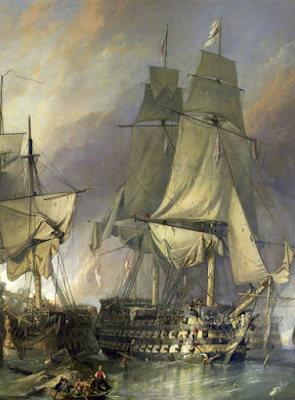
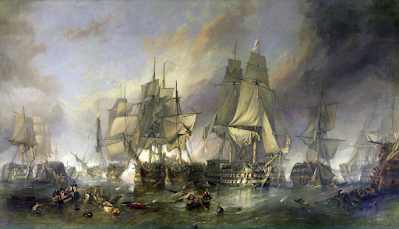
The Battle of Trafalgar .... on the wireless today

Now the family joke was always that they staged the Battle of Trafalgar on my birthday, which October 21st is, but the strategic decision to confront a combined French and Spanish Fleet by Nelson.

Detail from the Battle of Trafalgar, 19th century
And with that said the rest is down to Melvyn Bragg and guests who will discuss the events of October 21st 1805, on the programme In Our Time.*

"In which the British fleet led by Nelson destroyed a combined Franco-Spanish fleet in the Atlantic off the coast of Spain. 

Nelson's death that day was deeply mourned in Britain, and his example proved influential, and the battle was to help sever ties between Spain and its American empire. 

In France meanwhile, even before Nelson's body was interred at St Pauls, the setback at Trafalgar was overshadowed by Napoleon's decisive victory over Russia and Austria at Austerlitz, though Napoleon's search for his lost naval strength was to shape his plans for further conquests.

With James Davey, Lecturer in Naval and Maritime History at the University of Exeter, Marianne Czisnik, Independent researcher on Nelson and editor of his letters to Lady Hamilton and, Kenneth Johnson, Research Professor of National Security at Air University, Alabama

The Fall of Nelson, 1825

Producer: Simon Tillotson".

The programme goes out just after 9 am, and then will be available to listen to shortly after the talk finishes.

And the bonus of listening a little later, is an extra few minutes when each contributor gets the chance to add thoughts that they missed saying.

Picture; detail from The Battle of Trafalgar, 19th century, Clarkson Frederick Stanfield, and The Fall of Nelson, Battle of Trafalgar, October 21 1805, circa 1825, Denis Dighton, National Maritime Museum 


*The Battle of Trafalgar, In Our Time, Radio 4, https://www.bbc.co.uk/programmes/m0012141 


Revisiting Hare Street ……………….

Now I am not one of those that bemoans how places I knew have changed and some cases have changed dramatically.

It is just one of those things that places do change, and that can both mystify and upset those of us who have been away for a long time.

In my case the odd visit to Woolwich over the last few years has taken me a back, as indeed it does whenever I look at Google Street View.

It is less the disappearance of shops I regularly went in, but the wholesale changes to bits of the place, forcing me to “ask a friend” where some pictures from street view are located.

All of which was is a lead into this picture postcard of Hare Street sent to me by Brian Norbury.

I don’t have a date, but I am guessing we are sometime in the 1950s, which may well be contradicted by someone with access to the list of shops along the route or by the age of the cars.

It all looks very different from the scene today, and as I am in Manchester I have used Google to wander up and down admiring the trees, pondering on the success of the traffic schemes, but above all wondering whether the camping shop I briefly worked in during the mid-1960s was on the corner of Mare Street opposite what is now the Waterfront Leisure Centre.

Location; Woolwich

Picture; Hare Street, date unknown, from the collection of Brian Norbury

Wednesday, 1 December 2021

The Vending machine .......... nu 2...... lost and forgotten in Deal

Now here is another one of those bits of street furniture we all took for granted.

There was a time when the cigarette machine could be found almost everywhere.

But now I doubt that there are many left.

So much so that recently I was asked whether I could remember the machine that stood opposite the Seymour, and while the answer was yes I couldn’t offer up a date for its disappearance.

And I suppose that is the point about street furniture.

They are so part of our everyday lives and so taken for granted that we no longer see them let own clock when they vanish.

I don’t know when this one in Deal High Street was abandoned or why but given that neither of the properties on either side is now a shop I am guessing it will be a long time ago.

Today of course you can still come across and use vending machines but they are big, brash and usually dispense products which cost an arm and a leg.

Look closely and you can pick out that the charge for a packet of cigarettes was 30p compared to £9 today.

All of which may help date our machine as well as offering up a lesson on the price of things.

So as a way of celebrating their passing the challenge is to find and display a vending machine near you.

There are no prizes save the gratification of knowing you will have shared your vending machine with the world.

Location; Deal Kent


Picture; cigarette vending machine, 2016, from the collection of Elizabeth and Colin Fitzpatrick

The Lord Nelson on Newton Street …… no longer will it celebrate the Battle of Trafalgar

Now I am the first to admit that the title is a tad contrived.

The Lord Nelson circa 2010

But the 27 ships of the Royal Navy were commanded by Admiral Nelson when it engaged a larger force of French and Spanish ships at the Battle of Trafalgar.

The outcome was a victory for the Royal Navy, although Nelson died during the battle, and like so many victorious commanders he gave his name to a string of pubs across the country.

Here in Manchester and Salford, Pigot’s Directory for 1828-9 listed six pubs bearing the Admiral’s name and one of these was the Lord Nelson on Newton Street, when it was run by a Robert Walker. Mr. Walker is a shadowy figure, and I can find no reference to him in the Rate Books till 1840, but he will be there, I just haven’t found him yet.  

But then I can’t locate him on the census returns.  There are lots of Robert Walker’s in Manchester in 1841, but not one of them was a publican.

So I shall have to revert to the pub, which in Michael’s picture carried the date of 1895, which will be when it was rebuilt.

The Lord Nelson, 1851

The early pub was quite a substantial one taking up a largish footprint according to several maps from the middle decades of the 19th century.

 Leaving me just to add it closed around 2010 and was demolished the following year, after which it became a building site between 2016 and 18, and is now one of those modern buildings the city seems to throw up from Ancoats across to Deansgate.*

 Pictures; The Lord Nelson, circa 2010, courtesy of Michael Markey, and the pub in 1851, from Adshead’s map of Manchester, 1851, courtesy of Digital Archives Association, https://digitalarchives.co.uk/

 *Pubs of Manchester, http://pubs-of-manchester.blogspot.com/search?q=lord+nelson

"remain in the the state they are now in until they perish of their own accord" .......Antwerp ... one to listen to

Now I like the town ordinance from Antwerp which sought to ban the practice of smearing pitch and grease on the wooden facade of domestic properties.


The danger of fire and the destruction of whole swathes of Antwerp are all too obvious, and so the ordinance not only prohibited the construction of new houses with fronts of wood, but demanded that covering them with inflammable material should stop, adding that the buildings  "remain in the the state they are now in until they perish of their own accord" .......should stop adding that the buildings

The ordinance was passed in 1546, was repeated four decades later, and in the late 19th century there were still such houses in existence..... Not perhaps the best example of effective local government.

But it is a piece of social history from a fascinating series which runs all this week on Radio 4 between 9.45 and 10 am, and is repeated in the early hours, and is a "vivid and lively account of Antwerp's glory years takes us back to the 16th century when the city is transformed into a rich and cultured European powerhouse. Michael Begley reads.


Michael Pye's history of Antwerp is a fascinating account of the city during it's golden age. Told through character studies, novels, paintings, songs, inventories and city ordinances, an evocative portrait emerges. 

Transformed into a trading powerhouse, nationals from all over Europe converged in Antwerp, making deals and enjoying the free and easy manners in a place where scandal and heresy was tolerated, and fortunes could be made almost over night. It's not long before religious divisions, and bellicose heads of state bring about an end to the city's tolerance, and it's financial prowess.

Michael Pye is the author of twelve previous books which have been translated into fifteen languages. He has worked as a journalist, broadcaster and columnist in London and New York.

Abridged by Richard Hamilton

Produced by Elizabeth Allard"

Picture; View of Antwerp with Frozen Schelde, Lucas van Valckenborch:, 1593, The Städel Museum, Frankfurt, taken from Antwerp, https://en.wikipedia.org/wiki/Antwerp

*A Golden Dawn, Radio 4, https://www.bbc.co.uk/programmes/m00120rq