Saturday, 7 January 2023

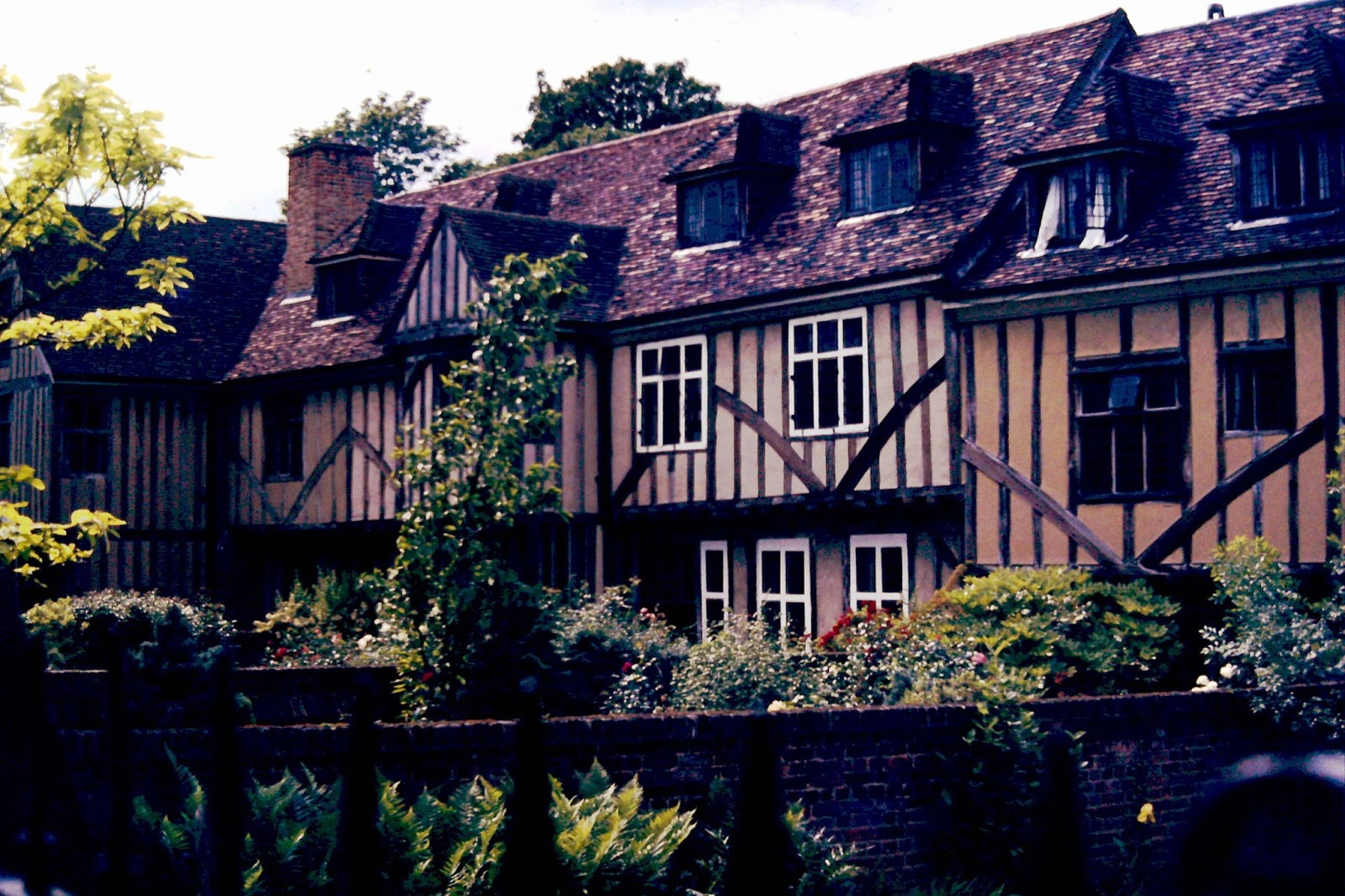
The lost Eltham & Woolwich pictures ...... no. 36 ..... how I remember it

A pretty timeless image.

For four decades it was one of the pictures I took of Eltham and Woolwich in the mid ‘70’s which sat undisturbed in our cellar.

But all good things eventually come to light.

They were colour slides which have been transferred electronically.

The quality of the original lighting and the sharpness is sometimes iffy, but they are a record of a lost Eltham and Woolwich.

Location; Eltham

Picture; Eltham circa 1976, from the collection of Andrew Simpson


Wednesday, 4 January 2023

Leaving for Canada in 1849 .... a momentous step


I think you would have to be really poor of imagination not to feel something at seeing the marriage certificate of an ancestor.

I am staring at the marriage certificate of James Hampson and Sarah Tildsley who were married on December 9th 1838 in the parish church of Eccles.

Now strictly speaking they are not family but belong to my cousins in, Ontario, but Pendleton where they were both born and lived is just five miles away from Chorlton and they began their married life during the time I been writing about our own township.

And sometime just a decade after their marriage they took the momentous step and left for Canada with their five children the eldest of whom must have been no more than eleven and the youngest just about two years old.

James Hampson was born in 1816 and Sarah a year later and they reflected something of the changes that were happening to Pendleton.  Both came from families which were connected with the new Pendleton which was a place of cotton mills, dye works and coal mines.  Sarah’s father was an engineer and both James and his father were cotton dyers. By the 1840s this part of the northwest had become a centre for the manufacture of cotton.  In 1842 there were 412 cotton mills employing thousands of workers in what is now the Greater Manchester area while Manchester alone had 41 factories.

And cotton dyeing is an essential part of the cotton process.  Many of the dye works were situated along the banks of the River Irwell utilising the steady flow of water.  Before the 1850s the process still relied on natural dyes using the flowers, berries, leaves, barks and roots of plants and herbs.  As such the work would not have been as dangerous as it was to become with the introduction of chemical dyes.

But it must still have been very uncomfortable.  James would have constantly been exposed to hot and cold water and dyes which left his hands stained different colours.  He would also have worked longer hours than other cotton workers.  Long after the government had begun to regulate working hours in the cotton industry a Royal Commission in 1855 found that many bleaching, dyeing and printing workers  regularly put in fifteen or sixteen hours a day and often continued for several days and nights without stopping.

The family lived on Ashton Street within a few minute’s walk from cotton mills, a dye works and a coal mine with the newly built railway and the slightly older canal close by.

Looking out from their home the Hampson’s would have been faced with a row of one up one down back to back houses which backed on to Miners Row.  Theirs might have been a slightly bigger house but the detailed 1848 OS map shows that their nearest water pump was some distance away.

And while there are was sill dotted with plenty of open land it must have been obvious that in the next few decades all of it would be developed for more industrial and residential use.

The rural appearance of where they lived should not blind us to the fact that it must have been a hard life.
Hours were long and wages were low. Engels quotes from the Factory Inspector, Leonard Horner in October 1844

“The state of things in the matter of wages is greatly perverted in certain branches of  cotton manufacture in Lancashire; there are hundreds of young men, between twenty and thirty, employed as piecers and other wise who do not get more than eight or nine shillings a week, while children under thirteen years, working under the same roof, earn five shillings, and young girls from sixteen to twenty years, ten to 12 shillings per week” *

Wages fluctuated with the trade cycle.**  In 1833 the highest wages were paid to men between the ages of 31 to 36, with huge disparities recorded for women and children. Their wages could also be docked for minor misdemeanours ranging from lateness to leaving a window open.***

Now trying to make sense of wages one hundred and sixty-years later is always fraught with difficulty. However Engels living in 1845 was in no doubt that the above wage levels were not good.  And this had a direct impact on the standard of living.  Their food was basic and monotonous. The staples were bread, oatcakes, watery porridge, potatoes, and a little bacon. Sometimes the porridge was flavoured with onions. Porridge was also made in thick lumps so it could be eaten with the hands at work. Tripe (sheep stomach lining), slink (calf born too early), and broxy (diseased sheep) were regarded as treats by the poorest.

Many workers were still paid on a Saturday evening and by then the quality of food at the markets was poor.
“The potatoes which the workers buy are usually poor, the vegetables wilted and the cheese old and poor quality, the bacon rancid, the meat lean, tough, taken from old , often diseased cattle”****
An observation Engels followed up the report that on January 6th 1844 eleven meat sellers had been fined for selling tainted meat.   Added to this there was the adulteration of food as this report from The Liverpool Mercury shows
 '
Salt butter is moulded into the form of pounds of fresh butter, and cased over with fresh. In other instances a pound of fresh is conspicuously placed to be tasted; but that pound is not sold; and in other instances salt butter, washed is moulded and sold as fresh...pounded rice and other cheap materials are mixed in sugar, and sold at full monopoly price. A chemical substance...the refuse of the soap manufactories...is also mixed with other substances and sold as sugar...chicory is mixed in good coffee. Chicory, or some similarly cheap substance, is skilfully moulded into the form of the coffee berry, and it is mixed with the bulk very liberally...cocoa is extensively adulterated with fine brown earth, wrought up with mutton fat; so as to amalgamate with portions of the real article...the leaves of tea are mingled with sloe levies and other abominations. Used leaves are also re-dried, and re-coloured on hot copper plates, and sold as tea. Pepper is adulterated with dust from husks etc; port wine is altogether manufactured (from spirits, dyes etc.), it being notorious that more port wine is drunk in this country than is made in Portugal. Nasty things of all sorts are mixed with weed tobacco in all its manufactured forms.” *****

Hard work, long hour’s poor housing and a poor diet left its mark on the health of people.  In 1842 the average life expectancy of the working class in Manchester was just 17 years of age.  There is no reason to suppose it was any better in Salford.  Indeed infant mortality in Salford in 1850 was much higher than the national average.******

All this took its toll as this description of mill workers by a medical worker in 1833 is horrifyingly unflattering:
'...their complexion is sallow and pallid--with a peculiar flatness of feature, ...their stature low--the average height of four hundred men, measured at different times, and different places, being five feet six inches...their limbs slender, and playing badly and ungracefully...a very general bowing of the legs...great numbers of girls and women walking lamely or awkwardly, with raised chests and spinal flexures...nearly all have flat feet, accompanied with a down-tread, differing very widely from the elasticity of action in the foot and ankle, attendant upon perfect formation...hair thin and straight--many of the men having but little beard, and that in patches of a few hairs...' *******


Given all this it is easy to see why a family might choose an alternative and the 1840s were a  hard time for all but the rich and there were schemes to resettle working families across the Empire. This was a policy that was actively pursued by the Poor Law Commissioners with parochial aid or assistance from local landlords.   The Commissioners reported that over 2, 000 had gone to Canada in 1841 which was an increase on the year before, and that assistance was also being given to move to Australia and New Zealand.

Location; Salford, Greater Manchester

*Horner Leonard Factory Inspector quoted by Engels Frederick The Conditions of the Working Class in England 1845 page 170


**Frow, Edmund & Ruth, Radical Salford 1984 page 34

***Frow, page 4

****Engels page 101

*****Liverpool Mercury quoted in Engels, Friedrick page 102

******In 1850 infant mortality was 175 per thousand compared to 150 nationally

*******Gaskell P, The Manufacturing Population of England, London, 1833

Pictures; Marriage certificate from the collection of Jacquie Pember-Barnum, 1848 OS map for Lancashire and Union Street Mill,Ancoats, Austin and Gahey, 1835, m52534, courtesy of Manchester Libraries, Information and Archives, Manchester City Council, http://images.manchester.gov.uk/index.php?session=pass 

Tuesday, 3 January 2023

My city .... my song ........ or Song for Belper ....... on the wireless today*

Now being from London I grew up with a shedload of songs about my city, and because dad was from Newcastle Upon Tyne there were plenty to stand in contrast.

But Belper, and Leicester passed me by, so I was intrigued by a gentle progrmame on the wireless about those towns who went out and commissioned their own song.*

Of these my favourite has to be "It's a Leciester Fiesta" which is on You tube, and which I have played at least five times, sharing it along the way with our Josh and Polly who live there.

All of which leave me to share the programme notes and a link yo Song for Belper.

"Britain has a revered canon of Great Music inspired by particular places and composed by Ralph Vaughan Williams, William Walton, Arnold Bax and others. Music performed live across the centuries and evoking parts of the British Isles in the imagination of millions around the world through recordings.

Then there’s the pop records released in the 1970s and 80s that were commissioned by town councils around Britain to promote the joys of the place and its people.

These are the small songs about places that were not created by great artists in the bliss of inspiration - but by the offer of hard cash, as an answer to critics, or as social engineering by a local council.

Bafta-winning writer and musician Jason Hazeley (Ladybird Books, Portishead) and producer Peter Curran enlist the help of legendary DJ Tony Blackburn, Emmy-winning James Bond and Sherlock composer David Arnold and contemporary architecture and social historian, John Grindrod. They are joined by town planner John Frankland and songwriters Tracey Wilkinson from the Rough Truffles Community Choir and The Rt Hon Sir Gregory Knight MP, composer of It’s a Leicester Fiesta.

A Foghorn Company production for BBC Radio 4"

Pictures; The Market Place, entry to the Market Place,  from a set of six, published in 1902, issued by Tuck & Sons, courtesy of TuckDB  http://tuckdb.org/history

*Song for Belper, Radio 4, https://www.bbc.co.uk/programmes/m001gk63

**It's a Leicester Festival, https://www.youtube.com/watch?v=QNUZIWce3cE

Working the river

These will be the last pictures of that stretch of the Thames from London Bridge to Tower Bridge.

Over the last few days I have indulged myself with images of the Thames when it  was still worked with warehouses, cranes and manual labour serving the many ocean going ships that delivered their produce into the heart of the city.

Now I have never been one to indulge in nostalgia or sentimentality and working the river was a dangerous and hard occupation, but it provided a livelihood for thousands and brought the river alive.

But I shall stop before someone points out the downside of labouring long hours in a casual trade with the ever present danger of injury and a life shortened by the sheer physical demands of the job.


Pictures, from Tuck and Sons, 1902-3, courtesy of Tuck DB, http://tuckdb.org/

Making a new start, Canada in 1851, an introduction to a story of immigration


James Hampson was born in 1816 and married Sarah Tildesley in December 1838 at the Parish Church of Eccles.

In 1841 he described himself as a cotton dyer and in that year was living in Pendleton.  Sometime after 1849, James, Sarah and their children left for Canada which was a popular destination for emigrants.  Now I can be fairly certain of this because their last child was born in  England in 1849 and the Canadian census of 1851 records them as there.

Thousands of people, many of them from Ireland left these shores in the nineteenth and early twentieth centuries.  Most hoped that a new country would mean a fresh start with new opportunities and a better life.


The 1840s were a hard time for all but the rich and there were schemes to resettle working families across the Empire. This was a policy that was actively pursued by the Poor Law Commissioners with parochial aid or assistance from local landlords.   The Commissioners reported that over 2, 000 had gone to Canada in 1841 which was an increase on the year before, and that assistance was also being given to move to Australia and New Zealand.


The main sea port for their departure was Liverpool.  In the hundred years from 1830 to 1930 over nine million emigrants sailed from to the US, Canada and Australia.  I don’t think we will ever know exactly why the Hampson's left and there is no record of when they went but they were part of a steadily rising number of people which  reached a high point in 1849.

Even today the decision to emigrate cannot be an easy one to take, but a hundred and sixty years ago the cost, the problems and the very real dangers must have weighed heavily.  A ticket for just one person travelling on the cheapest passage might be three to five times James’s weekly wage, and of course there were four of them.**

Then there were the ever present threats from unscrupulous dealers, ship owners and the crew who might cheat the passengers at every turn of the journey. Lastly there was the sea passage itself, a trip of a month in a sailing ship at the mercy of an unpredictable weather on the open sea, crammed together with people some of whom were ill with disease.

So, taking that decision was as much an act of faith as it was a rational choice with a secure conclusion.
The ships might hold up wards of four hundred passengers although some like the Isaac Wright could carry 900 people. The Hampson's could expect a fairly basic diet on the journey.  Each passenger was given a weekly ration of bread, rice, tea, sugar as well as oatmeal flour, molasses and vinegar and one pound of pork.   Passengers could however supplement this with their own provisions but there was an upper limit.  There are contemporary stories of passengers being cheated of their rightful ration either because it was delivered late or just not at all.

Conditions on board were not ideal.  Packed together there was the ever present threat of disease and death.  All the passengers were by law inspected by a doctor before they embarked but this did not always prevent the outbreak of illnesses.  In one month in 1847 twelve ships making landfall at Grosse Island reported a total of 198 dead passengers out of just over 3,000.  Some ships arrived safely with no deaths others like Bark Larch from Sligo lost 108 of its 440 passengers with another 150 reported ill.  

Location; Salford, Greater Manchester

*The Eighth Annual Report of the Poor Law Commissioners, HMSO 1842, Page 37 Google edition page 58

** In 1847 a ticket might cost between £3.10/- and £5. From a newspaper article The tide of emigration in the Illustrated London  News July 1850

Picture; detail of Pendleton from OS Lancashire 1841 courtesy of Digital Archives Association www.digitalarchives.co.uk/

Sunday, 1 January 2023

2023


Picture, Happy New Year, 2022 from the collection of Andrew Simpson

One hundred years of one house in Well Hall part 28 ........... celebrating New Year

294 Well Hall Road, 2014
This is the continuing story  of one house in Well Hall Road and of the people who lived there including our family.*

Now I have to say that I didn’t celebrate that many New Years at 294.

The first would have been in 1964 and a decade later I had left for Manchester but dad was there for thirty years.

For most of the 60s we saw it in with my uncle George although as all of us grew up the attractions of the various pubs in the High Street and parties took us away from home.

But you always knew that dad would be there with a mix of food a few drinks and memories of how it was done in the 1920s and 30s.

A Happy New Year, 1921
All of which made me wonder about some of the people who lived there before us and how they saw in the New Year.

The first of those residents was Basil Nunn who had moved in during the Great War and I guess New Years Eve would have been a quiet affair tinged with the hope that the war could not last much longer.

Much the same must have been the experience of those that were there in the Second World War which may have been even quieter given the shortages and the threat of air raids.

These may have lessened as the war drew to a close but never entirely went away.

Nor I suspect were the celebrations in the years directly following the end of the war any more elaborate.

Well Hall in 1950
There was still rationing which lingered on in to the 1950s compounded by fuel shortages and the scars left by the bombing.

So anything resembling the familiar events of today with a rich variety of food, drink and of course the  special television programmes would have to wait until the late 1950s, when the country began to enjoy that post war prosperity.

In our case it would begin with an early evening meal followed by the big family game of Monoply before the table was cleared away and we sat down to watch the telly.

I can’t say I remember with fondness either Andy Stewart or the White Heather Club which gently carried us towards midnight with a mix of Highland dancing, music and comedy.

But perhaps that is me, because a full half century later I am no less engrossed by Jooles Holland and the many ways his guests tell me about their future hopes for the year ahead.

Opposite our house, Well Hall Road, 1950
And I suppose that makes me reflect on whether you are a Christmas person or a New Year person.

I have always been a Christmas person.  I love the tree the cards, and all the build up, while New Year just leaves me cold.

In fact with the passing of the years I have become my father.  The food is there with the drink but as the children are all out celebrating I slide gently and with little effort towards bouts of sleep woken briefly by the sound of premature fireworks.

In time I will go looking for the other occupants of 294 and try and see if I can reconstruct how they celebrated the night.

Pictures; 294 Well Hall, 2014, from the collection of Chrissie Rose, A Happy New Year, 1921, Tuck & Sons, courtesy of Tuck DBhttps://tuckdb.org/ Well Hall Road in 1950, from Well Hall Estate, Eltham:  An Example of Good Housing Built in 1915, S.L.G. Beaufoy** 

Location;Well Hall, Eltham, London

*One hundred years of one house on Well Hall Road, http://chorltonhistory.blogspot.co.uk/search/label/One%20hundred%20years%20of%20one%20house%20in%20Well%20Hall 

**Well Hall Estate, Eltham:  An Example of Good Housing Built in 1915, S.L.G. Beaufoy, The Town Plan