Thursday, 4 May 2023

Hidden gems along the Via Roma

Now I have got to know the Via Roma well.

It begins as a narrow street leading off the Via Pallanza by the side of the lake and runs out to a broad road that takes you out of Mergozzo and onto the autostrada.

The first part of that street is typical old Italian with tall buildings which have a faded charm and amongst these, set a little back from the road is the tiny church of St Martha.

It dates from the 12th century and was originally dedicated to Saint Quirico and Julitta who were martyred in 304 in Tarsus.

Later the church was given to the brothers of St Martha, “with the task of giving shelter to wayfarers”.*

During its restoration in 1932, a fresco of Saint Martha along with the Brotherhood was uncovered.

Had I known that I might well have gone in on the Saturday and Sunday that the doors were open, but
I was busy and reasoned there would be plenty of opportunities to call in, which of course I never did.

And that was a shame, because such churches offer up plenty that is fascinating and a contrast to the churches in Britain.

If I am honest I think I was also a little wary of visiting a place of worship, just to take a few pictures.

All of which was my loss.

But Mergozzo is only an hour away from Varese, so we may nip back one weekend, and it may just be that the Babilonia Diner which is next door will finally open its doors.

In all the time we were there it remained closed, which was a shame.

But then there are plenty of restaurants along the Via Pallanza and an interesting bar jus up from the church frequented by the locals.

So, I suppose if Babilonia, remains closed, I can always fall back on the bar until the church reopens.

Location; Mergozzo


Pictures; along the Via Roma in Mergozzo, 2018, from the collection of Andrew Simpson

*Notes from the notice board outside the church

The Dead Sea Scrolls ...... one to listen to ...... on the wireless today

I grew up with stories of the Dead Sea Scrolls.

The cave , home to Dead Sea Scrolls were discovered
They were the stuff of mystery, and history and captured the imagination of a young boy growing up in south east London in the 1950s.  

"Melvyn Bragg and guests discuss the revelatory collection of Biblical texts, legal documents, community rules and literary writings.

In 1946 a Bedouin shepherd boy was looking for a goat he’d lost in the hills above the Dead Sea. He threw a rock into a cave and heard a hollow sound. He’d hit a ceramic jar containing an ancient manuscript. This was the first of the Dead Sea Scrolls, a collection of about a thousand texts dating from around 250 BC to AD 68. It is the most substantial first hand evidence we have for the beliefs and practices of Judaism in and around the lifetime of Jesus.

The Dead Sea Scrolls have transformed our understanding of how the texts that make up the Hebrew Bible were edited and collected. They also offer a tantalising window onto the world from which Christianity eventually emerged.

With Sarah Pearce, Ian Karten Professor of Jewish Studies and Head of the School of Humanities at the University of Southampton, Charlotte Hempel, Professor of Hebrew Bible and Second Temple Judaism at the University of Birmingham and George Brooke, Rylands Professor Emeritus of Biblical Criticism and Exegesis at the University of Manchester

Producer Luke Mulhall"*

Location; Dead Sea area

Pictures; Jericho and Dead Sea area and River Jordan. Qumran, caves where Dead Sea scrolls were found. Dead Sea in distance, Eric and Edith Matson Photograph Collection, 1 slide, between 1947 and 1961, This file was derived from: Jericho and Dead Sea area and River Jordan.

*The Dead Sea Scrolls, In Our Time, Radio 4, https://www.bbc.co.uk/programmes/m001ljc0

Wednesday, 3 May 2023

All that glitters and moves .......... the roundabout

I have to confess that I have never been a fan of any roundabouts.


They make me feel ill.  They did when I was a youngster and they still do, which has precluded me from going on those ones in the playground of old parks and the shinny, glittering ones you get at fairgrounds.

I haven’t seen those simple roundabouts of my youth for a long time.  They had a platform, with a circle iron bar and you worked them by pushing them and then when there was sufficient momentum you jumped on, and if you were me jumped straight off again feeling distinctly queasy and very giddy.

Along with the hobby horse, swings and see saw they were to found in almost all Corporation playgrounds when I was growing up, but not so now.

That said, I welcome any pictures and descriptions of locations of where they have survived.

A variation of the municipal roundabout, are those we have across in Greece and rural Italy, where you stand on a platform, hold on to a set of rails and the contraption is operated manually by an adult.

All small beer when compared to the big Merry-go-rounds or Carousels which are a mainstay of Fairs and big amusement parks.

Apparently they have their origin in medieval warfare, were developed in the 18th century into what we know today.

The first modern one was built by Thomas Bradshaw and appeared at the Alysham Fair in 1861.

The design was developed during the next two decades and evolved into what we know today, powered first by steam, then petrol and finally electricity.

They are best seen at night when all that gold and glitter stands out against the night sky, but on a hot May day with the sun shining down, all the sparkly stuff worked equally well.

This one had a permanent home in Trafford Centre where I photographed it during a Bank Holiday Monday.  
But alas the site has been redeveloped, leaving me to go looing for Merry-go-round.

Location; Trafford Centre

Pictures. The Merry-go-round, 2018, from the collection of Andrew Simpson

Remembering Eurovision ……… on the wireless*

Now there are heaps of mysteries about the Eurovision Song Contest.

Sheet music, date unknown
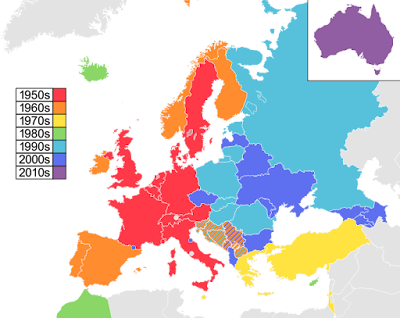
Why is Australia involved?  

How exactly do some of the most bizarre and seemingly awful songs win? 

And when can I next see Eurovision Song Contest: The Story of Fire Saga on the telly?**

To which out there are all the answers ranging from authoritative and scholarly works, TV documentaries, and the banal and crackpot conspiracy posts which wander across the internet.

All of which is a lead into another edition of the Reunion where Radio 4 bring together a group of people who remember an event from the past.

This week its all about Eurovision.

"Once a year, countries across Europe come together for a night of glittery madness known as the Eurovision Song Contest. Running since 1956, the song contest has evolved from a formal affair involving only seven countries into Europe's largest - and campest - election, all while weathering the tumultuous second half of the 20th century.

The early years of the contest laid the foundations for its modern iteration, and were integral to the careers of several stars. In this programme Kirsty Wark reunites Dana, Lulu, Phil Coulter, and Pete Murray, with help from historian Dean Vuletic.

The Club grows over the decades, 1950s in red


In the 1950s and 60s, Eurovision was populated by native language ballads and besuited diplomats - a far cry from the rock 'n' roll that was dominating the mainstream airwaves. Success at the contest, however, promised the possibility of fame and fortune across the continent.

Phil Coulter wrote the music for Puppet On A String, which became the UK's first winner in 1967, and Lulu built on an established career to win in a controversial four-way tie at the 1969 competition with Boom Bang a Bang. Dana was only 18 when she sang All Kinds of Everything, kicking off Ireland's legendary run of wins at the contest in 1970, and DJ Pete Murray was watching the action from the commentator's box throughout the period. Dean Vuletic provides a rare glimpse into the European Broadcasting Union's archives.

Ahead of this year's competition in Liverpool, our guests discuss the secret formulae of winning Eurovision entries, reflect on how contemporary politics produced voting scandals, and share stories from behind the scenes.

Producer: Rebecca Guthrie

Series Producer: David Prest

A Whistledown production for BBC Radio 4”

Picture; sheet music for the First Manchester March, date unknown from the collection of David Harrop, The Eurovision Club, This work has been released into the public domain by its author, Sims2aholic8 at English Wikipedia. This applies worldwide. Sims2aholic8 grants anyone the right to use this work for any purpose, without any conditions, unless such conditions are required by law.

*The Eurovision Song Contest, The Reunion, Radio 4, https://www.bbc.co.uk/programmes/m001lhzq

* Eurovision Song Contest: The Story of Fire Saga, a 2020 American musical comedy film directed by David Dobkin, written by Will Ferrell and Andrew Steele, and starring Will Ferrell, Rachel McAdams, Dan Stevens, Melissanthi Mahut, Mikael Persbrandt, Ólafur Darri Ólafsson, Graham Norton, Demi Lovato, and Pierce Brosnan. The film follows the personally close Icelandic singers Lars Erickssong and Sigrit Ericksdóttir as they are given the chance to represent their country at the Eurovision Song Contest, https://en.wikipedia.org/wiki/Eurovision_Song_Contest:_The_Story_of_Fire_Saga#:~:text=Eurovision%20Song%20Contest%3A%20The%20Story%20of%20Fire%20Saga%20is%20a,Demi%20Lovato%2C%20and%20Pierce%20Brosnan.


Tuesday, 2 May 2023

How we used to play ........... part 1 the roundabout ........

Now I have never been a fan of roundabouts.

So despite them making me feel ill, so many people like them that a new series has been born.

At first I was going to limit it to roundabouts, but I rather think it will be about all playground features, from the seesaw to the rocking horse and on to  the slide and the swing.

All were popular in the 1950s and into the 60s.

This is one of those very simple roundabouts which were still there in the 1984 in Longford Park.

The photograph was taken by David Dunnico and I like it, not least because it offers up that promise that playgrounds and the apparatus are not just for the young.

So, if there are people with pictures, or stories of the Corporation Rec and the things they played on .... just post them over.
You can see more of David's work at https://daviddunnico.wordpress.com/


Location; Longford Park

Picture; merry go round, Longford Park, 1984, from the collection of David Dunnico, https://daviddunnico.wordpress.com/

Monday, 1 May 2023

October 1980 …………

The early 1980s seemed a scary place.

The two Super Powers had decided that they didn’t like each other all over again, and to add to those tensions there were new nuclear weapons and delivery systems coming on line which were faster and not as easy to detect.

It was as if the Cold War had returned after a brief lull.

Of course, the threat of a nuclear confrontation had never gone away, we just tucked it away in a place where it could be forgotten.

But its return, prompted the British Government to issue a booklet on how to survive an attack, the membership of the Campaign for Nuclear Disarmament rose dramatically, and people took to the streets to protest.

Cynics and those who embraced the idea of nuclear weapons scoffed at the marches and demonstrations, while those who took part felt that they had to do and say something.

Which is why in the October of 1981 I was down at All Saints on a piece of empty land waiting for the march to set off.

And as many of us did I took a camera and recorded the event.  The pictures of that march and plenty of others have appeared on the blog over the years*, but I have always ignored these two.

Looking at them again, almost forty years, later they may appear a bit hammy, but back then they made the point, and in a very uncertain world with new conflicts breaking out across the planet,  I rather think they strike a chord, added to which they are a bit of our history.

Location; Manchester


Pictures; demonstration Manchester, October 1980, from the collection of Andrew Simpson


*Political Protest, https://chorltonhistory.blogspot.com/search/label/Political%20Protest


Looking through windows …….


Location; Beech Road, Chorlton


Pictures; Looking through windows, 2023, from the collection of Andrew Simpson