Sunday, 11 June 2023

The lost Eltham & Woolwich pictures ...... no.11 looking for the bargain

A short series on the pictures of Eltham and Woolwich in 1979.

For four decades the pictures I took of Eltham and Woolwich in the mid ‘70’s sat undisturbed in our cellar.

But all good things eventually come to light.

They were colour slides which have been transferred electronically.

The quality of the original lighting and the sharpness is sometimes iffy, but they are a record of a lost Eltham and Woolwich.

Location; Woolwich

Picture; Woolwich circa 1979, from the collection of Andrew Simpson

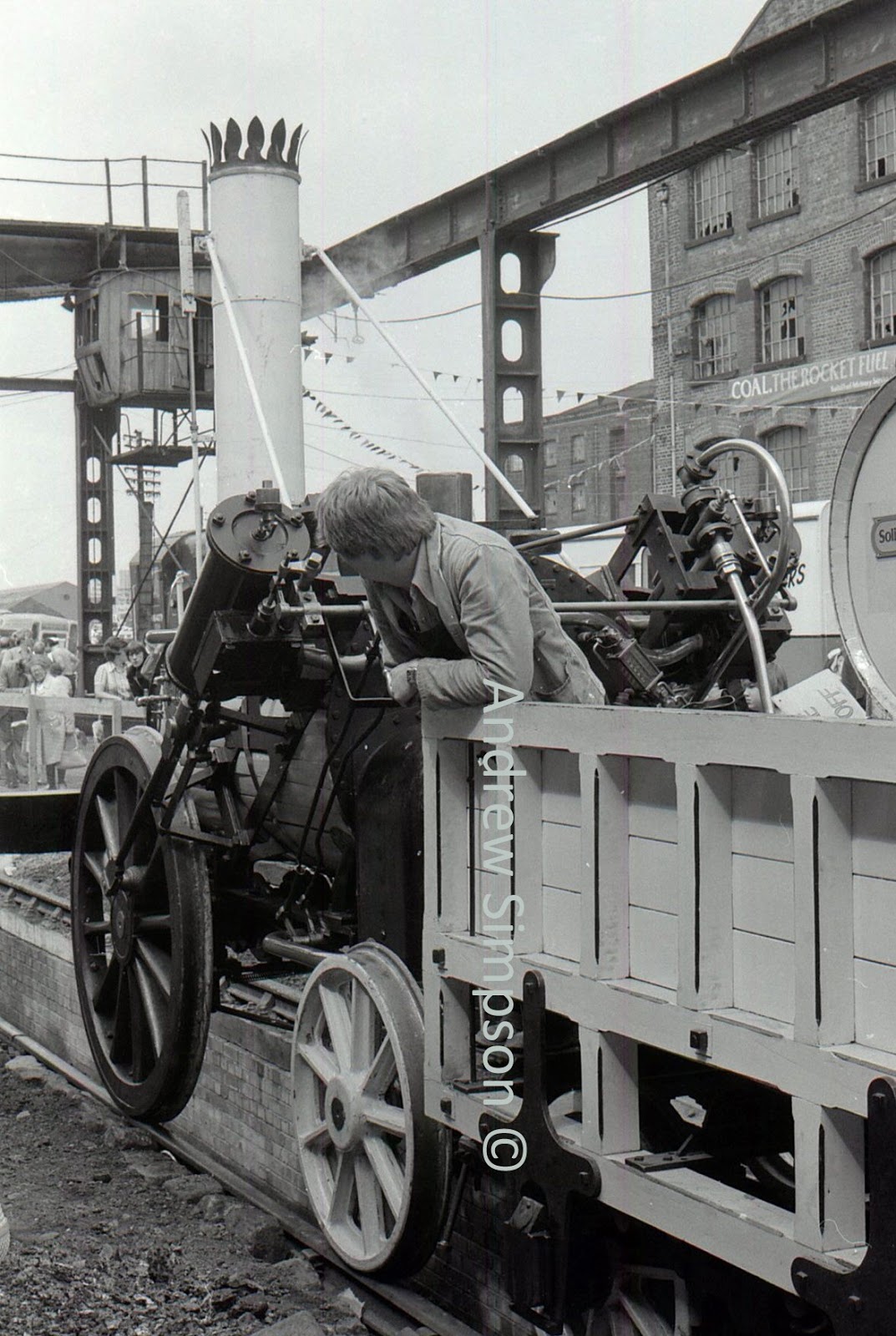
Travels with Friends ...... no.3 .... Mr Stephenson’s amazing locomotive

I say Mr Stephenson’s amazing locomotive, but it was of course a replica, but just as much fun.


Location; Manchester

Picture; Steam Expo, Manchester 1981, from the collection of Andrew Simpson

Saturday, 10 June 2023

A little of steam history ....... down at Liverpool Road in 1980

Looking towards Byrom Street, 1980
Now when I took these pictures back in the summer of 1980 I was not aware of the significance of that day.

I was down on Liverpool Road and the old goods yard had been thrown open to the public who piled in to view a collection of steam locomotives in what had once been the Liverpool Road Railway Station which was the first passenger railway station in the world.

It had opened in 1830, connecting Manchester to Liverpool and was an overnight success.  So much so that by 1844 the passenger part of the business was relocated to a new station at Hunts Bank and the Liverpool Road site was given over entirely to goods.

And this is what it remained till it closure and eventual conversion into the museum.
At the time I wasn’t aware of this long history or that I would in the fullness of time come to use the place as part of a series of examination courses stretching from 1986 through into the 2000’s.

Inside the warehouse, 1980
Over those decades the site has been transformed with some sensitive restoration and in places a bit of brutal butchery.  Part of the 1830 warehouse, opposite the station was gutted in the 1980s and many of the features lost forever, while all of the old manual turn tables for turning wagons have now also been lost.

The other end of the 1830 warehouse was carefully restored allowing visitors an opportunity to see what such a building would have looked like.

But in 1980, all of that was in the future.  In the company of hundreds of others I wandered over the site and the pictures I took reveal the place pretty much as British Rail had left it.

So looking up towards Lower Byrom Street at the replica locomotive, you can see the timber gates which once given access to the road, and have now been replaced by the entrance lodge, a set of metal gates and a brick addition to what is now the Power Hall.

The Power House, 2008
And the Power House with its mix of moving and fixed steam machinery was once just a cavernous space with cast iron pillars supporting a timber roof.

In 1980 crowds of enthusiasts along with curious wandered through the building admiring the steam locomotives.

Today, people who were also there have shared their pictures if the site later in the .onth I will preview some of them.

Location; the Liverpool Road Railway Station

Pictures; August 4, 1980, down with the steam, and in 2008, from the collection of Andrew Simpson


Friday, 9 June 2023

Walk the history of Chorlton Park ……… on June 24th at 2pm

 I maintain and I maintain most strongly that all parks should have their story recorded for all to know.

The mystery of the park, 2020

And so, on June 24th at the invitation of the Friends ofChorlton Park we will be taking a gentle stroll through its history.*

The ramble will start at Brookfield House that white building at the Nell Lane entrance and during the hour from 2pm we will explore the park’s past.

Looking at the park from the air, and clocking historic features, 2023
Now there will be plenty who remember the paddling pool, and the pets’ corner, but few who now know that beside the paddling pool there was a large open air swimming bath, a band stand with a covered seating area, and that during the last world war the park had its own air raid shelters.

Added to that the historic records suggest there was a racecourse and an observatory, which fit nicely with stories of Brookfield House, which dates back into the 18th century, and was once home to the son of Francis Deakin who had been brutally murdered in a beer house on Manchester Road in 1847.

Brookfield Park and the fields, 1853
And if you had strolled along Barlow Moor Road back in the 1840s, and looked out across what is now the park you might have been able to make out the ponds close to Brookfield House and perhaps even had conversations with the agricultural labourers working on the fields which had names like Pit Croft, Long Croft, Great Field, and Scaffold Field.

I doubt we will ever know the names of those farm workers, but I do know that the fields were owned by William Jackson, and that just across Nell Lane was Henry Jackson who lived in Hough End Hall and farmed 250 acres stretching back from the Hall across Withington.

All of which places the park and its surroundings in an agricultural context where tenant farmers, and market gardeners grew crops to supply the Manchester markets in the 1840s and 50s.

Brookfield House, circa 1900
Their lives will feature during our walk, along with that of John Stanway who lived in Brookfield House in the June of 1841 and was an accountant. He may also have been the same Mr. Stanway who was found not guilty of “Conspiracy to defraud” along with a William Jackson and a William Froggall in the December of that year.

And not to be shortchanged there will be plenty about the paddling pool, pets’ corner, the large open air swimming bath, the band stand with its covered seating area, and those air raid shelters, along with that racecourse and observatory.

Leaving me just to thank the Friends of Chorlton Park and to suggest the following reading material for those who want to know a bit before they arrive.

Paddling in the pool, circa 1930s
The list includes the stories from the blog** and the chapter in The Quirks of Chorlton-cum-Hardy, 2018, Andrew Simpson and Peter Topping which is available from Chorlton Bookshop or us at  www.pubbooks.co.uk.

So meet us at Brookfield House  that white building at the Nell Lane entrance at 2 pm for a walk through the past which should last ah hour.

 And for those who want more, the Friends of Chorlton Park have made the invitation  as part of Chorlton Open Gardens and  will be fundraising for the charity Freedom from Torture.

Location; Chorlton Park

Pictures; Chorlton Park 2020, from the collection of Andrew Simpson, Chorlton Park 2023, showing historic features, courtesy of Google Maps, Chorlton Park, 1853, ,from the 1853 OS for Lancashire, courtesy of Digital Archives Association, http://www.digitalarchives.co.uk Brookfield House circa 1900, and the paddling pool circa 1930s, from a series of picture postcards produced by Harold Arthur Clarke  from the Lloyd Collection

 *The Friends of Chorlton Park, https://www.facebook.com/groups/CholtonPark

**Chorlton Park, https://chorltonhistory.blogspot.com/search/label/Chorlton%20Park

Wendy houses …… and a bit of social history

Today I leave myself open for a bit of ridicule and perhaps worse, but I can think of no better way to learn about our recent past than to wander around those pretend show rooms.


They offer you a vision of what your home would look like if you bought a heap of furniture, decorative kitchen utensils and that thing you can use to extract the core from an apple.

I wish I had kept all my old Habitat catalogues from the late 1960s and 70s, because at a glance they tell the story of what we thought were new, chic, and must have items.

I say we, but of course it was the designers and the companies who did the thinking and us, or at least me who did the buying and then tried fitting them into rooms full of hand me down furniture.

And in the same way I suspect the latest offerings will provide future historians much to write about.

But I wonder if they will be kind about the orange and brown 70s colour schemes and the uncomfortable chairs which were suspended from the ceiling along with bean bags and wine carafes.

Leaving me just to appeal for old Habitat catalogues.

Location; the past

Picture; John Lewis showrooms, Cheadle Royal, 2023, from the collection of Andrew Simpson

Thursday, 8 June 2023

So goodbye and thanks for those Art Nouveau church windows* …… or a little bit of Didsbury’s finest

I have never visited St. Aidan’s Presbyterian Church on Palatine Road and now I doubt I ever will.

It closes for good in late June after a decision by the congregation to merge with Christ Church South Manchester on Parrs Wood Road. **

And that means I will never get to see its stunning Art Nouveau windows which my friend Phil Portus tells me were by Walter Pearce who once lived on Lansdown Road in West Didsbury.

His is a fascinating story which involved the death of his parents when he was just ten, followed by a succession of institutions where he grew up, culminating with an apprenticeship as a painter and decorator.

After a spell working for different firms, he set up on his own and by 1899 described himself as a Stained Glass Artist.  

The year before he had begun teaching painting and decorating at the Manchester Municipal School of Technology and published “’Painting and Decorating’ which became the standard text book, running to seven editions”.*** 

At this point if you want more follow the link to the article in Architects of Greater Manchester.

And never one to steal other’s research rather than describe the windows which he created in 1901 for the church I suggest you go to the Didsbury United Reformed Churches site and read the history along with some pictures of those windows.


For now, I will thank Phil for alerting me to both the windows and the closure as well as his own fine pictures of Mr. Pearce’s work.

And perhaps all is not lost as the congregation comments, "The  church building is Grade 2 listed having some beautiful stained glass windows so when the church is able to re-open we hope you will come to see them".

I hope so.

Location; Palatine Road, Didsbury

Pictures; courtesy of Phil Portus, 2023

*With apologies to Douglas Adams and his wonderful book So long, thanks for all the fish, 1984

**Didsbury United Reform Church,  https://didsburyurc.org.uk/

***Walter John Pearce, Architects of Greater Manchester, https://manchestervictorianarchitects.org.uk/index.php/architects/walter-j-pearce

****Didsbury United Reform Church, About Us, https://didsburyurc.org.uk/about-2/

Wednesday, 7 June 2023

Posters from the Past ........... no 4 a book opens the world

Now the series Posters from the Past has arrived in Eltham, and where better to settle than outside our Library.

It was built in 1906 and many of us will have fond memories of the place.

Our Stella worked there in the 1970s and ‘80s, and a decade earlier I sat in its Reference Library and was also a regular visitor to its music section while Jean regularly reminisces about her time there.

All of which means the Library is a perfect candidate for the new series which takes iconic buildings we know and love and offers them up again in the style of a poster from the mid 20th century.

I would like to think that Woolwich Borough Council commissioned one of their team to produce a poster sometime in the 1930s or 40s, but in the absence of one, here is Peter’s painting and my caption, with our version.

Poster; Eltham Library, © 2017 Peter Topping
Web: www.paintingsfrompictures.co.uk

Facebook: www.facebook.com/paintingsfrompictures

*Posters from the Past,   https://chorltonhistory.blogspot.co.uk/search/label/Posters%20from%20the%20Past