Monday, 12 February 2018

Piccadilly Gardens .... the easy target

Now if there is anything I have learnt from the last six and bit years of doing the blog is that Piccadilly Gardens is an easy target.

Put up a picture of what it once looked like or as today what it has become and you can be guaranteed a shed load of comments.

Most like me will remember the old sunken garden with affection.  In my case I came to the place quite late, having only washed up in the city in 1969.

But on warm autumnal days, and better still in high summer it was a magic.
There were always a few people sitting on the benches, which as it got round to midday became a host, from office workers on their break, to shoppers talking a rest from parading up down Market Street and Oldham Street, and of course in the holidays a gaggle of kids.

For me it was usually just before noon on the day when the Evening News ran its property page with flats and bedsits advertised to rent.

The gardens were just a short walk from the College of Commerce and were surrounded by telephone boxes.

So after buying the first edition of the papers, scouring the suitable “lets” it was into a telephone box only to be met with and engaged signal or that at just twenty minutes past twelve the flat had been taken.

Years later I used the Gardens only as a cut through and like many saw they deteriorate and like many I wasn’t convinced at the makeover.

The brutalist concrete wall was and is brutal, the lawn still seems to get waterlogged and there is little protection from the wind.

True is an open space which fits with the economies of the day when the Corporation is cash stripped and a decision to provide a care home takes precedence over employing a team of gardeners.

Nor should we forget that for a chunk of the early 20th century the area remained an open wasteland with people being unable to agree on its future after the demolition of the hospital.

There were plans for an art gallery and other “things” before we got the sunken garden.

At which point I could have just fallen back on an old picture postcard of what it was, but instead have settled for these three taken by Andy Robertson o Saturday, and as the instructions say I shall “stand well back”, and wait for the response.

Location; Manchester

Pictures; Piccadilly Gardens, 2018 from the collection of Andy Robertson

The Lost Red Cross Hospitals of Whalley Range

Patients and Red Cross VADs in a hospital in France
There were at least five of them ranging from private homes given over to the needs of war to theological colleges with room to spare.

Some across the border in Chorlton and Didsbury have been documented, but in the case of Whalley Range there is just a list in a Red Cross file and the occasional newspaper report.*

The Lancashire Independent College along with the Hartley Primitive Methodist College on Alexandra Road offered their dormitories as hospital wards.

But then there were the private homes which have been less easy to locate and a military HQ.

Burford Road in 1894
Of these there was Sunnyside on Range Road, numbers 1 & 3 Burford Road and Lancaster House.

Sunnyside still exits and is a tall semi detached house on the north side of Range Road.

In 1911 its occupant a Mr Henry Cartledge described it as having nine rooms with a longish garden which backed on to the properties fronting Yardburgh Street.

And that pretty much is all there is.  A newspaper report referred to it as the Britannia Hospital but places it on Withington Road which joins Range Road.

It was a small hospital accommodating just thirty-three beds and in 1917 the Red Cross decided to close it and transfer its patients to the Wesleyan College in Didsbury site which was to increase its capacity to 250 beds.

The houses on Burford Road are equally still shrouded in mystery.  In 1911 number three was home to Mr and Mrs Gamble and their three daughters and a servant.

It too had nine rooms and was one of two semi detached properties on the corner of Burford and Withington Road. Two years earlier, number one known as Burford House was the residence of Edward R Buck, manufacturer and number three, the Falklands   was occupied by A Mrs Hester.

Lancaster House, Whalley Road, 1961
But 1911 number one was vacant and in the way of these things perhaps number three was also empty by the outbreak of the war.

Already the Corporation had had plans to buy the 14 roomed properties known as the Alders just a little further along Burford Road and is it as preparatory school for Whalley Range High School for Girls.

Lancaster House on Whalley Road was already a military establishment being the HQ of C Squadron of the Imperial Yeomanry, continuing to serve the army well into the mid 20th century.

Now the existence of all these Red Cross Voluntary Hospitals across south Manchester has pretty much been forgotten which is a shame really, given the good they did and the work on the people of Whalley range, Chorlton, and Didsbury who staffed them  and raised money for them.

*The McLaren Memorial Baptist Church Edge Lane, Chorlton, The Wesleyan Church, Manchester Road, Chorlton, , The Wesleyan College, Wilmslow Road, Didsbury, Woodlawn, Mersey Road, Didsbury.

Pictures; Patients & Red Cross VADs in a hospital at Gournay, France, 1916, courtesy of the Red Cross, detail from the OS map of South Lancashire, courtesy of Digital Archives, Association, http://www.digitalarchives.co.uk/ and Lancaster House, Whalley Road, 1961, by A.E.Brown, m40912, courtesy of Manchester Libraries, Information and Archives, Manchester City Council

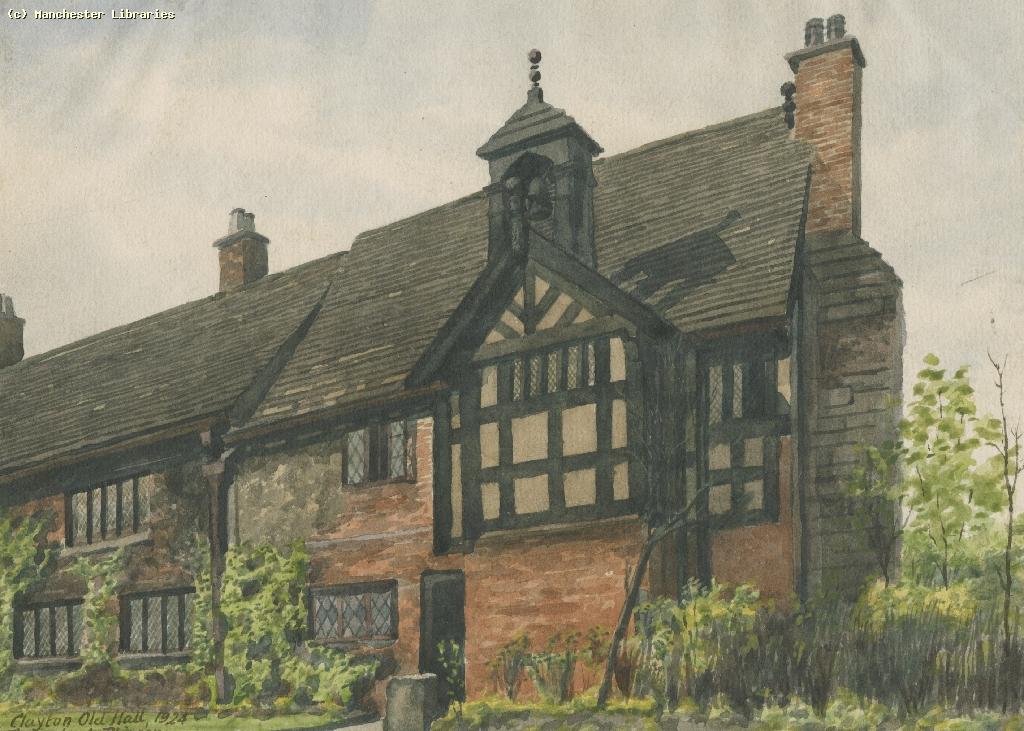
The Clayton Hall stories ....... no 2 “the gem in the east”

Now if you ever plan to motor east, travel my way on the route that’s the best ...... all the way from Piccadilly to Clayton.

The Hall in 1924
Well I know that it is never going to make a line to a song, but for those who haven’t taken the bus or better still the tram from town to Clayton you are indeed missing something, because there at the end of the journey is that gem of the east which is Clayton Hall.

I wrote about it yesterday and today there is more.

My old facebook friend Kay Simcocx tells me that “the hall is open on the first and third Saturday of each month 11am-4pm, is free to visits and there are history talks at 12 and 2.

The tea room serves home-made soup and cakes  and gluten free can be made available, if notified in advance. 

We also have a Memory Lane cafe on the first Monday of each month, from 10am-12:30pm which is also free to attend.

Visitors can chat and reminisce, and bring along their photos, newspaper cuttings or memorabilia to share and we have our Memories room and Clayton Hall/ Local History room open.


The Hall in 1944
More info can be obtained by messaging me on the Clayton Hall Fb page, or emailing Lynn via info@claytonhall.org

Group visits can be booked for a minimum of 10 people. 

We are happy to arrange a date and time on days or evenings when we are not already open to the public. 

The same applies for school visits. Information and bookings via info@claytonhall.com

We also offer history talks at clubs etc. which includes a slideshow presented by Beryl Poole.”

There is a metro stop directly opposite, which means there is no excuse for not travelling east to the hall they call a gem.

Location Clayton

Pictures; the hall in 1924 from a water colour E A Phipson, m80216 and in 1944 from the City Engineers Department, m78904, courtesy of Manchester Libraries, Information and Archives, Manchester City Council, http://images.manchester.gov.uk/index.php?session=pass

Sunday, 11 February 2018

The Clayton Hall stories ...... no. 1 the kitchen range

I last went to Clayton Hall sometime in the 1970s when were living in Ashton Under-Lyne and depending on the bus we took from Manchester would pass the place.

But now since it has reopened I have every reason to return, especially as it’s directly opposite a tram stop and I do love travelling on the tram.

Added to this my friend, Kay, who is one of the team responsible for the museum inside Clayton Hall has sent over some fabulous pictures of the restored kitchen range.

She told me that “here is the range that we bought off eBay when we were setting up the museum. It came from Wales, in pieces, without instructions.

My mum, Lynn, and another co-founder, Shirl, managed to install it, after a couple of tries and a bit of head-scratching.

The pictures show i with a new mantelpiece, really looking the part. 

You can see the slop stone on the right. The ironing board was donated by my neighbour. It had layers and layers of padding and an asbestos mat. 

Another fix-up job and it does the job nicely. The little maid was donated by me and is my daughter.

The original team included Kay Simcox, her friend Lynn  Blinkhorn and Shirley Hughes, Pauline Owen and Alma Smith, who sadly died.  We five co-founded the museum and did most of the work ourselves”.

Now that has to be a good story, and will be followed by more.
Clayton Hall is in the east of the city, and is directly opposite the Clayton Hall metro stop.

More info can be obtained by messaging Kay on the Clayton Hall Fb page, or emailing Lynn via info@claytonhall.org

Location; Clayton Hall

Pictures; courtesy of Kay Simcox 


Saturday, 10 February 2018

Welcome home Lois

Now the blog rarely does personal messages, but as my friend Lois prepares for a night at the Apollo with the Mavericks I just thought I would say hello.


Lois will no doubt be gazing down on the city from the 14th floor of her hotel and getting ready to meet up with us.

I first met Lois in 1969 when we were students at the old College of Commerce on Aytoun Street.

Yesterday she and her daughter, Madeline took a wander around the city at night , and today me and Tina will join them.

Despite a wet miserable day I am guessing there will be much to see and lots to catch up on.

And her challenge should she choose to accept, is to name all the places, and in the space of the time it takes us to meet up, get a picture of all three and post to social media, with a suitable caption.

No pressure, then, of course her breakfast chums and Madeline are allowed to help.

But not Eric at the breakfast bar.

Location; Manchester, 1969-2017

Pictures; from the collection of Andrew Simpson

The ghost sign waiting to be remembered

Now I don’t remember Lennards but someone will.

They may have closed before I arrived in the city in 1969 or more likely I just never noticed them.

Back then I didn’t tend to go down Oldham Street and rarely looked up at buildings.

But Andy Robertson who took the pictures on an adventure in the Northern Quarter may well have the answer.

He possess the 1969 street directory which lists who resided everywhere in the Twin Cities and I am guessing it will be in there.

Sadly it doesn’t feature in Pevsner, that guide to all things architectural in Manchester which is shame.*

But someone will and quick as a flash will give me its history.

I hope so.

And quick as a flash Bill's wife thinks it was a gentlemen's outfitters, and Andy confirmed it had gone by 1969, leaving just Ted to nail the story with, "It was the Public Benefit Boot Company. Lennards Brothers from Leicester were involved".

Of course I now shall go looking from them, so as they say .... watch this spot.

Location; Oldham Street

Picture; on Oldham Street, 2018 from the collection of Andy Robertson

*Manchester, Clare Hartwell, 2001, Pevsner Architectural Guides

Friday, 9 February 2018

A National Day for British Home Children

Now the news is just filtering through over here of the vote in the Canadian House of Commons to set a side a National Day in September to remember those  British Home Children who are still living and  the descendants of these 100,000 individuals who were shipped from Great Britain to Canada between 1869 and 1948 and i made me reflect again on the official apologies for the policy.

Report on Roger Hall 1914 ......our BHC
They are all  long overdue.

But that is a churlish response to what is a most important recognition of the countless broken lives and awful stories which followed from that migration.

All the more so because living in Britain I was unable to sign the petition calling for that apology from the Canadian Government but as a descendant of a BHC I am so very pleased, and appreciate the hard work that went into the campaign.

St John's River, NB, 2008, along way from Derby
It made me reflect on a story I posted in 2012 soon after discovering that one of my great uncles was a British Home Child.

At the time I reflected, that I had “mixed feelings about the need for Governments to apologise for acts done in their name or on their watch when those events have long since passed from living memory.

The opponents of such apologies tend to distort the argument by citing ancient acts of wrong doing from Herod’s massacre of the Innocents to the murder of the small Jewish community in York in 1190. 

William Henry Hall, circa 1930s
Who after all could be held responsible? Not only is there no one who could in anyway be linked to such acts but the very systems of government around at the time have long since vanished.

More recent crimes are no less easy to deal with. In most cases successor Governments had nothing to do with those past events and apologies do not allow those who suffered to escape from being seen as victims. 

How much better then to follow the South African policy of truth and reconciliation which has been a brave 
way of coming to terms with the years of oppression and apartheid. 

But I think this is to miss the point. It is not so much about saying sorry as allowing those who suffered to feel that their lives and experiences were important and deserve more than a footnote in a history book.”

Laura Isadore Pember, nee Hall, 1968

That is why I was pleased that the British and Australian Governments and now the Canadian  House of Commons have apologised for the way that thousands of our children were taken from Britain and placed in Canada and Australia.

Many may have had better lives as a result and made great contributions to their adopted countries, but few had much say in what happened to them. They paid the price for the fact that the biggest and richest world empire could not look after them, and chose instead to let a group of individuals and organisations solve the problem of child poverty by taking them elsewhere.

Now the same people who oppose such apologies will argue that it was a different time and under different rules, except there were plenty of people at the time from socialists and trade unionists to middle class reformers who criticised the way capitalism tolerated such poverty as an essential part of the system.

John  Hall, date unknown
Sadly for my great uncle and most of the children shifted off to Canada it is all too late. The last that went across in the 1940s will be very old. Most of them never talked about their lives as British Home Children and so the stories of who they were, how they got to Canada and their early childhood experiences are in danger of being lost.

Some of us have begun to do our own personal research and storytelling. In my case I have been helped by the growing network of others doing the same thing, and by the Library and Archive of Canada, as well people over here.

Along the way BHC has become a legitimate area of historical research and the apology is another step to a greater understanding of what happened.

So, not that they need me to say so, but well done to the Canadian House of Commons.

And while we have no photographs of our BHC we do have image of his three siblings which will always be as close as we will get.

Location; Canada, Britain & Australia

Pictures; from the collection of Andrew Simpson and the Pember family