Showing posts sorted by relevance for query The Welcome Inn. Sort by date Show all posts

Saturday, 25 October 2014

Who laments the passing of the Castle, the Welcome Inn and many more Eltham pubs?

The Rising Sun
If there was one certainty after death and taxes it was that almost everywhere would have a pub.

They might be those old comfortable and picturesque places hard by the village green steeped in history and beer where countless generations of farm labourers had sat and drank or those tall brick built Victorian public houses, all gleaming with brass and frosted glass.

In between there were the small beer houses made possible by the 1830 Beer Act which for the cost a small license allowed the publican to brew and sell his or her own beer often from the back room of the family home.

And finally there were the gin palaces, some trading elaborate settings along with the gin others no better than a dive where in Hogarth’s words you could get drunk for a penny, blind drunk for tupence and  the straw on the floor was free for those who fell down and slept the sleep of the drunk.

When I was growing up and the slum clearances were wiping away a century of poor housing it always seemed that the pub on the corner was the last building to go.  Even now long after most of the warehouses and factories along with the dwelling houses have vanished the pub still clings on.

But even these are vanishing like snow in the full glare of the winter snow.  The Pomona Palace on Runcorn Street facing Chester Road was one of the last on this stretch into town and now it has shut up shop.

I always had a fond spot for this pub whose name echoed the big Pomona Gardens which along with Bell Vue were for a big chunk of the 19th century where you went to enjoy the scenery but above all the variety acts, the fireworks and the special exhibitions.

The King's Arms
And just as the Gardens have gone more and more of the pubs be they on village greens with centuries of history or their Victorian city equivalents are losing the battle to survive.

In Eltham I remember the King’s Arms, the Castle, and out on the edges of Well Hall the Welcome Inn and even further away the Yorkshire Grey and the Dover Patrol.  All now gone and with them I bet many powerful memories from those who frequented them.

I suppose the Castle and the King’s Arms hadn’t that much going for them.  They were new build replacing much older venues with long histories but I did enjoy going to them.

The other three I thought would fare better, after all each was a lonely out post surrounded by residential properties with little else on offer.

But I guess the economics comes into play.  The bigger pubs especially those built to cater for coaching parties or people with cars are just not viable any more.  The coach parties have slowly dwindled and no one quite rightly will consider drinking and driving.

The Castle
Some lingered on as venues for variety acts offering big names at reasonable prices.  But that too has all but come to an end and with it the regular live acts which gave young comedians and musicians a place to play.

Here in Chorlton for the price a cheap bus ticket or even just a 15 minute walk it was possible to be entertained by some of the greats of show biz.

And I rather think the Welcome Inn and the Yorkshire Grey may have hosted more moderate entertainment.

Sitting at home with the chilled dry white, that cheeky but fruity red or the selection of fine organic beers and ciders is all very well but even on a wet February evening I still sometimes miss the call of last orders, and the happy walk home reflecting on the conversation of friends.

Which I suspect is fast turning into sentimental tosh so better just leave it with the thought that at least at home I am not told to drink up.

Pictures; from the collection of Jean Gammons

Wednesday, 14 January 2026

The Welcome Inn ................... the early days

Now some stories just have a habit of not wanting to go away.

They stay hanging around challenging you to go off and discover something new to add to what has already been said.

And so it is with the Welcome Inn which every time I feature the pub strikes a chord with many people usually about my age.

In particular it is tales of Sunday nights which continue to bubble up enriched by the memories of meeting future husbands or lasting friends.

And I should know because while I was just that bit too young to drink I would listen to the happy crowds coming back down Well Hall Road past our house in the mid 60s a little after closing time.

More recently I began looking for the history of the place, and while a few people were able to offer up names of past landlords the very early history of the pub proved illusory.

And then my old friend, fellow researcher and local historian Tricia Leslie told me about The Woolwich Story by E.F. E. Jefferson.

It is as she promised me a wonderful account of the Borough from the earliest of times up to its merger with Greenwich.

I have already used the book and know I shall go on plundering it for some time to come.

So in the chapter on the 1920s I came across this “On the brow of the hill stood a large wooden building used as a workmen’s club but demolished about 1927 when the Welcome Inn was built.  

This modern hostelry set new standards in both furnishing and service.  Seated in comfort, one had to preserve patience until the waiter came to take the order, for customers were not permitted to get their own drinks at the bar. 


But this arrangement proved too leisurely, annoyed those who only had time for a quick one and tended generally toward the restraint of trade. A wise host discontinued the practice.”

Now I have no idea when that service was discontinued but I well remember the practice was still in use in some of the big Manchester pubs in the late 1960s, with the waiters in white jackets and in some rooms a bell push to summon assistance.

Sadly there are few photographs of the waiters or indeed the interiors and it would be nice if any could be shared of the Welcome in its heyday.

So that is it.  I now know when the pub was open which was clearly aimed at the Progress Estate and the new build going up behind the pub and the appeal is out for pictures.

We shall see what we get.

But in the meantime I shall go looking at the electoral registers which will give us the names of the landlords or landladies from when it opened through to the 1960s.

Location, Eltham

Picture; the site of the Welcome courtesy of Jean and the cover of The Woolwich Story

Sunday, 11 April 2021

No one told me they were knocking down the Welcome Inn

True I was living in Manchester at the time and it was June 2006, but even so this place was part of my childhood, along with many others from Well Hall.

It is a pub I have written about already, particularly in a story exploring its history.*

And it was the first pub you spotted on the 161 coming in from Woolwich and after a long walk in the woods might well be the place to slack your thirst.

I first went in aged 17, pretending to be 18, and I guess because it was a quiet Wednesday afternoon we got away with it.

Today I shudder at the consequence for the landlord if we had been discovered by the police.

It was also where I first saw colour TV, in BBC 2, in the summer of 1968 when Wimbledon was being shown as a preview of what was to come.

But above all it will be of sitting in my bedroom late on a Sunday evening listening to the crowds walking back down Well Hall from the Welcome.

With the windows open on a warm summer’s night and the thought of school in the morning there was something very attractive about the happy groups making their noisy way home past our house at 294.

So I was pleased when John King posted these of the pub from June 2 2006.

His collection of images of south east London from the 1960s till now, continue to fascinate me and as ever I am indebted to him for granting permission to use them.

Location; Well Hall Road


Pictures; demolishing the Welcome Inn, June 2, 2006 from the collection of John King

*The Welcome Inn ................... the early days, https://chorltonhistory.blogspot.com/search?q=The+Welcome+Inn

Tuesday, 4 November 2025

Walks I wish I could have taken, ...... up Liverpool Road towards Deansgate in the spring of 1849

The station and staiton master's house

We are on Liverpool Road just a little under twenty years after the opening of the Manchester terminus of the Liverpool and Manchester Railway.

The station and its warehouse had been opened in 1830 and so successful had the venture been that two new warehouses were added very quickly followed by a second platform to accommodate the increased number of trains, and just fourteen years after its grand start all passengers operations were moved to a bigger and grander station at Hunts Bank.

There had been high hopes in the last decades of the 18th century that the area could be developed into an estate of fine houses like those on St John’s Street but the proposed plans to bring a railway into Manchester had pretty much scuppered that idea.

Instead the land from the Duke’s Canal at Castlefield, north to St John’s Church and east towards Deansgate was filled with more modest houses which were the homes of craftsmen, textile workers, warehouseman and a whole range of lesser occupations. 

The station master's house
Many of which were dependant on the collection of warehouses, timber yards, and coal sites which served the network of canals and now the railways.

The Duke's Canal which had come into the city in the 1760s was but the first of more canals, while our rail terminus was soon joined by the viaducts of the Manchester South Junction and Altrincham Railway which cut through the southern edge of the city.

So in 1849 this spot at the bottom of Liverpool Road may not have offered green fields and scenic views, but it was a place that many visitors would have flocked to because here like the cotton mills was what was making Manchester a new and different type of city. As the German Johann George Kohl wrote

“I know of no town in Great Britain, except London, which makes so deep an impression upon the stranger as Manchester.  London is alone of its kind and so is Manchester.  Never since the world began, was there a town like it, its outward appearance, it’s wonderful activity its mercantile and manufacturing prosperity, and its remarkable moral and political phenomena......”*

The entrance of the first class booking hall
And had he stood at the bottom of Liverpool Road looking up towards Deansgate this frenetic industrial landscape is what he would have seen.  Almost directly behind him was a dye works and just over the river the Regent Bridge Mill while just out of site behind the viaduct was the Elm Street Paper Mill and in all directions were  those timber yards, warehouses and coal yards.

So we shall accompany our visitor up Liverpool Road past what had once been the station entrance for first and second class passengers and was now the company’s offices.  And with a bit of luck we could get a glimpse at the three warehouses of which the first held corn, groceries and butter and the remaining two are given over to cotton. 

Here there is that smell of locomotives which is a mix of steam and oil along with the distinctive clunk of railway wagons being uncoupled and manually pushed into the warehouse on turntables. 

The station and warehouse complex, 1842
Each wagon can be unloaded beside the warehouse but the company had copied the design of the canal warehouse which allowed a boat to go into the building.  

Now this presented a problem because a railway track is not a canal and so getting the wagon into the warehouse involves uncoupling each wagon and turning it at right angles and pushing it in.

But enough of such industrial detail for just beyond this spot was the Oxnoble Inn so named after a type of potato landed at Potato Wharf and a reminder of the amount of agricultural produce that came in the Duke’s Canal.

But if you didn’t fancy the Oxnoble there are three others to chose from, starting with the Queens, Arms, the Railway and Quay Tavern and finishing with the White Lion. And if that was not enough you can throw in seven beer shops which means that a quarter of the shops along our route are given over to alcohol.

That does still leave plenty of grocers, a butcher’s, a druggist, a baker and a large number of furniture shops.  Less welcome are the fish stalls at the top of the road where it joins Deansgate.  The smell is pretty intolerable and has led to the residents’ complaining to the authorities who accept there is a problem but are not prepared to clear them away and lose the revenue that come from the stalls.**

St Matthew's 1850 from the front
On a more pleasant note there is the fine looking Sunday School sandwiched between Wellington Place and Duke Street.  

The entrance is on Liverpool Road but I rather like the rear with its rounded wall.  It was built with money voted by the Government to celebrate the victory at Waterloo and is the Sunday school for St Matthews Church which a little further up the road.

It is built in the modern Gothic style of architecture and according to one guide book “when viewed from the large open space in front has a very elegant appearance.  

The height from the ground to the top spire is 132 feet [and] the west gallery contains a fine organ by Nicholson of Rochdale and the choral service is performed here on Sundays, at half past ten and half past six.”****

All of which is fine but does not hide the fact that just beyond the church in the area known as the Haymarket was what one report described “as a great nuisance [which] at certain times  bears all the appearances of a public privy rendering access to the Church yard & Vestry  from the quarter altogether impossible.   

Looking up Tonman Street with the shambles ahead
Filth seems to have a magnetic attraction hence the whole eastern boundary of the Churchyard as well as the yard itself as far as practicable is the depot of all sorts of refuse from dead rats to decayed cabbage leaves.” 

Which “in the course of years, this open space having never been paved, its level has risen to the top of the stone parapet on which the iron palisading of St. Matthew’s church yard is fixed some 18’’ or more perhaps above the original level.  

To secure access to the Churchyard and through this east gate a sufficient space has been kept clear by propping up the surrounding accumulations with wood.”

Now that I suspect is not the sort of attraction Mr Kohl would have reported with enthusiasm, and I think it a good place to stop the walk.

The church, hay market, shambles and pubs
If we did walk on past the church and the Haymarket along Tonman Street ahead of us would have been the Alport Shambles which was also known as the Butcher's Market.  

It is there just behind St Matthews and the tall chimney may well be part of it.  

I suspect our residents would have been no happier about that place. 

Not that Ebenezer Heap of the Saint Matthew's Tavern or his fellow landlord, James Crowther of the Haymarket Inn would complain over much for long hours in the shambles meant thirtsty customers in their repective pubs.  

Something which may have also been why Mary Morrell opened her beer shop next to to the Haymarket at number one Tonman Street.

So I rather think we shall retrace our steps and look again at St Matthews Sunday school, which was opened in 1827, with its fine entrance facing Liverpool Road and the elegant mock battlements running down each side.


Next; on to Camp Street and its mean secrets, St John Street with its posh houses, and the search for the home of Cholera victims

Pictures; The former station on Liverpool Road, S. Langton, 1860, m62891, St Matthews’s Church, 1850, m71038, courtesy of Manchester Libraries, Information and Archives, Manchester City Council, Liverpool Road from the OS map of Manchester and Salford, 1842-49, courtesy of Digital Archives, http://www.digitalarchives.co.uk/

*Johann George Kohl, “Journeys Through England & Wales 1844, quoted from Visitors to Manchester, complied by L.D. Bradshaw, 1987, Neil Richardson
** Manchester and Salford Sanitary Association, Deansgate District, Report of the Visiting Committee 1853, Appendix A.
***The Strangers Guide to Manchester, H.G.Duffield, 1858
****ibid Manchester and Salford Sanitary Association,

Sunday, 2 October 2016

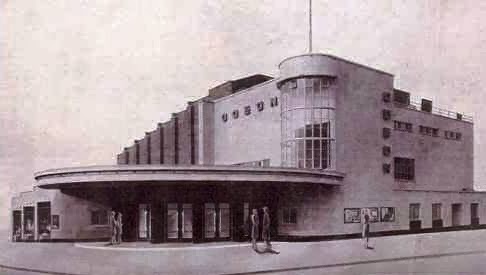
What should we do with the old buildings of Eltham?

The Well Hall Odeon in 1936
It is 80 years since the Well Hall Odeon opened and maybe 48 years since I last saw a film there.

And for a long time the place has sat empty and forlorn with an uncertain future.

It was the boldest of our cinemas, grander than the ABC in the High Street and more fun to be in than that other one on the hill.

Now I know some people are less than pleased with its current use and this does raise that interesting debate about what should happen to an old and much loved building.

Ideally of course it should continue doing what it did but that isn’t always an option.

Our own old school house on the village green languished empty for years before a property developer transformed into four homes, and across the city textile mills with a history dating back to the early 19th century have been saved by being given a new use.

Sometimes it works well, while in a few cases you do have to reserve judgement.

The 1830 warehouse and replica of the Planet, 2004
Such was the fate of the 1830 warehouse which was part of the Liverpool Road Railway Station complex.

Back in 1830 this was the eastern end of the Liverpool and Manchester Railway which was the first passenger railway in the world.

When the site became the Manchester Museum of Science and Technology part of the inside of the warehouse was dramatically altered to allow exhibits from an old power station to be displayed there.

But as if to make up for what was a pretty ruthless act of vandalism the remainder of this unique early railway building has been preserved.

So could anything else have been done with my old cinema?

I shall sit back and await the debate, which is more than just an argument about one building in Well Hall but begs the question of what should happen to any of those iconic and respected buildings in Eltham.

I am up for accepting almost any changes although I do feel uneasy at how certain fast food outlets and supermarkets have settled down in some of the places I knew as a child.

And the old cinema today in 2014
But then the alternative may be demolition which was the fate of the Welcome Inn, a place where I first saw a colour TV transmission.

Not that either me being in there or that it was one of the first places in Eltham to show a BBC 2 colour programme warranted it’s preservation.

But it was a little bit of our history, one I remember fondly.

That said there will be those who mutter “sentimental tosh.”

The Victorians and even the planners of the mid 20th century along with private developers had no such quibbles about tearing down and building a fresh.

Still, glad that the Odeon is not a car park or worse

Location; Well Hall, Eltham .

Pictures; of the Well Hall Odeon in 1936 and today courtesy of Chrissie Rose, picture of the 1830 warehouse from the collection of Andrew Simpson

Saturday, 19 October 2013

Now no one told me about the Greyhound

The Greyhound in 2000
It is one of those things.  You leave the place you grew up in and they start changing things.

In their defence I did leave Eltham in the summer of 1969 and apart from brief visits home I have lived in the North ever since.

Now there are lots that are still the same, but today I want to reflect on the Greyhound.  It is another of those places that I have fond memories of but never really appreciated its history.

I always sensed it was old but when you are 18 out on a date, the history of the pub you are in is not the most pressing thing on your mind.

And of course on those rare times you go back there is not always the opportunity to revisit old haunts.

But I always thought the Greyhound would continue to pull pints and offer evenings of relaxation.

It never even occurred to me that it would join those vanished pubs of Eltham whose passing I mourned recently.*

The Greyhound in 1909
And it was only when Amanda and Michael both commented on the passing of the Greyhound that I discovered it too had shut up shop and moved on to other things.  In this case the Yin and Yetti.

Now there will be those who deplore this but then sadly so many of our pubs are closing that any new lease of life that keeps an old building with character and a rich past from being demolished has to be a good thing.

Here the old village school on the green and the  old Wesleyan Chapel on the Row have been saved from years of slow decay and eventual vandalism and demolition.  Not so 113 Beech Road which dates from the early 19th century and is now boarded up with half its roof gone after a fire a few years ago.

The Greyhound in 1909
So I am on a quest to discover all I can of the Greyhound today.

I know it suffered a fire and I am intrigued to know what of the original features have survived the fire and the passage of time since Ernest Robert Elms ran it back in 1908 with his wife, two children and a barman.

And I have already signed up Amanda and Michael, so as they say, watch this space.

*Who laments the passing of the Castle, the Welcome Inn and many more Eltham pubs? http://chorltonhistory.blogspot.co.uk/2013/10/who-laments-passing-of-castle-welcome.html

Pictures; The Greyhound in 2000 from Discover Eltham and its environs, by Darren Spurgeon, 2000 and the Greyhound and other buildings, from The story of Royal Eltham, R.R.C. Gregory, 1909 and published on 
The story of Royal Eltham, by Roy Ayers, http://www.gregory.elthamhistory.org.uk/bookpages/i001.htm

Saturday, 1 April 2017

War Baby ......... stories by Eddy Newport no 32 .............. my first gig

Another in the series by Eddy Newport taken from his book, History of a War Baby.

I was still rehearsing with the skiffle group and we had moved to the canteen of OPC one evening a week.

One night a delegation of managers from OPC came to see us and asked us if we could be booked to play at the forthcoming annual dinner and dance to be held at the Welcome Inn pub Eltham.

We did not have a name and had no idea as to how much to charge. We convened a quick meeting and decided to charge them the sum of £2 for the whole group. We were to play during the interval when the dance band was off having their break.

I went to the evening meal as a member of staff and the other group members showed up at the appointed time. We decided to call ourselves “The Ramblers Skiffle Group” and the name were printed in the menu leaflet as the cabaret for the evening.

All this was a bit scary as we only had about four tunes we could actually play reasonably well. We rehearsed but had no idea how to present ourselves on stage. We were very apprehensive and as the time approached for us to go on, the dance band drummer asked me if I would like to set my one and only drum with his kit and for the first time in my life, I was behind a full drum kit.

Steve Searl had his tea chest bass and Ron Devlin and Bob Taylor playing guitars had to do their stuff. We made a fatal error and started with our best number first and by the time we got to our last number we were struggling badly.

However we made it to the end of our show and to a mild appreciation from the audience, we took our bows and got off. The big payoff moment came when we got paid 10 shillings each (50pence). My first paid gig and I decided I must get a bass drum and a high hat to go with what I already had to make up a proper drum kit.

I managed to get dad to take me to a musical shop Len Styles in Catford where I selected a second-hand bass drum a new Premier hi-hat stand and a bass drum pedal. Ron Hawes sold me a pair of cymbals I could use as a hi-hat.

These are the cymbals that are worked by the left foot and make a clicking sound that is played on the off beat.

Now I was all set up to play a proper drum kit. I still needed some tom-toms to go with it but I had the basics to start with. Later on, a new member joined our group and we had progressed to playing more rock and roll. At that time a hit song that was topping the charts was Cliff Richard with his song “Move It” and we would try and play our version of it.

The new guy (I have forgotten his name) had an electric guitar and an amplifier which gave the group a bigger sound. Soon all the guitars had a pickup attached to the guitars and amplifiers were bought and guitar playing became a serious thing.

Ron and Bob dropped out and I carried on with some other guys. I got involved with a rehearsal group in Welling and as I did not have any transport. I loaded my kit onto Geoffrey’s old pushchair and took it to Kidbrooke station and put it into the guards van and got off at Welling station.

Pushing it to the group member’s house, playing in his front room and going home the way I came.

All this was a good experience for me and I could call myself a drummer. At one time I got my drum kit with the help of dad’s motorbike and sidecar to Tim’s house we played a primitive form of jazz in his garage. Nothing was coming together as a proper band and we were not doing any paid gigs, but the experience was very valuable.

© Eddy Newport 2017

Pictures; courtesy of  Eddy Newport

Thursday, 19 June 2025

Home thoughts from abroad nu 3 ................. lost in the woods in the summer of 1964

An occasional series on what I miss about the place where I grew up.*

Now I say lost but that would not be strictly true but thinking back to that summer of 1964 I might as well have been.

This was the first summer after we had moved to Well Hall from Peckham and it was magic.

After all how could it be other wise?

True there were parks in Peckham and neighbouring New Cross but the woods above Well Hall were something different.

For a start they were big, stretching all the way to that unknown place called Welling, offered great views down across Eltham and Woolwich but above all were just somewhere to wander.

And as the next few years rolled by and I was faced with yet another broken romance, walking alone in the woods got me out and pushed away that feeling of teenage melancholy.  
.
I was too old to see the woods as an adventure playground but they were still a place of fascination.


We went back recently took the old familiar routes up to the Castle looked down towards Eltham Park and then headed across to Shooters Hill Road and the Red Lion.

Of course back in 1964 the pub would not have featured over much on my journeys, but a little over three years later the Welcome Inn would be a fine finishing point to a long wander through the woods.

None of us were 18 but we looked it and that was enough.

And it was here sometime around then that I got to watch one of those first colour transmissions of a tennis game on TV.

It’s hard now to think all we watched was in black and white and I have to say that afternoon in the Welcome was a revelation.

Today of course we take it for granted, the welcome has gone and I seldom walk the woods.

Location; Oxleas Woods, Eltham

Pictures; the Woods, 1976 courtesy of Jean Gammons, and looking down, 2015 from the collection of Ryan Ginn

*Home thoughts from abroad, http://chorltonhistory.blogspot.co.uk/search/label/Home%20thoughts%20from%20abroad

Thursday, 4 June 2026

When pop music was Saturday Club at home in Well Hall

Saturday Club on the Light Programme still has the power to invoke fond memories.

Now if you are my generation, born in the decade after the last World War who entered their teenage years to the sound of Elvis Presley, Buddy Holly and Cliff Richard and who can still remember listening to “She Loves You” for the first time, Saturday Club was essential listening.

It had begun in 1955 but I suppose I was not really aware of its existence for another five years.

Back then if you wanted to listen to pop music on the radio it was slim pickings.

There was of course Radio Luxembourg which I listened to on my small transistor radio but the adverts for Horace Batchelor* plus the way the signal would fade and wane irritated me.

And on Saturday nights after the football results there was Juke Box Jury and later Thank Your Lucky Stars which showcased the latest singles and passed judgement on them.  But all too often these were shows watched by the whole family and as much as I loved my parents and young sisters there were times when you wanted to listen alone.

Now Saturday Club just fell into that requirement.

It went out after my sisters were at Saturday Morning Pictures and mum and dad were doing things.

It’s only real rival for me was Pick of the Pops the following afternoon, that rapid whizz through a week’s chart ups and downs.

This after all was the time when I was still too young to go to the dance hall above Burton's on Well Hall Road and those other live music venue like the Welcome Inn and the Yorkshire Grey were out of the question.

But then came Radio Caroline in 1964 followed by its rival radio London and things just were not the same again.

All of which is teetering on nostalgic tosh and so to the point.  Saturday Club was one of those programmes which didn’t just play records but offered up live performances with interviews which always appealed to me.

But the attention span of a teenager is fickle and with the arrival of Ready Steady Go with its visual and slightly edgy feel I was pulled in a totally new direction.

Top of the Pops might be required viewing to be shared with the whole house and discussed the following day at school but RSG had me hooked.

So bit by bit Saturday Club faded but has never quite left me, and as I head towards my 77th year I still have Tony Blackburn offering me something of the same on Radio 2 with “Sounds of the Sixties.”

Now that is perhaps the point to close but not before one last observation, which is that I know I am growing old when the music of my youth is now played on Radio 2.

Pictures; of Brian Matthew & Saturday Club, featured on Saturday Club** and Burtons in the mid 1960s


* Horace Cyril Batchelor was as an advertiser on Radio Luxembourg. He advertised a way to win money by predicting the results of football matches, sponsoring programmes on Radio Luxembourg.

**Saturday Club
This site is non profit making and solely for fans of Saturday Club to trade/swap off - air copies of the programme in whatever format eg reel to reel, cassette, cd etc, http://www.saturdayclub.info/


Friday, 11 July 2025

The history of Eltham in just 20 objects ........Nu 3 the Rock Band and the Welcome Inn from Paula

The challenge is to write a history of Eltham in just 20 objects which are in no particular order, and have been selected purely at random.

Here is Paula's choice

ROCK legends Status Quo were filled with nostalgia after they were honoured with a plaque commemorating their first gig.

The Music Heritage Plaque from the Performing Rights Society was unveiled at the former site of the Welcome Inn in Well Hall Road, Eltham, where the band first performed in 1967.

The pub, at the junction of Westmount Road, burnt down in 2006 and is now a block of flats.

Location' Eltham

Contributed by Paula Nottle

Picture; supplied by Paula Nottle

Friday, 22 July 2016

Who remembers the Welcome Inn? Memories requested


 I went looking for a photograph of the Welcome Inn and instead only found adverts for the new flats that occupy the site.

The idea was to do a then and now and invite comments about the pub in its heyday.

I can remember watching the crowds walk down past our house on Well Hall Road on a Sunday after I guess a night in the pub.

Later still it was where I watched one of the first colour transmissions on BBC 2, which was a tennis match.

Now tennis bores the pants off me but there was a real novelty value in watching it in colour.

I think we only went the once and then a few more times after that.

And then it was gone.

Picture; courtesy of Jean Lowe

Friday, 12 December 2025

One hundred years of one house in Chorlton ....... part 156 ..... the telly that makes you feel ancient

 The continuing story of the house Joe and Mary Ann Scott lived in for over 50 years and the families that have lived here since.*

We all have those moments when you realize just how many years have passed you by.

For me it can be any one of a heap of things from the comics of my youth, the shocking revelation that I grew up eating sugar sandwiches, or that back in the 1950s our first phone was shared with another family, which meant we could only use it when they weren’t but we could listen into their conversations.

But today it is the telly, and not any telly but the one we rented which offered up just three channels.  It was colour and was a recent upgrade from a black and white one and yes to change channels you had to get up, cross the room and push the button.

No fancy remote gadget for which every family spawned a different name, which in our case was “the dit dit”.  

Of course, the absence of one meant we couldn’t lose it and end up arguing about who had lost it, only to find it down the side of the settee two hours later.

But it did have a wooden case which allowed you to polish it and think it was really a bit of furniture.

And that I suppose was a step forward from our first 1950s set which had double doors with a walnut finish which I I suppose was a statement about how tellies were not yet fully accepted and had to be hidden as a piece of something else.

This particular set dates from 1978 and is a reminder that the first colour transmissions by the BBC were only a decade earlier.

I remember going to the Welcome Inn one summer afternoon to watch Wimbledon, not that I am a tennis fan rather it was the novelty of watching one of the first colour transmission.

The observant will spot that we rented this set.  In those years we were customers of both Visionhire and Rediffusion, although I can’t quite remember which we finished up with.  Suffice to say I think Visionhire occupied a double fronted shop on Barlow Moor Road, and Rediffusion or maybe Granada were almost opposite on the corner of St Annes and Barlow Moor Roads.

As a story it’s not perhaps the most dramatic piece of history but is how we lived in the late 1970s and early 1980s, and looking at the set now I do feel old.

Location; Beech Road

Pictures; Our telly, circa 1978, from the collection of Andrew Simpson

*The Story of a House, https://chorltonhistory.blogspot.com/search/label/The%20story%20of%20a%20house

Monday, 15 July 2019

On Wilmslow Road celebrating the coronation of King George V in 1911

The coronation of King George V on June 22 1911 was celebrated in Didsbury as it was all over the country.

The Principal of the Wesleyan College in Didsbury read a passage from the scriptures at the service in the Cathedral, in West Didsbury there was a procession from the Cavendish Road Recreation Ground to Barlow Hall Field where there were sports, maypole and Morris dancing, and passing near the station was a military march past.

Didsbury had set to work preparing for the event with a Festivities Committee and the local historian Fletcher Moss recorded the day.

A few copies of his book with the accompanying photographs have survived and seem to have been plundered by almost all the historians of the township since it was published in 1911.

“The great glory of the Coronation festivities of 1911 was the procession.
Everybody in Didsbury was expected to take some pat in it, either in work or money or both and both were freely given.


There were nearly a score of emblematic cars that is wagons laden with villagers dressed in fancy costumes...”*

And so to the pictures both were taken as the procession passed the Wellington Inn at the junction of Wilmslow and Barlow Moor Roads and both offer up something of Manchester as well as Didsbury in 1911.

Directly opposite the Wellington was the Nelson Inn run by Samuel Robert Cheetham who no doubt was on hand to welcome anyone who later wanted a drink.

And clear to see in the picture was the sign of A.E. & Co Ltd, fishmongers.

But I am more interested in the second picture with the Gymnasium Car and the Italian Dancing Girls.

Manchester’s Little Italy was off Great Ancoats Street and back in 1911 was a thriving community.

And here the photographer has caught that moment with the dancers in full action.


Pictures; from the Souvenir of the Coronation Festivities Held at Didsbury, June 22nd 1911, Fletcher Moss

*Fletcher Moss, Souvenir of the Coronation Festivities Held at Didsbury, June 22nd 1911

**Little Italy, http://chorltonhistory.blogspot.co.uk/search/label/Little%20Italy


Thursday, 15 January 2026

On the 161 heading for Well Hall and home


Some of the best photographs are the ones that leave you thinking.

Here as this 161 enters Well Hall Road on its way to Chislehurst, I am drawn by the two passengers that Jean has caught in the picture.

Now that journey from Woolwich on the 161 or 122 was a trip I must have made countless times.

For me by the time we had passed the old police station I was just minutes away from the stop just past 294 which was our house.

And like as not  I was like the woman on the lower deck, dog tired from a long shift at Glenville’s Food Factory by the Thames at Greenwich and pretty much ready for bed.

On the other hand sitting at the front on the top deck you were just alive to
all there was to see.

It started with that climb up from Woolwich with the common on the right and the military buildings to the left and once over Shooters Hill as the bus fell down towards the roundabout there were the woods, the Welcome Inn and of course in the distance the Odeon.

So little chance of dozing off with all of that to look at which pretty much is why I reckon that lady is wide awake.

Well it’s a thought anyway.

My memories of that 161 stretch on to a girl friend who lived in Chislehurst but that is another story and one for a long dark night when I reminisce with my kids about growing up in Well Hall.

Location; Well Hall, Eltham, London

Picture; from the collection of Jean Low

Friday, 4 November 2022

Changing Didsbury …….. the bits we miss

 Now, we are all familiar with those old images of Didsbury stretching back into the last century and beyond, and the fun is comparing them with the same spot today.

Pub and restaurant, 2022,
It is something that publishers and historians go in for in a big way with titles like Then and Now, Old and New, and Times Go By.

All of which is fine but doesn’t always capture the last few decades.

After all when you have lived through those times it is easy to become blasé about what has changed around you.

And that is the subject of a short series predicated on the idea that we quickly forget the name of the bar or restaurant which occupied the site of that new Italian and which played a big part in our lives only a few years before.

It was Peter’s idea who on passing the Ye Old Cock reflected on the small restaurant next door.

I can remember it as an up market steak restaurant, and ate there when it was an off shoot of Dimitri’s around 2012.

But never really worked out why it changed its name to Olive and Vine but still advertised itself as Dimitri’s.

And last time I passed it was Jajoo, Indian Street Food.

Leaving me just to remember that back in 2008 it had been The Didsbury Village Restaurant.

Of course you can indulge yourself and slip ever backward, peeling away the decades.

But 20 or so years is perhaps enough.

The pub, 1954
And that makes a nice contrast to the Old Cock which has been a pub for a long time and I mean a long time.

It was already quite ancient when it hosted the Wakes events back in 1825.

So back to Peter who thought the series might not just focus on changes across the last few decades to two buildings, but also point out how one had stayed the same and the other had changed a lot.

Which is true of the Old Cock and its small neighbour. 

The pub has always had that name, and always offered up "beer and cheer" while its friend has had different names, and served different cuisines..... and the really oldies will remember when it wasn't a restaurant.

Olive & Vine in the summer
All of which is fine but does rather ignore that annoying little fact that the pub underwent a massive interior transformation, which saw all the intimate little rooms vanish to be replaced by a large open space.

But I shall ignore that development.  After all why let a bit of reality get in the way of a story, and just conclude that according to Peter  "The pub has always had that name, except for a brief moment in the early 1900s, when the ‘e’ in ‘Olde’ was dropped, while its neighbour  was the Welcome Cafe in 1928"

And then as sometimes happens, just after the story went live, Dimitri Griliopoulos, the owner of Dimitri's in town and Olive and Vine, replied with "Very sad to have given up Dimitris in Didsbury. 

8 months closed due to Covid was a big nail in a coffin, after 8 years hoping to make a financial success. 

The name Olive and Vine was to show that it was a slightly different style to Dimitris in town. 

Last time I passed it looked like the new owners also had trouble keeping going. 

Appeared closed ,

PS I worked at the Steak & Kebab restaurant there in the 1980s."

Along with the comment came some fine pictures which I just had to use.

Olive & Vine in the snow
So the postscript takes us full circle to Peter's original idea of presenting and informing the residents of Didsbury with a bit of the townships recent past

Location; Didsbury

Painting; Ye Olde Cock Inn and Jajoo @ 2022, Paintings from Pictures*

Picture; The Old Cock, 1954, from Didsbury Through Time, Peter Toping, & Andrew Simpson, 2013, and Olive and Vine, undated courtesy of  Dimitri Griliopoulos

*Dimitri's, https://www.dimitris.co.uk/


Wednesday, 11 December 2024

The secret of the Narnia Lamppost ……. the string quartet .......and four pubs

 The History talk and walk is back.

On December 15th we will be exploring tales of the odd, the scandalous and the bizarre taking in some local historic landmarks, more than a few interesting people, and of course our four local pubs.

The Narnia Lamppost, 2020

In the course of which we will look for the missing plaque to a murdered policeman in the Bowling Green, wonder why the Methodists were cheated of their Sunday school on the site of the Beech Inn, and ask who was Trevor at the Trevor Arms?  

Snow on the green, 1984
And we will end inside the Horse and Jockey who will be our hosts as we round off with tales of suspected murder, the arrest of a prize fighter and the man who stole the village green.

In between there will be that string quartet, the Narnia lamppost and myths of tunnels under the green from the Jockey to the church and on to the Bolwer

So meet on the village green by the Narnia Lamppost at 12.30 pm on December 15th and finish in the Horse and Jockey.

Tales in the Horse and Jockey, 2024

A free history talk and walk.

All welcome

Location Chorlton Green

Pictures, The Narnia lamppost, 2022, and inside the Horse and Jockey, 2024, from the collection of Andrew Simpson, and Chorlton Green in the snow, courtesy of Tony Walker, 1984


Sunday, 15 December 2024

Today ...stories of the Narnia lampost, four pubs and heaps more

 The History talk and walk is back.

Today we will be exploring tales of the odd, the scandalous and the bizarre taking in some local historic landmarks, more than a few interesting people, and of course our four local pubs.

The Narnia Lamppost, 2020

In the course of which we will look for the missing plaque to a murdered policeman in the Bowling Green, wonder why the Methodists were cheated of their Sunday school on the site of the Beech Inn, and ask who was Trevor at the Trevor Arms?  

Snow on the green, 1984
And we will end inside the Horse and Jockey who will be our hosts as we round off with tales of suspected murder, the arrest of a prize fighter and the man who stole the village green.

In between there will be that string quartet, the Narnia lamppost and myths of tunnels under the green from the Jockey to the church and on to the Bolwer

So meet on the village green by the Narnia Lamppost at 12.30 pm on December 15th and finish in the Horse and Jockey.

Tales in the Horse and Jockey, 2024

A free history talk and walk.

All welcome

Location Chorlton Green

Pictures, The Narnia lamppost, 2022, and inside the Horse and Jockey, 2024, from the collection of Andrew Simpson, and Chorlton Green in the snow, courtesy of Tony Walker, 1984


Tuesday, 18 February 2014

Municipal Housing in Manchester before 1914: tackling ‘the Unwholesome Dwellings and Surroundings of the People’

Jersey Street, 1910
Now I am a great fan of Municipal Dreams which celebrates the efforts and achievements of our early municipal reformers ever since I came across an article about Woolwich in south east London close to where I grew up.*

The articles are well researched, well written and thought provoking.

I had hoped that at some time the blog would focus on Manchester and today it has.**

"Manchester has been described as the ‘shock city’ of the Industrial Revolution and if you lived in Ancoats it was, indeed, pretty shocking.  Ancoats was the world’s first industrial suburb – factories and workshops cheek by jowl with mean terraces of back-to-back working-class housing and courts."

And what follows is a description of how the Corporation began to tackle these very real problems.

So as I always say rather than tell you about the story I just suggest you read it yourself.

"Municipal Dreams celebrates the efforts and achievements of our early municipal reformers.

These men and women dreamed of a better world.  

But this was a dream built in bricks and mortar; an idealism rooted in the practical power of the local state to transform lives and raise the condition of the people.

I believe that the legacy of our early municipal reformers is unjustly neglected and often unfairly maligned.  

This is a modest attempt to record their story and set that record straight.

This isn’t a crudely party political blog but, at a time when the local state and directly provided public services are under unprecedented attack, the lessons of the past seem relevant.  

In other words, this is not an exercise in nostalgia but a reminder that it doesn’t have to be this way.


In practical terms, I aim to add a new entry each week.  These entries are not intended to be a record of only metropolitan politics: if there’s a London bias that reflects only my location and my access to archives.

I would welcome comments, suggestions and assistance in adding to this record of municipal dreams wherever they were dreamed and however they took shape.

Well I have left my comment.

Pictures; Jersey Street, Maria Street Passage to Royal Oak Inn J.Jackson 1910, m10281, Ancoats, Angel Street, 1900, S.L. Coulthurst, m08798, Rochdale Road, S.L. Coulthurst, 1900, m41073, courtesy of Manchester Libraries, Information and Archives, Manchester City Council

*Municipal Dreams, http://municipaldreams.wordpress.com/about/

**Municipal Housing in Manchester before 1914: tackling ‘the Unwholesome Dwellings and Surroundings of the People’
http://municipaldreams.wordpress.com/2014/02/18/municipal-housing-in-manchester-before-1914-improving-the-unwholesome-dwellings-and-surroundings-of-the-people/