Tuesday, 4 July 2017

Little Ireland and a bit of our history ........ soon to vanish ....... part 2 walking towards it

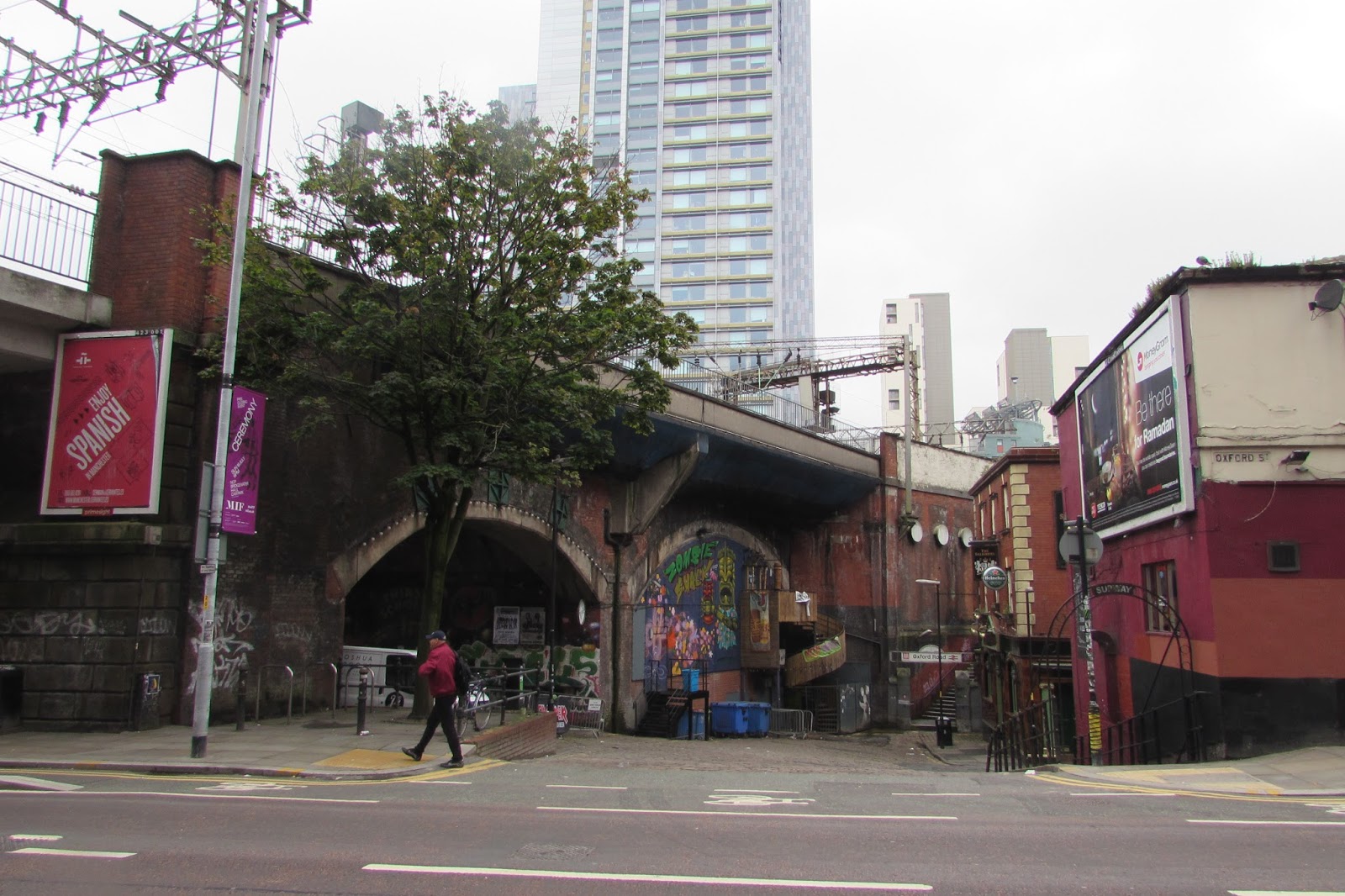
Now the walk down the side of the railway viaduct is one I never tire of.

And in the past few years there are murials to admire as well as looking into the railway arches which were once full of workshops.

The area continues to be in flux with new buildings rising to dominate what was once the mean streets of Little Ireland, as well warehouse and factory conversions.

So Andy’s new series has lots to offer both the casual tourist and newcomer to the city as well as those who can claim to have been born here.

Location; Manchester


Pictures; from the collection of Andy Robertson, 2017

Debates on migrating to Canada ......... 1910 ...... part one

Now I know I won’t be alone in wishing I could have been at the conference called in the March of 1910 to discuss the “work of emigrating people from this country to the colonies.”.

Leaving Manchester for Canada, 1897
What follows is pretty much just a report on the events.

The over arching theme was to explore ways of “introducing order and uniformity into emigration" and over fifty agencies were represented ranging from children’s charities to ex servicemen’s groups.

The conference was called by the Royal Colonial Institute which had been formed in 1868 with the purpose of “providing a meeting place for gentlemen interested in colonial and Indian affairs.”*

The Institute had carried out some preliminary investigation into the methods of emigrating societies and in the words of the Manchester Guardian had come up “with some interesting results.”*

“Some of the societies, such as the Boys’ and Girls’ Homes of Manchester and Salford and Dr Barnadardo’s Homes are mainly for giving aid to poor and destitute children promoting emigration to the farm school system.  Two societies encourage emigration to South Africa only and there is a league for assisting ex servicemen.  The arrangements for the repayment of loans differ greatly.”

The Institute was keen “to divert the stream of British emigration now going outside the empire to the colonies” and there was a suggestion for a national emigration association.

Naturally there were divergent interests, with one focus on the need to establish a land bank to settle men in depression times and the Canadian Government’s position of refusing to accept immigrants unless they are prepared to settle on the land.”

But most of us will I suspect have been drawn to the discussions around child migration.

The Society for the Furtherance of Child Emigration didn’t support sending out “little children as child labour for the colonies or for boarding out pauper children.” 

Barnado’s defended migration, "now 10,000 children" and claimed "there was only a 2% failure rate" which most us would want to know what that actually meant.

The Women’s Emigration Society had just begun emigrating teachers at the request of the authorities who were badly needed.

The Manchester Refuge speaker Mr T.R. Ackroyd said that the charity “only sends out boys who have been rescued from evil surroundings.”

Report on my BHC, 1916
In Manchester he said “there is a good deal of opposition to the system of emigrating children” he “urged fixing a limit of age to the children sent to Canada. Adding that there is a feeling that they are not treated as kindly as they ought to be, and it would help us if from expert evidence it could be generally understood that these children are cared for and loved.”

The discussions fixed on many of those issues all of us have ourselves pondered on from the Salvation Army reflecting that “On the one side we wanted to get rid of a large amount of our surplus population; on the other hand the Government of Canada would not have them at any price.”

And the Canadian response from Mr Aitken K.G   “Canada doesn’t want any  population, Great Britain doesn’t want” adding “We want immigrants of good character and health , energy and industry.  We are willing to throw Canada open to the right class – but it must be the right class.”

So there we have it and I know others have explored the opposition to migration from within Canada and I want to follow up on what constituted “failure” and what happened to those failures.

In the case of my own BHC he did indeed fail twice on his first two placements but reading the reports and knowing his background I am not surprised at the outcome.  He kicked against authority and so when he did finally run away from his last farm and join the C.E.F., in 1915, his experiences were no less dramatic.

More on the Conference soon.

Pictures; ccourtesy of the Together Trust, https://www.togethertrust.org.uk/

* Emigration Manchester and Canadian Child Labour, Manchester Guardian, May 31, 1910

** Reese, Trevor R. (1968), The History of the Royal Commonwealth Society 1868–1968, London: Oxford University Press

Monday, 3 July 2017

The Steedman's of Woolwich a family remembered

I have featured those new books on the history of Eltham and Woolwich by Kristina Bedford already so I was pleased when Ms Bedford agreed to write a story for the blog.*

Powis Street, early 20th century
It is the way that when you sit down to write a history of a place there is much that has to be left out.

So here is the  story of the Steedman family by Kristina.

When planning the running-order for the illustrations in Woolwich Through Time, I was delighted to be able to close the book on a personal note, with a rare Carte-de-Visite memorialising the grave of the Steedman family, 19th century Woolwich residents whose local migrations mirror the spider’s web of connections between Woolwich and its neighbour villages of Charlton and Plumstead.

The Steadman  family grave
Although near- indecipherable on the small CDV, digital scanning brought up the full text of the headstone, which reads

The Family Grave of
James Steedman
of
Edward Street Woolwich
In
Affectionate Remembrance of
Fanny
Wife of James Steedman
Died January 10th 1869
Aged 49 Years

Born in Scotland in 1812, engineer James Steedman married Fanny Joyce on 14 December 1840 at Deptford St Paul, by banns.

The following year’s census, taken in June, records the couple living on Dock Street in Poplar, Tower Hamlets, a district dominated by shipwrights and watermen.

They had moved to Blackheath by the time the birth of their first son James Thomas was registered under the September quarter, migrating again within two years to Charlton, where son John was born in 1843, and son Henry in 1848.

Powis Street,early 20th century
The 1851 census lists the family at 12 Paradise Row, Charlton, revealing that Fanny was herself born in Woolwich, where they had re-located by the time daughter Fanny was born on the 2nd of July, christened on the 24th of that month at the Parish Church of St Mary Magdalene, their address recorded as No 8 Edward Street.

Despite commemorating Fanny with the Rolls Royce of Headstone Monuments in the most expensive row at Woolwich Cemetery in Plumstead, widower James, now working as a money scrivener, re-married only six months later, on 22 July at Southwark St Saviour, the home parish of his bride, spinster Eliza Brumage.

The site of the family grave today
The 1871 census records the couple as living at No 8 Edward Street with Fanny Jr, who was attending school, Eliza’s widowed mother, and one domestic servant.

Edward Street had been re-christened Powis Street by the time of the 1881 census, when James, Eliza, Fanny, and one servant were living at No 158.

James had retired to a house named “Thames View” on Humber Road in Greenwich by the time of the 1891 census, where he lived on his own means with wife Eliza, daughter Fanny, and ‘scholar’ grandson Henry.

The National Probate Calendar reveals those means to have been considerable: “STEEDMAN James of “Thames-view” Humber-road Westcombe-park East Greenwich Kent died 15 July [1899] Probate London 16 September to Eliza Steedman widow James Thomas Steedman scrivener’s-clerk and Anthony Michael Brumage retired engineer from the Royal Navy Effects £17182 15s. 6d.” 

James Steedman, aged 87, was buried with his first wife Fanny in Woolwich Cemetery on 19 July 1899, joined on 11 July 1908 by second wife Eliza, three days after her death.

Despite the considerable financial investment James made in the family grave he took such pride in, the memorial was demolished and the plot planted over with grass during a general clearance at Woolwich Cemetery during the 1960s, to make the grounds easier and cheaper to maintain.

I hope that he would find some compensation in his family being re-commemorated in Woolwich Through Time and here in Andrew Simpson’s Blog.

© Kristina Bedford


Pictures; from the collection of Kristina Bedford

*Woolwich Through Time, Kristina Bedford, 2014, Amberley Publishing, http://www.amberleybooks.com/shop/article_9781445615998/Woolwich-Through-Time%3CBR%3E%3CI%3EKristina-Bedford%3C_I%3E.html?sessid=f42LuNWNjgDnHlkr3Etd8rM4BTeNXIQYwmBHgTVsVRMJHdYsgtXh06DHtO7pQGrv&shop_param=cid%3D16%26aid%3D9781445615998%26

Eltham Through Time, 2013, Amberley Publishing,  http://www.amberleybooks.com/shop/article_9781445616001/Eltham-Through-Time%3CBR%3E%3CI%3EKristina-Bedford%3C_I%3E.html?sessid=f42LuNWNjgDnHlkr3Etd8rM4BTeNXIQYwmBHgTVsVRMJHdYsgtXh06DHtO7pQGrv&shop_param=cid%3D1%26aid%3D9781445616001%26

Ms Bedford also has an interesting web site, Ancestral Deeds, http://www.ancestraldeeds.co.uk/


Little Ireland and a bit of our history ........ soon to vanish ....... part 1 looking in

Now on the turn of a conversation starts a major new project by Andy Robertson, who commented that “Ian says as Oxford Road Station is being redeveloped much of Little Ireland will disappear, so I thought I had better get snapping.

For those who don’t know Little Ireland was one of ours slums.

Both Dr Kay and Frederick Engels wrote of the horrors to be encountered there and lots of enterprising guides and historians have made a living from describing its horrors and taking walks around the little that is left to see.


And soon they may not even be anything left.

The Corporation did their best to rid the city of the slum, and the railway did its best and now the new plans for Oxford Road Railway Station my complete the job although I rather think Derek the Developer has an eye on some of the area.

And yes, I should have gone looking for those plans, which I might still do but now I shall close by saying this is the first of the series.

Location; Little Ireland


Pictures; from the collection of Andy Robertson, 2017

Alexander Freeman a soldier of the Great War from Longsight


This is the memorial medal of Alexander Freeman.

It was bought by David Harrop  for his collection honouring those who died in two world wars.

And in the fullness of time I want to find out more about Mr Freeman who was driver in the Army Service Corps.

He died on July 24 1916 and was buried in Southern Cemetery.


Picture; courtesy of David Harrop

Sunday, 2 July 2017

Farewell Star Wars ........ Dr No and Bambi ..... almost the very end of the Odeon

Now Andy has recorded the slow end of the Odeon and its time has almost finally come.

Leaving Andy to return to photograph the empty site, the day the builders break the ground for the new building and the slow rise of that development.

Location; Manchester


Pictures; the end of the Odeon, 2017 from the collection of Andy Robertson

Saturday, 1 July 2017

My pacamac and a day in August 1957

When you are nine years old and spending the summer in the village of Chellaston, time can hang heavy, especially when it’s raining. 

They say you only remember the sunny summer holidays; well this is true only up to a point.

Given our English weather all too often I woke to a wet morning. And as if to rub salt into the wound it would still be hot which made it a double whammy. Hot enough to go out in just shorts and shirt which in August is how it should be but so wet that there was no fun in being outdoors.


To make matters worse Nana would insist I wore my pacamac which was ideal for summer showers. But they were a cruel invention. Despite being light and flexible enough to be squeezed into a small bag they smelt awful and were a nightmare to wear. It didn’t take long before the warmth of the body trapped in a sheet of clinging plastic made you sweat and the more you walked the hotter and more uncomfortable you became. Which meant you had a choice, wear it and suffer or take it off, get wet and suffer later when Nana discovered that this act of rebellion had got me soaked.

Now their garden was a big one, which they had lovingly restored. The ornamental ponds had been repaired and once again water trickled from one to another down one side of the garden. They had replanted the Japanese bushes and tamed the overgrown trees. All of which was fine on a dry summer day, but after a night of rain and some brief but powerful morning showers, the bushes and trees held the water like a reservoir. And I never seemed able to avoid them. Even if I took care not to brush up against the bushes which would smother you in wet clinging leaves there was the ever present danger from trees, any one of which could send an avalanche of rain drops on to the back of your shirt or worse still down your neck.

All of which meant you were forced back into the house. Now my grandparents didn’t have a television back in 1958, and with grandfather out at work and Nana doing something, the long morning from breakfast stretched out before with little hope that the tedium could be broken.
The house was large or so it seemed to me, but it had been turned into bed sits and so I was confined to the kitchen, scullery and the posh front room. There was also my grandparent’s bedroom which was off the kitchen but this held little mystery and any way was their private place.

So it had to be the posh front room which was like a grave yard. The furniture was the “best” and never used and so the room had an air of being forgotten. It also had an odd smell which I suppose came about because for most of the year it was never used and not even aired properly. Nana kept it spotless but it somehow smelt dusty. Nor was it much fun to be in. The clock on the mantel piece ticked away and emphasised that it was the only thing in the room that regularly did anything.

This just left the landing with a fine old massive oil painting hanging from the wall. When all else fails a gigantic depiction of some historical event is guaranteed to pass the time. There were days when I sank myself into the picture reliving the event and acting out the story. And there were other days when I tried copying some of the detail. Eventually my grandparents took advice, had it cleaned and sold.

The same fate befell the suit of Japanese armour which had somehow been left by the previous owner. It fitted perfectly but even at nine I was aware that it might have been valuable and so it became something to put on and then take off. Sadly I never remember fending off fierce Samurai warriors or saving a young girl from the hands of an oriental dragon. On the other hand the army holster from the Great War was something different. It had that strong leather smell and was perfect for the Roy Rogers cap pistol. I kept both in a draw in the cupboard beside the kitchen range.

And more often than not when the posh room and the landing had been exhausted it would be the kitchen I sat in. Thinking back I am amazed at how my grandparents lived in just two rooms. There was their bedroom and the kitchen. The kitchen doubled up as the main living space, work area and of course the place we ate. But then they had spent almost their entire married life in a two up two down in Hope Street.

So nothing had changed except for the garden. Here they spent much of their time. Granddad in the greenhouse with his tomatoes and Nana pouring over the vegetable patch. Even now fifty three years later the memories of that green house are powerfully vivid. Nothing prepared you for the heat as you entered or that pungent smell of tomatoes or the damp. Behind all that glass it was a silent place and for a nine year old it held my attention for about ten minutes.

Which was about right, because summer showers eventually go away and are replaced by sunshine. And that of course is another of those experiences of summer that has never left me, that damp warm smell of wet grass which you know soon enough will be dry and offers the promise of hot carefree afternoon under an August sun.

Picture; from the collection of Andrew Simpson