Sunday, 21 June 2020

Boring pictures after the lockdown …. no. 2 .... the playground

Now that lockdown has been relaxed, the 2 meters distance might shrink and you can again visit Primax and Top Shop, the new series is launched.

Ottawa, 2020
Boring pictures after the lockdown, invites everyone who is out and about to offer up their own photograph.  The only qualifications are that it should be by you, and be boring.**

Contributions can be sent to me on facebook or twitter, or as a reply to this blog story on any of the social media sites you come across it.

Location; Ottawa


Pictures; children's play ground, empty with caution tape still on, Saturday, June 20, 2020, from the collection of Lori Oschefski

*Boring pictures after the lockdown, https://chorltonhistory.blogspot.com/search/label/Boring%20pictures%20after%20the%20lockdown

My Salford ..........nu 8 more glass

Now I don’t claim that any of the following short series of pictures of Salford are magnificent photographs but I like them.


Location; Salford

Picture; Salford, 2013, from the collection of Andrew Simpson

Saturday, 20 June 2020

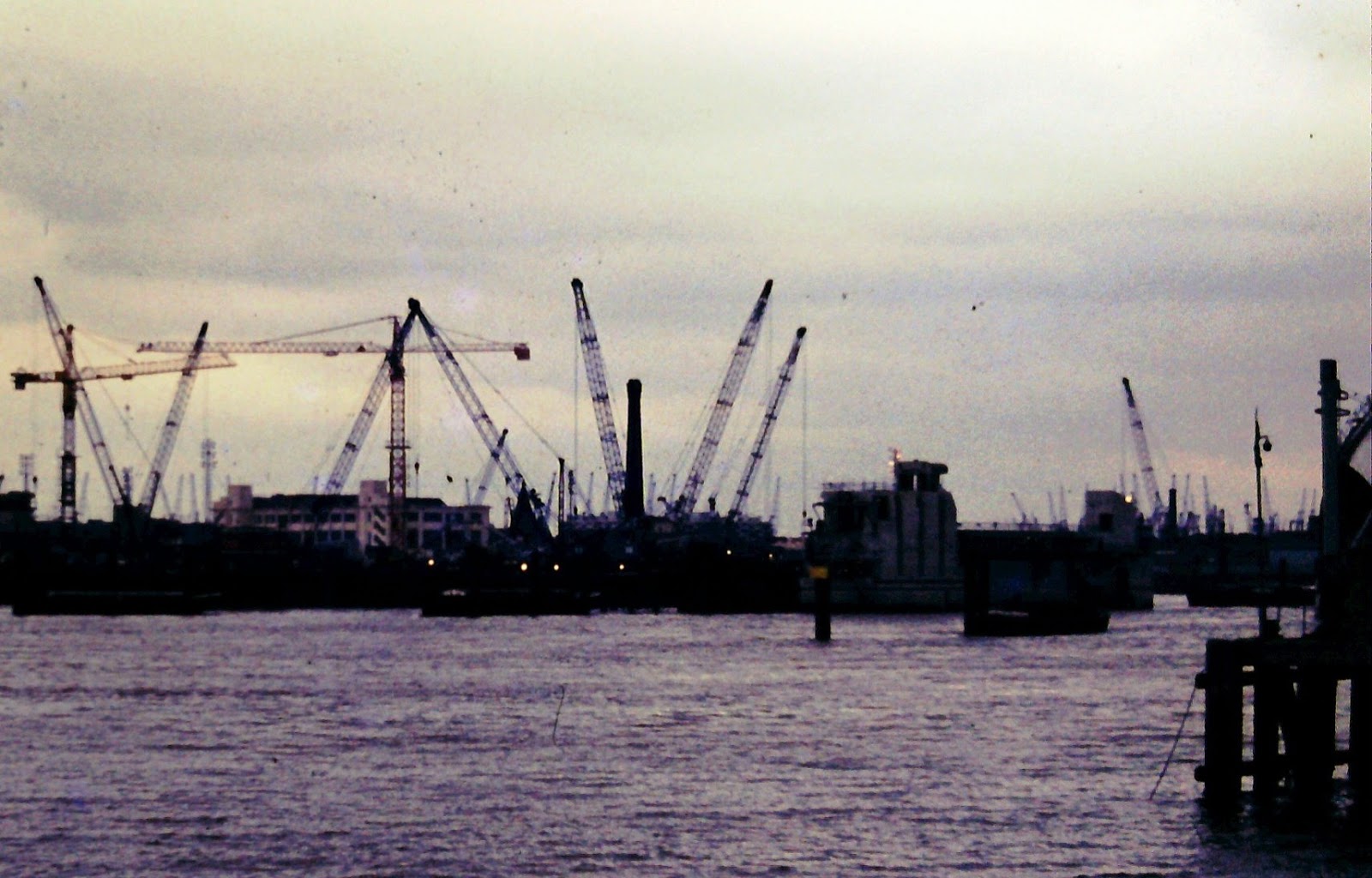
The lost Eltham & Woolwich pictures ...... no. 48 ..... my river

Now after almost half a century of living away from south east London I still miss the river.


And I am the first to say that it was a noisy, smelly and grimy place which could also be capricious and dangerous but it was part of home.

I loved the smell and the colour of the water which often came with  oily streaks, and I loved the fact that there was always something going on.

It might be a tug or a stately sailing ship or just the birds following a line of barges on their way down river.

And in the evening outside the Cutty Sark sitting with friends, the stillness of the night might be interupted as the moored barges banged together on the swel from a passing pleasure boat.

This was one of the pictures I took of Eltham and Woolwich in the mid ‘70’s which sat undisturbed in our cellar.

But all good things eventually come to light.

They were colour slides which have been transferred electronically.

The quality of the original lighting and the sharpness is sometimes iffy, but they are a record of a lost Eltham and Woolwich.

And this one really is a lost scene for which no more needs to be said.

Location; Woolwich

Picture; looking across the River, circa 1978, from the collection of Andrew Simpson

Boring pictures after the lockdown …. no. 1 .... getting out on to Beech Road

Now through the months of lockdown the series Boring pictures on a moment of self-isolation ....., proved a success.*

Starting with a view from our back bedroom, there were contributions from other bits of Chorlton, as well as Italy, Spain, Poland, Ontario, Didsbury and Pennsylvania, along with Eltham, Weston-Super-Mare, Porto, and a little place south of Buxton.

So now that lockdown has been relaxed, the 2 meters distance might shrink and you can again visit Primax and Top Shop, the new series is launched.

Boring pictures after the lockdown, invites everyone who is out and about to offer up their own photograph.  The only qualifications are that it should be by you, and be boring.**

And for those who mutter …but this isn’t history as we know it ….. you’d be right, but as my pal Eric always says, “history is just what you want it to be, no more no less”.***

Contributions can be sent to me on facebook or twitter, or as a reply to this blog story on any of the social media sites you come across it.

Location; Beech Road


Pictures; early morning on Beech Road, Saturday, June 20, 2020, from the collection of Andrew Simpson


*Boring pictures from a backroom, on a moment of self-isolation ..... https://chorltonhistory.blogspot.com/search/label/Boring%20pictures%20from%20a%20backroom

**Boring pictures after the lockdown, https://chorltonhistory.blogspot.com/search/label/Boring%20pictures%20after%20the%20lockdown

***Apologies to Dr. McCoy and Mr. Spock, The Devil in the Dark, Star Trek, Season 1, Episode 25, March 9, 1967 and also to Humpty Dumpty and Lewis Carroll in Alice Through the Looking Glass, 1871

When you have Chorlton Bookshop ….. who needs Amazon?

Now I am not sniffy about using Amazon.

And I have even been known to look on the site for those out of print old books that even J. R. R. Hartley would be hard pressed to find.*

But for books in print I will always first visit our own local bookshop, and this week I sent them a request for Michael Stedman’s book on the Manchester Pals.**

Out of curiosity and because I wasn’t sure Chorlton Bookshop was open I tried Amazon on Monday, but was told it wasn’t available.

On the same day I emailed Chorlton, and received a reply within the hour that they would contact the publishers, and the following day they had placed the order, which was delivered on Thursday.

All of which is excellent service, and only bettered in more ordinary times when the team can get the book the following day.

So that is it …………. I have produced an advert or a post of appreciation for our local book shop? 

I will leave that up to you.

Location; Chorlton

Picture; cover of Manchester Pals

*J. R. Hartley is a fictional character in a popular advertisement promoting the British Yellow Pages, first shown in 1983.

**Manchester Pals, Michael Stedman, 1994, 2004

Friday, 19 June 2020

The Didsbury story ….. with a bit from Hulme, Chorlton-cum-Hardy and a pile of beer

Never underestimate just how twisty history can be.

The Crown Brewery, 1964
This is the story of William Roberts, brewer from Hulme, resident of the Oaks in Didsbury and the man linked to a 17th century bowling green.

And because this is a history story I shall follow the chronology which took me from the pub by the Green, via the Crown brewery on Renshaw Street in Hulme to a fine house off Barlow Moor Road in Didsbury.

Just a few days ago the Bowling Green Hotel Bowling Club posted a picture of an inscription on the wall by their green, with the comment, "We are fairly certain that our bowling green is the oldest one in the country, and we are going to contact Historic England to try to get this formally recognised. (This carving was until recently buried under overgrown ivy, and we think it says “1698”.)

Now I have to say I was a tad skeptical, but the evidence is stacking up in favour of a 17th century bowling presence on the spot of the inscription.

That 17th century inscription, 2020
And early in the research I uncovered the name of William Roberts who owned the Bowling Green Hotel, where no doubt tired and thirsty players retired to when rain stopped play.

The pub had belonged to the Egerton family who owned most of south Manchester, but for reasons I don’t understand, the estate sold it off to a William Partington in 1859, whose widow sold it on to Mr. William Roberts.

Mr. Roberts proved rather elusive at first, but I finally found him listed as owner of the Crown Brewery in 1848, and by degree living on the Oaks in 1871 in Didsbury, which was a step up for the family from a more humble property on Renshaw Street in Hulme, which may have doubled as his place of work.

And there is no doubt that he had prospered, allowing him to employ “45 hands” at his Crown Brewery by 1871 at a site spread over two properties, which according to one source ran 72 pubs.*

Although this does appear to be after Mr. Robinson’s death in 1888, when the brewery was registered as the Hardy Crown Brewery the following year.

The Crown Brery, 1894
At which point someone I know will come forward with chapter and verse on both the Crown Brewery and the Hardy Crown Brewery.

As for Mr. Robinson, I know he was born in 1806 and came from Darley Dale in Derbyshire, which is north of Matlock.

Today it has a population of just 6,000, has six churches, and consisted of six settlements.

And it also has a park, hospital and institute, all named after  Sir Joseph Whitworth, the 19th-century machine toolmaker and engineer.

Back in 1825, there were just “227 houses and 1175 inhabitants, one half of whom are engaged in agricultural pursuits, [with] Fairs on May 13th and October 27th.**

So, a young enterprising Mr. Roberts, may well have decided his future lay elsewhere, and that future was Hulme.

Just when that was moved was made is unclear, but it must have been between 1830 and 1832, because his marriage to Martha in 1830 was in Derbyshire while the birth of his eldest child, Emma two years later in Hulme.

"The Gentleman", at the marriage of his daughter
And here the family stayed until sometime after 1861.  This I know because in that year the census shows them still at Renshaw Street, and a decade later they were living at the Oaks in Didsbury.

Moreover, his journey up the social ladder is complete by 1875, when at the marriage of his daughter Fanny, he no longer described himself as a brewer, but adopted the title of “Gentleman”.

Added to which five years later the Manchester Guardian reported that he had “offered to build and endow [a new church] on the Oaks estate, Barlow Moor Road, and a school church on Burton Road.”***

He died in 1888, leaving £73,000.

All of which just leave me to go and look for the Oaks, along with the church and school he helped establish.

Location; Derbyshire, Hulme and Didsbury

Pictures, that 17th century inscription, 2020, courtesy of the Bowling Green Hotel, Bowls Club, Renshaw Street and the Crown Brewery, 1894, from the OS map of South Lancashire, courtesy of Digital Archives Association, http://digitalarchives.co.uk/, and the Crown Brewery, 1964, J. Ryder, m26676, courtesy of Manchester Libraries, Information and Archives, Manchester City Council, http://images.manchester.gov.uk/index.php?session=pass

*Brewerypedia, http://breweryhistory.com/wiki/index.php?title=List_of_Hardy%27s_Crown_Brewery_Ltd_Pubs


**A Topographical Dictionary of the United Kingdom, Benjamin Pitts Capper, 1825, page 251

***Fatal accident to the Rector of Didsbury, Manchester Guardian,  Dec 20th, 1880

George Cieslik‎’s Manchester ……… the lost square

I always came to think that the small square behind Marks and Spencer which shared the old Shambles with a Safeway was a planner's after thougt, thrown in once the Arndale had been completed.

Of course without looking at the plans that is what it felt.

It was not I thought the best way to show off the historic buildings of Manchester, and with the redevelopment of the are after the IRA bomb it was cleared away.

Location; Manchester


Picture; the lost square, circa 1980s, from the collection of George Cieslik